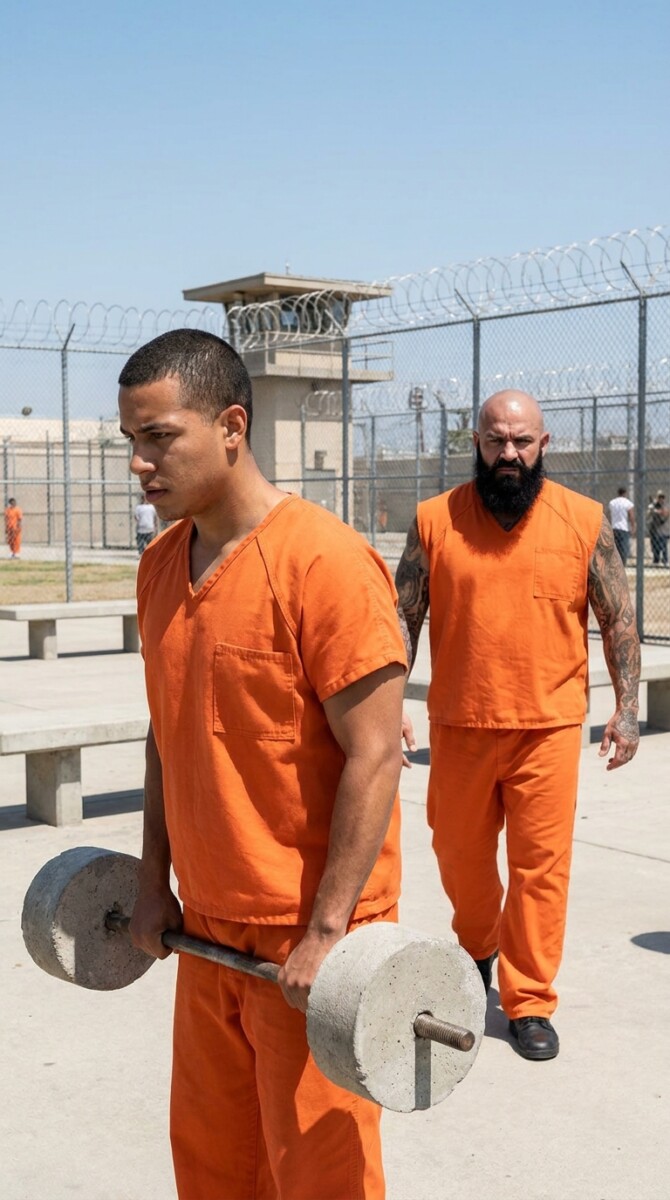
The metallic sound of the bar hitting the ground echoed throughout the yard.
Mateo slowly exhaled, flexed his fingers, and wrapped his hands around the metal again.
He had been in that place for a little over a week.
Long enough to learn the schedules.
Long enough to recognize a few faces.
But still far too little time to understand all the rules no one explained out loud.
He was twenty-five years old, with short dark hair, light-brown skin, and an athletic body that revealed years of training.
Since he was a teenager, weightlifting had been a way for him to control his anxiety and organize his thoughts whenever everything else seemed to move too fast.
That was why every morning, whenever he had a few free minutes in the yard, he looked for a barbell.
He did not talk much.
He did not try to impress anyone.
He simply trained.
That morning, he had managed to get one of the few available bars with weight plates.
He was calmly doing repetitions under the sun while other men talked around the concrete tables.
Mateo finished a set.
He placed the bar back on the rack.
Counted slowly to ten.
He was about to begin another set when he heard a voice behind him.
“Hey, new guy.”
Mateo turned his head.
A huge man was walking toward him.
He looked to be around forty-five years old.
Completely shaved head.
Thick black beard.
Tattooed arms.
Sleeveless orange uniform.
And three other men walked behind him.
Mateo already knew who he was.
Everyone called him Cárdenas.
Not because that was necessarily his real last name—no one seemed completely sure about that—but because it was the name everyone used when speaking about him.
He was one of those men whose reputation arrived before they did.
Mateo had seen him during his first few days.
Never alone.
Always taking the best table.
Always using the equipment first.
Always speaking as if everyone else should be grateful simply because he allowed them to exist around him.
Cárdenas stopped in front of the bar.
“Leave that.”
Mateo raised an eyebrow slightly.
“What’s the problem?”
Cárdenas pointed toward the weights.
“You didn’t understand. I want the ones you’re using.”
Mateo looked at the equipment.
Then at Cárdenas.
“Then wait your turn.”
The nearby conversations began to quiet down.
One of the men behind Cárdenas laughed.
Another slowly shook his head.
Mateo immediately understood that he had committed the kind of offense that, in that place, could matter more than any official rule.
He had said no.
And worse:
He had said it in front of everyone.
Cárdenas smiled.
“My turn?”
He stepped a few inches closer.
“No one makes me wait around here.”
Mateo remained still.
“Well, today you’re going to learn.”
The silence was almost immediate.
Mateo knew he had gone too far.
Not because he was afraid of Cárdenas.
But because he knew exactly what was happening.
The other man did not want the weights.
Not anymore.
Maybe he had never truly wanted them.
He wanted obedience.
He wanted the newcomer to leave the bar, lower his head, and walk away while everyone watched.
The weights were only an excuse.
Cárdenas took another step.
Now they were very close.
“I’m going to give you one last chance,” he said. “Leave the weights and get out of here.”
Mateo held his gaze.
“And if I don’t want to?”
One of Cárdenas’s companions started laughing.
The leader raised a closed fist near his own chest.
He did not hit Mateo.
He did not need to.
The gesture was enough.
“Look at him,” he said, briefly addressing the others. “The new guy thinks he’s brave.”
Mateo let out a small smile.
Cárdenas looked back at him.
“One more word and you’re going to end up on the floor.”
Mateo kept smiling.
Cárdenas frowned.
“What are you laughing at?”
Mateo could have answered in many ways.
He could have insulted him.
He could have raised his hands.
He could have started exactly the confrontation everyone expected.
And for a fraction of a second, an old part of him wanted to.
Because Mateo knew how to defend himself.
Too well.
That was precisely one of the reasons he was there.
He had spent years training in boxing and wrestling.
He had competed.
He had worked as an instructor.
He knew exactly which movements worked when someone invaded his space.
But he also knew how expensive a single moment of pride could become.
He had learned that in the worst possible way.
Mateo breathed slowly.
Then he looked at Cárdenas.
“I’m laughing because you’re doing all of this over some weights.”
“It’s not about the weights.”
Mateo nodded.
“Exactly.”
Cárdenas went silent.
The men behind him stopped smiling.
Mateo pointed toward the equipment.
“You want me to leave so you can show everyone that you can make anyone get up when you arrive.”
Cárdenas’s expression changed.
“Watch what you say.”
“I’m not disrespecting you.”
“Sounds like it.”
“I’m telling you what’s happening.”
Cárdenas moved even closer.
“And what do you know about what happens here?”
Mateo answered:
“Still not much.”
“Then learn.”
“I am learning.”
“Doesn’t look like it.”
Mateo looked at the three men behind him.
Then back at the leader.
“I’m learning that too many people here confuse respect with fear.”
A murmur spread across the yard.
Cárdenas clenched his jaw.
“You think you’re very smart.”
“No.”
“Then what are you trying to prove?”
Mateo slowly shook his head.
“Nothing.”
That seemed to confuse Cárdenas.
“Everyone is trying to prove something.”
Mateo remained silent for several seconds.
“I used to think that too.”
“And now?”
Mateo looked at the bar.
“Now I know how expensive it can become.”
Two years earlier, Mateo was still working at a small neighborhood gym.
He was good.
Very good.
He was not particularly large, but he was fast, technical, and disciplined.
The students respected him.
The other trainers trusted him.
And Mateo was beginning to think that someday he might open his own gym.
Then one night changed everything.
He had gone out with two friends after work.
Nothing special.
Food.
Music.
A long conversation.
When they left the restaurant, one of his friends accidentally bumped into another man.
Words were exchanged.
A provocation.
A shove.
Mateo stepped in.
At first, he only wanted to separate them.
That was what he told himself for months.
But the truth was a little more uncomfortable.
At one point, he had the opportunity to walk away.
He did not.
Someone insulted him.
Called him a coward.
And Mateo decided he could not allow people to see him walk away.
The situation escalated.
A shove became a struggle.
The struggle became a fall.
One of the men ended up seriously injured.
He survived.
But Mateo paid the consequences.
For months, he blamed everyone except himself.
His friend.
The other group.
The alcohol.
Bad luck.
Until an older man who worked in a rehabilitation program asked him a question:
“At what point could you still have walked away?”
Mateo answered:
“At many points.”
The next question was worse.
“Then why didn’t you?”
Mateo had no immediate answer.
He found it months later.
Pride.
He did not want to look weak.
That night he began to understand that a person could know exactly how to win a fight and still lose something far more important.
That was why now, standing in front of Cárdenas, he decided not to repeat the same story.
“What was it that cost you so much?” Cárdenas asked.
Mateo returned to the present.
“Responding to someone who wanted to provoke me.”
The leader laughed.
“And now you’re going to lecture me?”
“No.”
Mateo pointed to the weights.
“I’m finishing my set. After that, you can use them.”
“I want them now.”
“Then we have a problem.”
Cárdenas lifted his chin.
“You’re going to fight over them?”
Mateo shook his head.
“No.”
“Then move.”
“Not doing that either.”
Cárdenas stared at him, confused.
“Then what?”
“I’m going to finish.”
“And if I try to take them?”
Mateo held his gaze.
“That will be your decision.”
That answer changed the dynamic.
Cárdenas expected fear.
Or aggression.
Either reaction would have worked for him.
But Mateo simply stood his ground.
Without raising his fists.
Without insulting him.
Without stepping back.
A whistle sounded from the far end of the yard.
One of the supervisors was walking toward the group.
Cárdenas looked over.
Then back at Mateo.
“This isn’t over.”
Mateo picked up the bar again.
“For me it is.”
Cárdenas remained still for several seconds.
Finally, he stepped away.
His three men followed him.
Mateo finished his set.
But he already knew that probably had not been the end.
That afternoon, a man named Julián sat across from him during lunch.
“You’re crazy.”
Mateo kept eating.
“I’ve been told that.”
“Do you know who that was?”
“Cárdenas.”
“That’s his name. Do you know who he is?”
Mateo looked up.
“I assume you’re about to explain it.”
Julián moved his chair closer.
“He’s been doing that for years.”
“Taking weights?”
“Controlling everything.”
Mateo smiled.
“That sounds like a lot of responsibility.”
Julián did not laugh.
“Don’t joke about it.”
“I’m not.”
“People give up tables, equipment, food, whatever he wants.”
“Why?”
“Because nobody wants problems.”
Mateo put down his fork.
“And does that work?”
“What?”
“Giving everything up to avoid problems.”
Julián thought.
“To a certain point.”
“Then it doesn’t work.”
“You don’t understand this place.”
“Probably not.”
Julián lowered his voice.
“He’ll come back.”
Mateo nodded.
“I know.”
“And probably with the others.”
“I know that too.”
“So what are you going to do?”
Mateo breathed.
“The same thing I did today.”
“Nothing?”
“No.”
Mateo looked at him.
“Set a boundary without handing him control of my mind.”
Julián frowned.
“That sounds very philosophical.”
Mateo smiled.
“I’ve been told that too.”
Three days passed.
Cárdenas did not return.
Mateo began to suspect that maybe the situation really had ended.
Until one morning, when he found the entire training area occupied.
Cárdenas and his three companions were using almost all the equipment.
One bar had weight plates loaded on it, but no one was using it.
Mateo approached.
“Is this free?”
One of the men looked at him.
“No.”
“Who’s using it?”
He pointed toward Cárdenas.
“Him.”
Mateo looked at the leader.
He was sitting several yards away talking to someone else.
“He’s not using it.”
The man smiled.
“But it belongs to him.”
Mateo breathed.
“I understand.”
He walked away.
Julián, who had been watching from a table, caught up with him.
“That’s it?”
“What do you want me to do?”
“I thought you were going to confront him.”
Mateo shook his head.
“I don’t need those weights today.”
“Then he won.”
Mateo stopped.
“Won what?”
Julián opened his mouth.
But he did not answer.
Mateo smiled.
“Exactly.”
That phrase began to spread.
Won what?
It was simple.
But it forced people to think.
Because many people in that place had turned small things into enormous battles.
A chair.
A place in line.
A weight.
A look.
A sentence.
Every little detail could become a matter of pride.
Mateo refused to play that game.
If he could use the equipment, he trained.
If he could not, he did bodyweight exercises.
If someone occupied a table, he found another.
But when someone tried to force him to surrender something he was already using simply to demonstrate authority, he said no.
Without shouting.
Without threats.
Without turning it into a war.
And that began to have an unexpected effect.
Others started doing the same.
Not against Cárdenas specifically.
Just in general.
One man asked to finish eating before giving up his seat.
Another asked to finish his phone call.
Another simply said:
“When I’m done, it’s your turn.”
Nothing extraordinary.
But small rules of respect began replacing some of the old customs.
Cárdenas noticed.
And he was furious.
One afternoon, he approached Mateo without his group.
“We need to talk.”
Mateo was sitting down stretching after training.
“Talk.”
Cárdenas sat across from him.
“Ever since you arrived, everybody thinks they’re important.”
Mateo raised an eyebrow.
“That sounds good.”
“I’m not joking.”
“Neither am I.”
“Things used to work around here.”
“For who?”
Cárdenas fell silent.
Mateo continued:
“If things only work because everyone is afraid of you, maybe they never really worked.”
“You don’t understand.”
“Then explain it.”
Cárdenas looked across the yard.
“When I got here, I was different.”
“How?”
“Like you.”
Mateo smiled.
“That should worry you.”
Cárdenas ignored the comment.
“I didn’t know anyone. People took things from me. They laughed at me. Shoved me around.”
“And what did you do?”
“I learned.”
“What?”
Cárdenas looked at him.
“That if you make everyone afraid of you, they stop bothering you.”
Mateo remained silent.
“It worked,” Cárdenas added.
“Are you sure?”
“Look at me.”
Mateo did.
A huge man.
Strong.
Surrounded by people.
Respected by some.
Feared by many.
But always alert.
Always watching who said what.
Always needing to prove that he was still in control.
“Sounds exhausting,” Mateo said.
Cárdenas frowned.
“What?”
“Having to remind everyone who you are every single day.”
The leader went still.
No one had ever described his life that way.
“You know nothing about me.”
“You’re right.”
Mateo stood up.
“But I know what it’s like to let other people decide how you have to act just so you don’t look weak.”
Cárdenas watched him walk away.
Two weeks later, something happened that surprised the entire yard.
A young man was using a barbell.
One of Cárdenas’s companions approached him.
“Give me that.”
The young man hesitated.
Looked around.
Before he could answer, he heard a voice.
“He’s using it.”
It was Cárdenas.
His companion turned.
“What?”
“Wait.”
“But—”
“I said wait.”
The yard became silent.
Mateo was at the other end.
Cárdenas looked toward him.
Mateo did not smile.
Did not raise a thumb.
Did not make any gesture of victory.
He simply continued training.
And perhaps precisely because of that, Cárdenas did not immediately regret what he had just done.
Days later, during lunch, he sat across from Mateo.
“No one asked me for the weights today.”
Mateo smiled.
“That must be difficult.”
Cárdenas laughed.
“Idiot.”
It was the first time the two of them had laughed together.
“You know what I discovered?” the older man asked.
“What?”
“Waiting five minutes didn’t kill me.”
Mateo opened his eyes dramatically.
“Incredible.”
“Shut up.”
They both laughed again.
Julián watched from another table with his mouth slightly open.
Later, he approached Mateo.
“Are you two friends now?”
Mateo shook his head.
“I don’t know.”
“Cárdenas laughed with you.”
“People do strange things.”
“You did something.”
Mateo looked at him.
“No.”
“Of course you did.”
“He decided to change something.”
“Because you confronted him.”
Mateo shook his head.
“I didn’t confront him.”
“You told him no.”
“Exactly.”
Julián frowned.
“What’s the difference?”
Mateo answered:
“Confronting someone to prove you’re superior is one thing. Setting a boundary so both people can move on with their lives is another.”
The months passed.
Mateo kept training.
Cárdenas began using the equipment while respecting other people’s turns.
Not always.
Sometimes an old habit came back.
But when it happened, someone simply said:
“Cárdenas.”
And the man normally responded with a grunt before correcting himself.
The fear in the yard began to decrease.
And something curious happened.
When people stopped being so afraid of him, Cárdenas discovered that some of them actually wanted to talk to him.
Not because they needed protection.
Not because they wanted to be part of his group.
Simply because he was funny when he was not trying to prove his authority.
He knew how to tell stories.
He had a dark but surprisingly good sense of humor.
He had worked as a mechanic for years and could explain how to repair almost any engine.
One day Mateo asked:
“Why did you never talk about that?”
“About what?”
“Your work.”
Cárdenas shrugged.
“No one cared.”
“Maybe because you were too busy scaring everyone.”
Cárdenas thought about it.
“Maybe.”
A year later, Mateo received unexpected news about his case.
New evidence had been reviewed.
His original involvement still carried consequences, but several factors changed how long he would remain there.
He was getting out early.
Much earlier.
When he told Julián, the man nearly shouted.
Cárdenas reacted differently.
“Good.”
Mateo looked at him.
“Thanks for the enthusiasm.”
“What do you want? You want me to cry?”
“A hug would be nice.”
“Don’t exaggerate.”
Mateo laughed.
Cárdenas became serious.
“What are you going to do outside?”
“Work.”
“At the gym?”
“I hope so.”
Cárdenas nodded.
“Good.”
“And you?”
“I still have time left.”
Mateo studied him.
“You can use it.”
“For what?”
“To decide who you want to be when you get out.”
Cárdenas laughed.
“There you go again with your speeches.”
“You’re going to miss them.”
“Definitely not.”
The day of Mateo’s release arrived.
He packed his few belongings.
Julián said goodbye first.
Then the others.
Cárdenas was last.
The two men stood face to face.
The same scene as the first day.
But completely different.
“Remember when I asked you for the weights?” Cárdenas asked.
Mateo smiled.
“Hard to forget.”
“I thought you were arrogant.”
“I thought something similar about you.”
Cárdenas extended his hand.
Mateo shook it.
“Thank you,” the older man said.
“For what?”
“For making me wait my turn.”
Mateo began laughing.
“That sounds ridiculous.”
“I know.”
Cárdenas smiled too.
Then he became serious.
“But I needed someone to do it.”
Mateo nodded.
“See you outside.”
“I hope so.”
Mateo walked toward the door.
Cárdenas shouted from behind him:
“Hey, new guy!”
Mateo turned.
“What?”
Cárdenas smiled.
“Now you can leave the weights.”
Mateo burst out laughing.
“Now they’re all yours.”
And he walked through the door.
Months later, Mateo returned to training people.
But his way of teaching had changed.
He no longer talked only about strength.
He talked about discipline.
Respect.
Self-control.
One afternoon, a teenager asked him:
“Coach, how do you know when someone is truly strong?”
Mateo thought about Cárdenas.
About that yard.
About the clenched fist near his chest.
About the words:
“No one makes me wait around here.”
And then he remembered the same man months later saying:
“Wait. He’s using the weights.”
Mateo smiled.
“When someone is capable of doing something and still knows how to choose whether it’s worth doing.”
The boy frowned.
“I don’t understand.”
Mateo picked up a dumbbell.
“Lifting this proves physical strength.”
Then he put it back in place.
“But you don’t have to carry everything you’re capable of lifting.”
“Like what?”
“Problems.”
“Pride.”
“Provocations.”
The young man smiled.
“That sounds deep.”
Mateo laughed.
“Don’t get used to it.”
Two years later, he received a phone call.
“Mateo?”
The voice was impossible to mistake.
“Cárdenas.”
“I’m getting out in six weeks.”
Mateo smiled.
“What are you going to do?”
“I need a job.”
“Here we go.”
“You told me you worked at a gym.”
“Yes.”
“Machines break.”
Mateo started laughing.
“You want to come repair them?”
“I want to start somewhere.”
Mateo remained silent for a few seconds.
“Come by when you get out.”
“Is that a yes?”
“That’s a ‘wait your turn.’”
Cárdenas laughed so loudly that Mateo had to move the phone away from his ear.
“You’re still an idiot.”
“And you finally learned how to wait.”
Cárdenas ended up working at the gym.
He was not a trainer.
Not yet.
He repaired machines.
Organized equipment.
Helped with maintenance.
And from time to time, whenever a young man left dumbbells lying around or tried to take them from someone else without asking, a huge bald figure appeared behind him and said:
“Wait your turn.”
Mateo would hear it from across the gym.
He always smiled.
Because the great victory had never happened in a fight.
There had never been any need to prove who could take whom down.
The real victory had been much quieter.
One man discovered that he did not need to create fear in order to earn respect.
And another proved that he could stand his ground without repeating the mistake that had cost him his freedom years earlier.
It all began with some weights.
A turn.
A sentence.
A simple:
“Then wait your turn.”
And it ended by reminding both of them of a far more important truth:
Being strong does not mean no one can make you wait.
Being strong means your pride no longer makes your decisions for you.