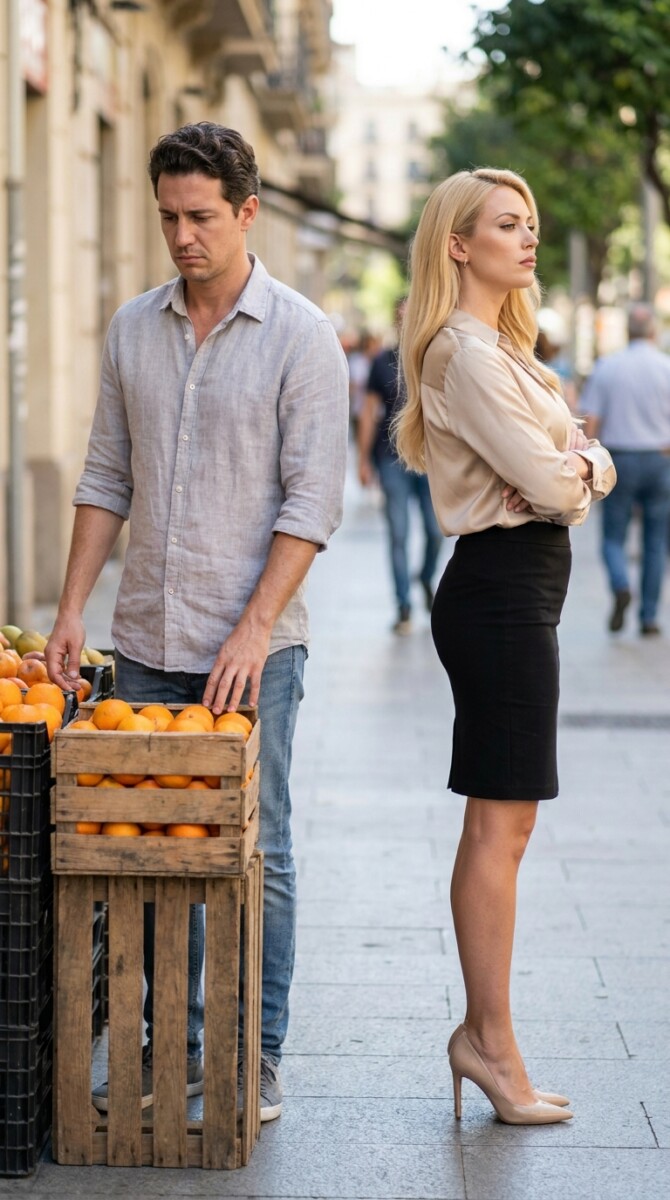
When Valeria walked away from that street, leaving behind the wooden stand, the boxes of oranges, and the most hurtful words Carlos had heard in months, he did not run after her.
He did not call her.
He did not ask for another chance.
He simply stood still, one hand resting on one of the boxes, watching her heels disappear through the crowd as if their love had been nothing more than a seasonal outfit that no longer matched her new life.
The city carried on as usual. Cars passed by. A vendor shouted prices from across the street. A child pointed at a blue balloon. Everything kept moving, as if the world had no intention of stopping for the broken heart of a man selling oranges inherited from a small farm that was nearly in ruins.
Carlos lowered his gaze.
Deep down, part of him had already known that Valeria would leave sooner or later.
For months, she had endured the relationship as though she were waiting for some miraculous transformation. She liked Carlos, yes. She found him attractive, kind, different from other men. But she did not like his reality. She did not like the dirt beneath his fingernails, the smell of the countryside, the early mornings, the debts, or the slow effort of planting without guarantees. And she especially disliked seeing him on a city street corner, standing behind a humble fruit stand, selling oranges with the same dignity with which other people defended office jobs and prestigious titles.
What she called failure, he called perseverance.
But at that moment, the thought brought him little comfort.
“Hey.”
Carlos looked up.
Standing in front of him was a young woman wearing a padded orange costume so bright and ridiculous that, under different circumstances, it would have made him smile immediately. Her brown hair hung loose, her face radiated energy, and a cloth bag crossed her shoulder. In one hand, she held two oranges as if she were about to begin a street performance.
“If you’re going to stand there looking like you’re at a funeral,” she said, “at least let me help you sell. With that face, we won’t even sell a tangerine.”
Carlos blinked, confused.
“We?”
She raised an eyebrow.
“Yep. As of this moment, your business has officially adopted an unsolicited promoter.”
He let out an involuntary laugh, brief and tired.
“I don’t need pity.”
“Perfect,” she replied. “Because I don’t do pity. What I do have is absolutely no tolerance for watching someone give up too soon.”
She turned around, stepped onto a small empty crate beside the stand, and began addressing the people passing by with outrageous enthusiasm.
“Attention, everyone! The sweetest oranges in the whole city are right here! Vitamins, a great price, and on top of that, you get to help this serious gentleman avoid turning into an emotional statue!”
A few people turned to look. Others laughed. An older man approached and bought two kilos. Then came a woman with her daughter. After that, a couple.
In less than half an hour, the stand that had struggled all morning suddenly began moving at a pace Carlos had not seen in weeks.
The young woman in the orange costume never seemed to get tired.
She smiled, joked, awkwardly juggled the fruit, handed out slices for people to taste, and treated every customer as though buying a bag of oranges were the biggest event of the day.
When things finally calmed down for a moment, Carlos looked at her, still surprised.
“Who are you?”
She gave a small theatrical bow.
“Lucía Fernández. Part-time student, event entertainer, promoter when necessary, and sworn enemy of pessimism.”
Carlos smiled genuinely for the first time.
“Carlos.”
“I know. Your ex shouted your name like she was announcing the shutdown of an entire company.”
He looked down, slightly uncomfortable.
Lucía’s expression softened.
“Sorry. I wasn’t trying to make fun of you.”
“It’s okay.”
She picked up an orange, examined it as though it were a piece of artwork, and asked:
“Do you really believe what you said? That the farm will be worth millions someday?”
Carlos took a few seconds before answering.
“I didn’t say it out of pride. My father always said that land was special. He never had enough money to prove it, but he was convinced that one day, if someone knew how to work it properly, it could become something great.”
“And you believe him?”
Carlos looked ahead at the movement of the street.
“I believed him my whole life.”
Lucía nodded with unexpected seriousness.
“Then don’t let it go.”
That sentence, spoken by a stranger dressed like an orange, stayed with him far longer than he could have imagined.
The Farm That Was Almost Lost
Carlos had inherited the farm from his father only a year earlier.
It was not an enormous property, but it was extensive for someone with no modern machinery, business partners, or capital. There were old fruit trees, a small shed, a modest house, and one section of land that had barely been cultivated for years because Carlos’s father had always insisted that it should neither be sold nor disturbed too much.
“That land is hiding something,” he used to say.
Carlos had always assumed it was a mixture of intuition and stubborn rural wisdom.
After his father died, he found himself alone with debts, overdue taxes, and pressure from several acquaintances who advised him to sell everything before he went under.
Valeria was one of them.
“You don’t have to carry the burden of an old farm just because you’re sentimental,” she would tell him. “Sell it, buy a small apartment in the city, and start a real business.”
But Carlos could not do it.
There was something about that farm he could not let go of. Maybe it was pride. Maybe loyalty. Maybe love for a man who had spent his entire life working with hands cracked by sunlight and hard labor.
That was how Carlos ended up selling oranges in the city.
It was not the dream.
It was simply what he had.
And that was exactly where Lucía appeared.
Not only on that first day.
She came back the next day.
And the day after that.
At first, Carlos thought it was just a funny coincidence. It was not. Lucía decided to genuinely help him. She suggested improving the appearance of the stand, replacing the sign, offering samples, using social media, and recording short videos in which she, dressed as a cheerful orange, invited people to buy fruit “straight from the farm, with heart included.”
Carlos understood barely half of her ideas, but he let her try.
And it worked.
Little by little, sales increased.
People began recognizing them.
Some came only for the fruit. Others came for Lucía’s friendly entertainment. Many came for both.
One Saturday, while they were loading empty crates into the back of an old pickup truck, Carlos asked her:
“Why are you doing this?”
Lucía shrugged.
“Because I like helping you.”
“That doesn’t really answer the question.”
She leaned against the truck.
“All right. Long answer. My grandfather had a small vegetable stand. I grew up watching him fight for every sale. One day, a huge supermarket opened across from his business and nearly wiped him out. A lot of people thought he was finished. But watching him taught me something: sometimes the difference between closing down and continuing isn’t money. Sometimes it’s having one person show up and tell you that it’s still worth trying.”
Carlos watched her silently.
“Besides,” she added with a smile, “you looked so serious that I figured if I didn’t intervene, you’d start talking to the oranges like they were your only friends.”
He burst out laughing.
And it was at that moment, without fully realizing it, that the sadness Valeria had left behind began mixing with something new.
Not romance yet.
Just relief.
Lightness.
Companionship.
The Discovery
Months later, when the orange business had become stable and Carlos had managed to catch up on some of his debts, something happened that changed everything.
A construction company visited the farm.
The representative was impeccably dressed, with a calculated smile and a friendly tone.
“We’re interested in buying part of your land,” he said. “This area is expected to develop significantly over the next few years.”
Carlos listened without much enthusiasm.
He was not the first person who had offered to buy.
But this time, something was different.
The amount offered was unusually high for the least productive section of the property—the exact area his father had always refused to disturb.
Carlos did not accept.
He also did not immediately refuse.
Instead, he spoke to an agricultural engineer who was a friend of a distant cousin, and then to a geologist recommended by an old neighbor.
He wanted to understand why that nearly useless strip of land had suddenly become so attractive to a construction company.
The report took several weeks.
When it arrived, Carlos read it twice before fully understanding what it meant.
Beneath part of his land lay an important reserve of high-quality groundwater. In addition, the soil composition made the property ideal for developing a large-scale premium agricultural operation, especially organic citrus fruits and other export crops.
In other words, the farm did not merely have sentimental value.
It had enormous potential.
His father had not been crazy.
He had never been crazy.
Carlos carried the report into the kitchen of the old farmhouse and stared at the empty chair where he had watched his father drink coffee so many mornings before sunrise.
A knot formed in his throat.
“You were right,” he whispered.
He did not know whether to cry or laugh.
He chose to work.
With the help of a small loan, he reinvested in the farm. He improved the irrigation system, repaired the shed, expanded distribution, and began negotiating with larger buyers.
Lucía was there through all of it: organizing social media content, designing labels, proposing brand names, speaking with customers, filming ridiculous but effective videos, and constantly reminding Carlos that a company was also built through humanity.
The brand was eventually named Living Legacy.
Lucía came up with the name.
“Because that’s what this farm is,” she said. “It isn’t a sad memory. It’s a legacy that is still alive.”
Carlos looked at her differently after that.
He said nothing.
But he knew he no longer saw her simply as the girl in the orange costume.
Valeria Came Back
Success did not arrive overnight.
It took almost three years.
Three years of hard work, bad rainy seasons, failed contracts, sleepless nights, and days when everything seemed impossible.
But when success finally came, it came powerfully.
The farm was modernized.
Production increased.
A serious investor became a partner without taking control away from Carlos.
The brand became recognized in specialized markets.
Then came exports.
After that, a premium juice line and other related products.
And one day, without exaggeration, that farm really was worth millions.
Not only because of the land.
But because of what Carlos had built on it.
The local press published an article about “the young farmer who transformed his father’s property into a model company.”
He was interviewed.
Photographed among the orange trees.
People talked about innovation, vision, and growth.
The article also mentioned the charisma of the company’s brand strategist, Lucía Fernández, whose original “happy orange” campaign was still remembered as the detail that made the business feel human and approachable.
It was inevitable.
Valeria saw the article.
And she came back.
She arrived at the farm one afternoon wearing an immaculate dress, dark sunglasses, and expensive perfume that seemed to compete with the honest smell of damp soil.
She stepped out of a shining white car and walked carefully, looking around as though she had entered a place from her past that had suddenly been dressed up in success.
Carlos saw her from a distance near the livestock enclosure.
He did not feel the romantic rush he had once feared he might experience.
He felt surprise.
And then, strangely, calm.
“Hello, Carlos,” she said, removing her sunglasses with a carefully practiced smile. “It’s been a long time.”
“Yes,” he replied. “It has.”
Valeria looked around at the renovated farm, the freshly painted shed, the workers moving around, and the perfectly arranged trees.
“I have to admit… I’m impressed.”
Carlos said nothing.
She adjusted her handbag.
“I’ve thought a lot about us.”
He almost smiled.
That sentence had arrived late and far too well-dressed.
“I don’t think there’s much left to think about,” he said.
Valeria changed her approach.
“I was hard on you, I know. But I was confused too. We were young. I didn’t understand your dreams, and you didn’t always listen to me either…”
Carlos let her speak.
Not because he was interested.
Because he wanted clarity.
It was the first time he saw her without nostalgia.
Valeria was not there because of lost love.
She was there because the failure she had once looked down upon had turned into visible success.
“I always knew you had potential,” she added.
That sentence made him look at her directly.
“No,” he said calmly. “You saw potential when it appeared in the newspaper.”
Valeria blinked.
“That isn’t fair.”
“It’s actually very fair.”
An uncomfortable silence followed.
Lucía emerged from the packing area wearing work boots, jeans, a cotton shirt, and carrying a folder under one arm.
She no longer wore the orange costume except at special events, but the same brightness remained in her face.
When she saw Valeria, she understood the situation immediately.
Not out of jealousy.
Out of instinct.
“Am I interrupting?” she asked with a gentle smile.
“No,” Carlos answered. “We were just finishing.”
Valeria looked at her with tense politeness.
“So you’re Lucía.”
“And you’re the famous Valeria,” she replied with such precise kindness that it almost sounded like a lesson.
Carlos held back a smile.
Valeria chose to ignore the tone.
“I’ve heard a lot about you.”
Lucía tilted her head.
“I hope the version that reached you improved over the years.”
Valeria realized she would not have an easy advantage.
So she changed tactics again, this time becoming more direct.
“Carlos, I think we should speak privately.”
“There’s nothing we need to discuss privately,” he replied.
That irritated her.
“Do you really replace years of history that easily?”
Carlos looked at her calmly.
“I didn’t replace anything. I learned.”
The response was simple.
Without bitterness.
And that was precisely what made it more powerful.
Valeria took a step backward, annoyed, and one of her heels sank slightly into a muddy patch beside the fence.
She tried to recover her balance with dignity but slipped awkwardly.
She did not fall into anyone, and there was no violence or dramatic accident, but she ended up sitting near the lower edge of the pig enclosure, splattered with mud and wearing an expression of complete disbelief.
One of the pigs, curious and completely indifferent to human drama, wandered a little too close.
Lucía was the first to react, offering her a hand.
“Careful. The mud around here doesn’t forgive anyone.”
Red-faced with embarrassment, Valeria accepted the help and stood up.
Carlos also stepped closer, but without making a scene.
She brushed herself off as best she could, humiliated more by the situation than by the mud itself.
Years earlier, Carlos might have found the scene deeply satisfying.
Now, it only felt symbolic.
He took no cruel pleasure in seeing her embarrassed.
It simply became even clearer that their worlds had never truly fit together.
Valeria took a deep breath.
“I understand,” she finally said, her voice hardened. “You’ve made your choice.”
Carlos nodded.
“Yes.”
She looked at Lucía.
Then at the farm.
Then at Carlos one last time.
“I hope you’re not making a mistake.”
Lucía, still polite, answered before he could.
“A mistake is coming back to a place you only wanted once you smelled the money.”
Valeria said nothing else.
She climbed into her car and drove away.
This time, for good.
What Carlos Really Felt
That night, sitting on the porch of the main house, Carlos looked at the trees as the sky faded into shades of orange and violet.
Lucía stepped outside carrying two cups of coffee and handed him one without saying anything at first.
“Are you okay?” she eventually asked.
Carlos nodded, although he hesitated for a second.
“Yes. I think so.”
“You think?”
He smiled faintly.
“It’s strange. For a long time, I imagined that moment. I thought that if she ever came back, I’d feel angry. I’d want to show off everything I had accomplished… something like that.”
“And what did you feel?”
Carlos looked down at his cup.
“None of that. Just… distance. Like I was looking at an old version of my life.”
Lucía sat beside him.
“That’s a good thing.”
“Yes.”
They sat quietly for a moment.
“And I felt something else too,” he added.
Lucía turned toward him.
“What?”
Carlos finally looked directly into her eyes.
“That a long time ago, I stopped needing her to recognize my worth, because someone else saw it when there was nothing impressive to look at.”
Lucía lowered her eyes toward her coffee, trying to hide an emotional smile.
“Carlos…”
“No. Let me say this properly.”
He took a deep breath.
“Lucía, you appeared on the worst day. I was hurt, broke, uncertain about where I was going, and trying to keep a promise I didn’t even know if I could fulfill. You could have made a joke, kept walking, and forgotten about me. But you stayed. You worked beside me. You believed in all of this. And, as much as it hurts my pride to admit it, your orange costume probably saved my business.”
Lucía burst out laughing.
“That might be the strangest declaration of love I’ve ever heard.”
Carlos smiled.
“Maybe it is. Because I also wanted to tell you that I love you.”
The silence that followed was not uncomfortable.
It was beautiful.
Lucía looked at him for a few seconds, as though she needed to make sure the scene was real and not some fantasy built among boxes of fruit.
“You took long enough,” she finally said.
Carlos raised an eyebrow.
“Excuse me?”
“I’ve loved you since the day you very seriously told me that your farm would be worth millions while your ex was leaving you in the middle of the street. Either that, or I thought you were crazy. Both possibilities seemed interesting.”
Carlos laughed loudly.
Then he kissed her.
It was a calm kiss, without any grand spectacle.
Like all important things that arrive after you have learned to tell what is real from what only looks impressive.
The Business Kept Growing
Carlos and Lucía did not suddenly change the way they worked together.
They continued arguing about labels, distribution routes, contracts, packaging, social media, and harvests.
But now there was an even deeper trust between them, a quiet understanding that made everything feel lighter.
A year later, they became engaged.
There was no extravagant proposal.
It happened during a walk through the orange grove at sunrise.
Carlos had been carrying a simple ring in his pocket for weeks, and when he finally stopped and offered it to her, Lucía cried so much that she made fun of herself for days afterward.
“I looked like I was auditioning for a rural soap opera,” she kept saying.
They married at the farm beneath a wooden structure surrounded by trees.
There was music, family, workers, friends, and boxes of oranges decorating the tables as a tribute to how everything had begun.
In one corner, at Lucía’s request, they placed the old orange costume, cleaned and framed like an unlikely company relic.
Everyone laughed when they saw it.
During the toast, Carlos said:
“Some businesses start with capital. Mine started with stubbornness, heartbreak… and a woman dressed as a piece of fruit.”
Lucía nearly threw a napkin at his face because she was laughing so hard.
The Real Lesson
Over time, Carlos’s story became one of those anecdotes people tended to oversimplify:
“The poor farmer who became a millionaire and left his shallow girlfriend behind.”
But the truth was a little more complicated.
And much more human.
Carlos did not succeed to get revenge on Valeria.
He succeeded because he decided to honor his father’s legacy.
Because he worked while others gave up.
Because he accepted help.
Because he listened to new ideas.
Because he refused to be ashamed of the humble work of selling oranges on the street.
And, above all, because he learned to recognize who was beside him out of love and who was there only because it was convenient.
Valeria represented a wound, yes.
But she also brought clarity.
Her contempt taught him something important: he should never measure his worth through the eyes of someone incapable of respecting honest work.
Lucía, on the other hand, taught him that the right person does not arrive only to admire the final result.
The right person helps support the process.
Years later, when journalists asked Carlos about the key to his success, he gave answers about vision, sustainability, diversification, and strategy.
All of those things were true.
But in more personal interviews, when someone asked:
“How did you know Lucía was the right woman?”
Carlos would smile and answer:
“Because she believed in me when I smelled like sunlight, exhaustion, and oranges—not when I had already started appearing in magazines.”
And in the end, that was the difference that changed everything.
Not the money.
Not the humiliation of the past.
Not Valeria’s late return.
But the discovery that real love does not arrive when the harvest is already complete and the numbers are already convincing.
Real love appears while you are still setting up the stand, when you have no idea whether you will sell half the truckload, when the future feels like a promise too big for your hands.
And even then, someone climbs onto a crate, raises two oranges into the air, and tells you:
“Don’t give up. We’re going to sell all of it.”
Carlos never forgot that sentence.
Because deep down, it had not only saved one day of sales.
It had restored his faith in his own future.