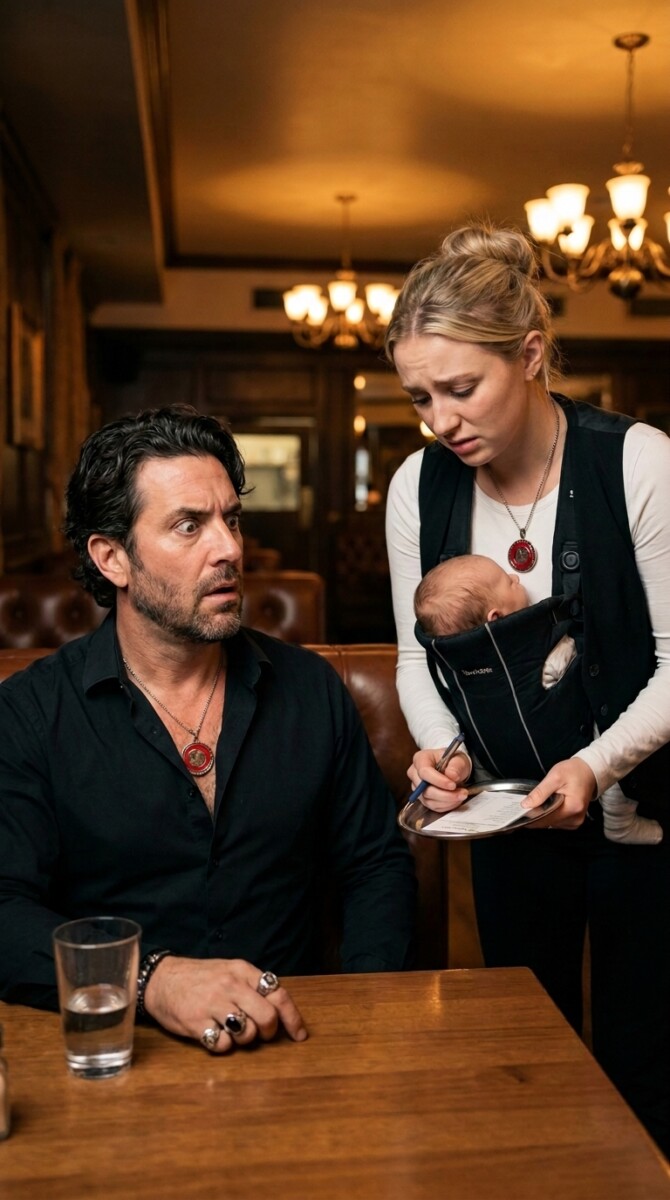
No one in the restaurant moved for several seconds.
The young waitress remained standing, the baby carrier secured against her chest, one trembling hand resting on the tray, her eyes wide with fear. Across from her, the man in the black shirt no longer looked like a powerful customer, but like someone whose old wound had suddenly been torn open with a single blow.
And behind them both, as if the moment had become too dangerous for him, the bodyguard stepped forward.
“Get her out of here right now!”
The order came too quickly. Too nervously.
The man at the table turned his head with a hardness that silenced the entire dining room.
“No one touches her.”
His voice was low, but unquestionable.
The young waitress looked down at the baby resting against her chest, as if her first instinct was to protect her even from words she did not fully understand. She had told the truth without thinking much about it: she had carried that medallion with her ever since she had been abandoned as a baby. She had never expected those words to cause such a dramatic change in the man’s expression.
His name was Adrián Salvatierra.
He was forty-four years old, with a fortune built through restaurants, hotels, and family businesses, and a loss he had never truly been able to accept: a daughter who had disappeared when she was only a few months old.
The waitress was named Eva.
She was twenty-three years old, living a life strained by bills, double shifts, exhaustion, and a one-year-old daughter named Lucía, who sometimes slept against her chest because Eva could not always afford someone to watch her through the night.
The medallion was small, dark red, framed in old silver. It would not have seemed valuable to anyone looking at it from a distance. But Adrián knew it all too well. He himself had commissioned it twenty years earlier for his wife, back when they still dreamed of a peaceful family life that never came to be.
“You said they left it with you when you were a baby,” Adrián repeated, never taking his eyes off Eva.
She nodded cautiously.
“Yes, sir.”
“Who raised you?”
Eva swallowed hard. The entire restaurant was watching.
“A woman named Teresa.”
Adrián tightened his jaw.
The bodyguard, Bruno, interrupted again.
“Mr. Adrián, this is not the place to discuss these things. The girl probably just wants attention.”
Adrián looked directly at him.
“Attention?” he repeated coldly. “She just mentioned a medallion that belongs to my family, a story almost no one knows, and a name I recognize. So if anyone is going to remain silent for a few minutes, it will be you.”
Bruno stood motionless.
Eva felt a knot form in her throat.
She understood nothing, but she understood fear. And what disturbed her most was not Adrián’s surprise, but the bodyguard’s reaction. There was something about him, a poorly concealed urgency, as though he wanted to remove the truth from the room before it could take shape.
Adrián slowly stood.
“Sit down,” he told Eva, pointing toward an empty chair at the table.
She took a small step backward.
“No, sir. I’m working.”
“Right now, you’re in the middle of something more important than this shift.”
Eva hesitated.
The restaurant manager approached nervously from the back, but Adrián raised one hand without even looking at him.
“No one is going to bother her. Have someone else take care of her tables.”
Eva finally sat down, stiff and uneasy, with Lucía still resting against her chest. The baby slept peacefully, unaware that her mother’s life was about to change.
Adrián sat across from her.
“I want you to tell me everything you know about that medallion.”
Eva took a deep breath.
“I don’t know much. Teresa always told me they found me with it. She said it was the only thing I had with me.”
“Where did they find you?”
“Outside a small parish church on the outskirts of San Miguel.”
Adrián closed his eyes for a second.
San Miguel.
The same town where, according to the police report from years earlier, his wife had last been seen before disappearing with their baby.
“And who was Teresa to you?”
“She raised me. She never said she was my mother. She just… raised me.”
“Is she still alive?”
Eva lowered her gaze.
“She died two months ago.”
The news felt like another door slamming shut.
Bruno shifted slightly, almost imperceptibly, and Adrián noticed.
Too much discomfort. Too much tension.
“Go to the car,” Adrián ordered without looking at him.
“Sir, I don’t think it would be wise to leave you alone right now.”
Adrián looked up.
“I didn’t ask for your opinion.”
Bruno hesitated.
That hesitation, coming from a man accustomed to obeying without question, was enough to plant a suspicion Adrián could no longer ignore.
“To the car. Now.”
Bruno left, but before turning away, he cast a brief glance at Eva. She noticed it and felt a chill run through her.
Adrián waited until he was gone.
“Don’t be afraid,” he told her.
Eva gave him a sad smile.
“That would be easier if I understood what was happening.”
Adrián placed both hands on the table.
“Twenty-three years ago, my wife disappeared. Her name was Clara. Our daughter was only three months old. We never found them. All that remained was a confusing trail, contradictory witnesses, and an unbearable silence. That medallion belonged to Clara. She always wore it. Later, she wanted our daughter to have it when she grew older.”
Eva felt her chest tighten.
“Do you think I’m…?”
Adrián did not answer immediately.
“I think there are too many coincidences to ignore.”
Eva looked down at her sleeping baby.
Her entire life had been shaped by a mixture of questions and resignation. She had never known where she came from. She had never pushed too hard for answers because Teresa cried whenever the subject came up. Over time, Eva had learned to settle for very little: an identity without roots, a modest room, a job, a daughter she loved, and the feeling that the world demanded that she keep moving forward even when she did not understand her own story.
But now a man sat across from her, looking at her as though he were seeing her and remembering her at the same time.
“We need to do a test,” he said.
Eva raised her eyes.
“A DNA test?”
“Yes.”
She nodded slowly.
“All right.”
“I’m not going to force you into anything,” Adrián added. “But if you agree, I’ll take care of everything.”
Eva almost laughed at the irony.
“That would be the first time in my life someone took care of something for me.”
The words hit him harder than she expected.
He said nothing.
That same night, Adrián instructed his legal and medical teams to arrange the procedure with complete discretion. Eva ended her shift early, although she could barely concentrate. When she walked out through the restaurant’s back entrance, a dark car was waiting.
It was not Bruno.
It was a young attorney sent by Adrián.
“I’m Valentina. I work with Mr. Salvatierra. He asked me to accompany you home and make sure you arrive safely.”
Eva hesitated.
“Is this really that serious?”
Valentina looked at her honestly.
“I don’t know yet. But Mr. Salvatierra believes it is.”
Eva barely slept that night. She watched Lucía in the makeshift crib beside her bed and felt an absurd question circling through her mind: if she truly belonged to another family, would that change who she was? Or would it only change what she had never known?
Two days later, she took the test.
At the same time, Adrián began moving pieces he had not touched in years.
He reopened the private investigation into Clara’s disappearance.
He asked his attorney for every archived document.
He contacted former investigators.
And above all, he began looking at Bruno differently.
Bruno had worked for him for eighteen years. He had always been efficient, apparently loyal, and quiet. He was the kind of man people stopped thinking about precisely because he seemed indispensable. He had stood beside Adrián during negotiations, trips, and difficult meetings. He had accompanied him through the darkest period of grief and chaos, when Clara disappeared and Adrián’s entire world seemed to collapse.
That was what made it disturbing.
Bruno had been there since then.
And never before had he reacted with fear to any subject.
But that night, he had.
Valentina was the first to say it plainly.
“His reaction wasn’t protective,” she said as she reviewed notes in Adrián’s office. “It was containment. As if he wanted to shut down the conversation before it grew.”
Adrián stood beside the window.
“I thought the same thing.”
“Did you trust him that much?”
Adrián let out a bitter laugh.
“Enough that I stopped asking certain questions.”
Valentina took a breath.
“Then it’s time to start asking them.”
The test took three days.
For Eva, they felt endless.
She continued working, although the restaurant manager now treated her with a strange combination of excessive respect and nervousness. Some of her coworkers began whispering. She noticed, but tried to ignore it.
One evening, after finishing her shift, she found a folded piece of paper inside her bag.
It contained only one sentence:
“Don’t continue with this if you want to live peacefully.”
She felt the blood drain from her face.
There was no signature.
Nothing else.
She kept the note and went directly to Valentina.
An hour later, Adrián was holding it in his hand.
“This is no longer just suspicion,” he murmured.
“Bruno?” Valentina asked.
“Or someone who knows more than they should.”
Adrián contacted private security and ordered discreet protection for Eva and the baby. She protested.
“I’m not an important person.”
Adrián stared at her.
“You might be. And even if you weren’t, someone has already threatened you.”
Eva did not know how to respond.
The results arrived the following day.
Adrián opened the envelope in his office. Valentina was there. Eva was there too, sitting on the edge of a chair, squeezing her hands together so tightly that her knuckles had turned white.
Adrián read silently.
Then he looked up.
His eyes filled with something Eva had never seen in a man like him: pure vulnerability.
“It’s positive,” he said, his voice breaking. “You’re my daughter.”
Eva did not cry immediately.
At first, she remained completely still, as if her body needed several seconds to understand what her mind had already heard. Then she looked at Lucía, who was babbling in her stroller beside the door. Finally, she looked back at Adrián.
“So… you really searched for me?”
The question cut through him.
“Every day.”
Then Eva cried.
Not from simple happiness.
From exhaustion. From years of uncertainty. From every moment she had believed she came from nowhere, that no one had wanted her, that she had simply been a forgotten mistake left behind with a medallion.
Adrián knelt in front of her. Formality, pride, and appearances no longer mattered.
“I’m sorry,” he said. “I’m sorry I didn’t find you sooner.”
Eva shook her head through her tears.
“I didn’t even know someone was supposed to find me.”
They embraced awkwardly.
Like two strangers connected by an enormous truth that had arrived far too late.
But the emotion did not last long.
Because the most dangerous part remained unanswered.
Who had caused Clara to disappear?
And why had Bruno reacted that way?
The answer came from an unexpected source.
That same afternoon, Valentina obtained a copy of an old Salvatierra family will. One clause was clear: if Adrián died without a legally recognized descendant, control of a decisive portion of the business group would pass to a council that included two key people.
One of them was Esteban Villalba, Adrián’s cousin.
The other was the group’s trusted legal representative… appointed years earlier on Bruno’s recommendation.
Adrián read the document several times.
It was not direct proof.
But it established a motive.
If the daughter disappeared, the line of succession changed.
Valentina continued investigating and discovered something even more troubling: years earlier, Bruno had received discreet payments from a shell company linked to Villalba.
“We’re not talking about intuition anymore,” she said.
Adrián clenched his jaw.
“I want to know where Clara is.”
They located Bruno that same night.
They did not confront him alone. Attorneys and a private investigator were present.
At first, Bruno denied everything.
Then Adrián placed the bank transfers, the will, the threatening note, and the DNA results on the table.
Bruno remained silent for a long time.
Finally, he spoke.
“I never wanted anyone to get hurt.”
That sentence was enough to confirm the essential truth.
Adrián did not shout.
He did not threaten him.
He simply looked at him the way someone looks at a betrayal that had been hidden for far too many years.
“Start talking.”
And Bruno talked.
Twenty-three years earlier, Esteban Villalba had discovered that Clara intended to convince Adrián to restructure several family assets to secure their daughter’s future. If that happened, Esteban would lose influence and money.
He had not planned to kill them.
He had planned to frighten Clara.
They followed her. They pressured her. They made her believe Adrián would be in danger if she remained by his side. Bruno, young and ambitious at the time, served as the intermediary. Terrified, Clara fled with the baby. Along the way, she became ill, ran out of resources, and eventually turned to Teresa, a woman connected to a parish in San Miguel.
What happened next was even worse because of its pettiness: Clara tried to contact Adrián, but the message never reached him. Bruno intercepted the information. Shortly afterward, Clara disappeared again. Teresa took responsibility for the baby. Bruno assured Esteban that the problem had been resolved.
“Where is Clara?” Adrián asked, motionless.
Bruno lowered his gaze.
“I don’t know for certain.”
“Don’t lie to me.”
“The last I heard, she was living in a rural area up north. After that, I lost track of her.”
It was not enough.
But it was something.
A formal complaint was filed that same night.
Bruno was arrested the following day, and Esteban tried to deny any connection until financial evidence and old witness accounts began to surface.
Meanwhile, Eva was living through an impossible whirlwind. Suddenly she had a father. A different family name. A different history. A potential fortune connected to her very existence, something that made her deeply uncomfortable. Yet she was still a waitress. Still a single mother. Still the same young woman who counted every coin at the end of the month.
Adrián, for his part, tried not to overwhelm her.
He offered financial help, housing, security, and support for Lucía.
Eva accepted some things and refused others.
“I don’t want to feel like you suddenly owe me an entire lifetime,” she told him one afternoon.
Adrián nodded.
“And I don’t want to try to buy back the time we lost.”
That answer reassured her.
They began seeing each other frequently, but without theatrics. Short breakfasts. Awkward conversations. Small questions.
What was your favorite color when you were little?
I don’t know.
Did you like reading?
I didn’t have many books.
What do you remember about Teresa?
She was a good cook, and she cried whenever she heard old songs.
Their relationship did not grow the way relationships do in movies. It grew the way real things grow: through mistakes, pauses, and an enormous amount of time.
Two weeks later, they found Clara.
She was living in a small coastal town under a different last name, working in a sewing shop.
She was alive.
When Valentina received confirmation, she remained silent for a moment before calling Adrián.
“We found her.”
Adrián took several seconds to respond.
“Is she okay?”
“She’s alive.”
That was the only sentence he needed.
The reunion took place three days later.
Eva went with him.
She did not know what she was supposed to feel. Anger, fear, longing, confusion. Everything at once.
Clara was waiting for them, sitting on a wooden chair outside the closed shop. Her once-light hair had faded with age, her hands were delicate, and her eyes carried the sadness of someone who had learned to survive without expecting too much.
When she saw Eva, she slowly stood.
She did not immediately say “daughter.”
She simply looked at her.
As though trying to recognize in her face the baby she had lost.
Eva spoke first.
“Are you my mother?”
Clara covered her mouth with one hand and burst into tears.
It was not a perfect scene.
There were no perfect words.
There was pain.
A great deal of it.
Through her tears, Clara explained that for years she had believed getting close would put her daughter in danger. Teresa had convinced her to stay away when they realized they were still being watched. Eventually, fear became habit. Then came guilt. Later came shame.
“I didn’t know how to come back after so much time,” she said.
Eva cried too, but she did not immediately embrace her.
“I needed you to come back.”
Clara nodded, devastated.
“I know.”
Adrián listened in silence.
What followed was not an instant reconciliation.
It was something more difficult:
Truth.
Truth about bad decisions, poorly handled fear, someone else’s ambition, and silences that had left scars.
Esteban was eventually charged with fraud, coercion, obstruction, and other offenses. Not everything could be proven as thoroughly as Adrián would have wanted because time had erased many traces. But there was enough to remove Esteban from the company and expose his role in what had happened.
Bruno faced more serious charges. His downfall was swift. For years, he had been the trusted man who appeared to protect Adrián, when in reality he had been protecting a secret that benefited others.
For Eva, however, the most complicated part was not happening in court.
It was learning what to do with a family she had found far too late.
Adrián wanted to become part of Lucía’s life as her grandfather, but without forcing himself into it.
Clara wanted to recover twenty years with her daughter, but she had to accept that twenty years could not be recovered overnight.
Eva wanted to understand who she was without abandoning the person she had already learned to become.
One evening, months later, the three of them sat together at Adrián’s house. Lucía was asleep on the sofa beneath a light blanket. The red medallion rested on the table.
“My whole life, I thought that object was the only thing I had,” Eva said.
Adrián listened.
“And now it turns out it was a key.”
Clara wiped her eyes.
“A key I should have used sooner.”
Eva looked at her.
There was still pain. There would still be difficult days. But Eva no longer wanted to live only through the wound.
“We can’t change what happened,” she finally said. “But we can decide what we do with what remains.”
Adrián smiled faintly.
Coming from the daughter he had never been able to raise, those words felt like the clearest sign that a future was still possible.
Eva left the restaurant months later, not because she wanted to “move up in the world,” but because Adrián suggested she study hotel management, and she discovered that she genuinely wanted something different for herself. Even then, she kept her habit of working hard, distrusting anything that came too easily, and checking every bill twice. She had no interest in becoming a decorative heiress. She wanted to build something of her own.
Clara began visiting frequently. At first, it was uncomfortable. Then it became less so. Lucía became the most unexpected bridge between them: she did not understand the past, so she carried none of its prejudices. She smiled, reached out her arms, and forced the adults around her to relax.
One year later, during a simple dinner, Adrián watched Eva laugh while Clara unsuccessfully tried to feed Lucía. The red medallion hung around his daughter’s neck.
It was no longer a mystery.
It was a recovered story.
Then Adrián thought about something he had never dared to say aloud until that moment.
“I lost you once,” he told Eva. “I’m not going to lose you again.”
Eva looked at him with a mixture of tenderness and firmness.
“Then don’t try to control me. Just stay.”
Adrián gave a brief laugh.
“Deal.”
And that was what they did.
They did not have a perfect ending.
They had something better.
An uncomfortable truth, justice that was incomplete but real, and a family that, although it had come together late, had finally stopped living in the shadow of a medallion and begun building something in the light.