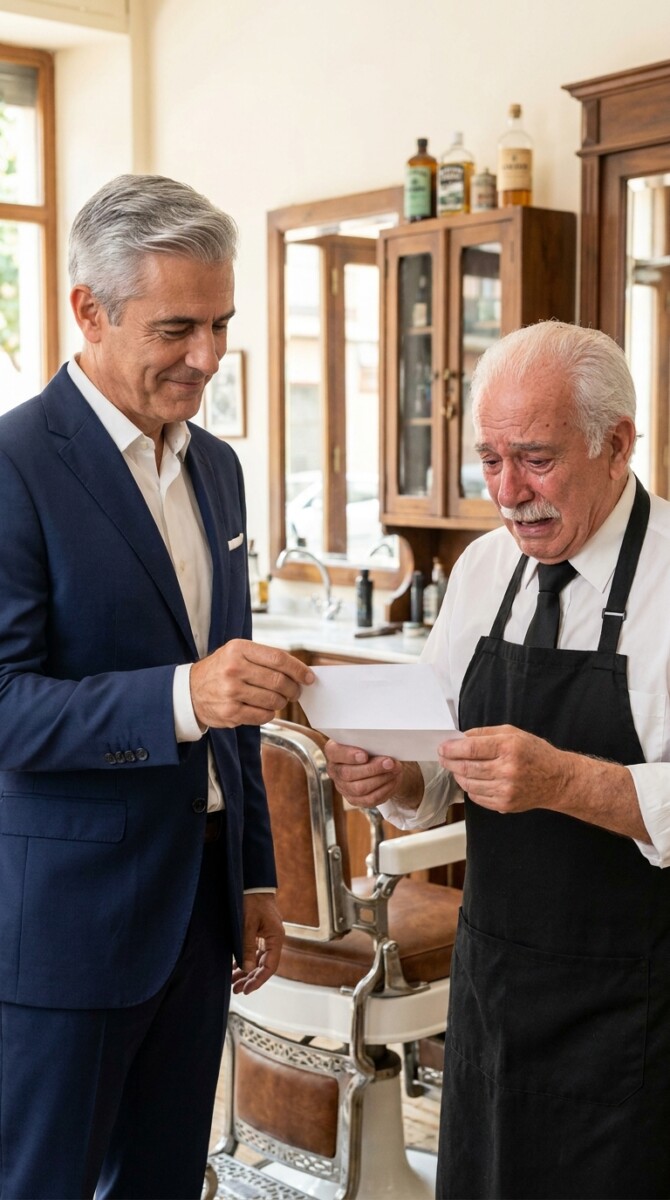
Luis stood completely still behind the counter.
For several seconds, he was unable to take his eyes off the white envelope Carlos had just handed to Don Miguel.
The man he had looked down on the day before because of his worn-out clothes no longer seemed like the same person.
His gray hair was perfectly trimmed and combed back. His unkempt beard was gone. He wore an impeccably tailored navy-blue suit and a spotless white shirt. He walked upright and calmly, with a confidence that contrasted completely with the fragile image he had shown barely twenty-four hours earlier.
But that was not what confused Luis the most.
It was the sentence he had just heard.
“Starting today, this barbershop no longer pays rent. It belongs to you, Don Miguel.”
Miguel held the envelope in his hands.
The old barber looked at Carlos as if he had not understood him correctly.
“What do you mean, it belongs to me?”
Carlos smiled.
“Exactly what you heard.”
Miguel slowly opened the envelope.
Inside, he found several documents.
He read the first page.
Then the second.
He removed his glasses, cleaned them with the edge of his apron, and read everything again.
“Carlos…”
His voice cracked.
“I can’t accept this.”
“You still don’t know what you’re accepting.”
Miguel looked up.
Carlos pointed toward one of the chairs.
“Sit down.”
Luis continued watching from the back.
He wanted to come closer.
He wanted to ask questions.
But for the first time since he had started working at that barbershop, he understood that the conversation did not belong to him.
Miguel sat down.
Carlos pulled up another chair across from him.
“Yesterday, you asked me very few questions,” Carlos said. “That was exactly what impressed me the most.”
Miguel frowned.
“I only did my job.”
“No.”
Carlos shook his head.
“Your job was to cut hair. What you did was treat me like a human being when someone else had already decided how much I was worth based on my appearance.”
Luis slowly lowered his head.
There was no need to mention his name.
He knew perfectly well who they were talking about.
What Was Really Inside the Kraft Envelope
The previous day, when Carlos arrived at Miguel Barber Shop with long hair, an unkempt beard, and worn-out clothes, he was carrying a kraft paper envelope in his hands.
Luis assumed it contained unimportant personal documents.
He was wrong.
Inside was a notice for a meeting with attorneys and an old copy of a property deed.
Carlos had spent almost five years searching for that exact document.
His story had begun long before he walked into the barbershop.
Carlos Mendoza had worked in real estate for more than twenty-five years.
He had not started as a businessman.
As a teenager, he worked carrying construction materials.
Later, he became a maintenance assistant.
Eventually, he found a job in property management.
He studied at night.
He learned about contracts.
He bought a small apartment.
Then another.
Then a modest building.
He never became a public figure.
But he built a stable company.
Over time, he came to manage hundreds of properties.
At forty-eight, it seemed as though he had life figured out.
Until everything changed.
Carlos’s Fall
His wife, Ana, became ill.
Carlos left much of the daily management of his businesses in the hands of a partner named Ramón Espinal so he could stay by her side during treatment.
Ana fought for almost two years.
Carlos remained beside her.
Business stopped mattering to him.
When she finally died, Carlos lost more than his wife.
He lost his sense of direction.
For months, he barely went to the office.
Ramón continued running the company.
When Carlos finally tried to return, he discovered a devastating situation.
Several properties had been sold.
There were loans he did not remember authorizing.
Documents appeared bearing signatures under powers of attorney Carlos insisted he had never granted.
His company was practically destroyed.
A legal battle began.
Carlos still had money, but the expenses kept growing.
Legal fees.
Investigations.
Court proceedings.
Part of his accounts were temporarily frozen while claims were being resolved.
He sold his house.
He moved into a small apartment.
Then he began spending entire days reviewing files, public records, and old contracts.
His appearance began to deteriorate.
Not because he was completely broke.
But because he had stopped taking care of himself.
He ate poorly.
He barely slept.
He shaved whenever he remembered.
He wore the same old work jacket he had used for years when visiting properties.
Then a clue appeared.
The Last Property
Among the old documents, he found references to a small commercial building that Carlos and Ana had purchased more than twenty years earlier.
The property had somehow remained outside several corporate restructurings.
Carlos believed he had sold it.
But the records indicated otherwise.
It was still held by a company in which he was the majority beneficiary.
The problem was that the original deed was missing.
Without that document, the process would be much more complicated.
Carlos began searching through boxes stored in different places.
Finally, he remembered that Ana had left documents inside a safe-deposit box.
He found the kraft envelope.
The deed was inside.
And the address of the property looked very familiar.
1458 Franklin Street.
Carlos stared at the document for several seconds.
He had passed that location many times.
A barbershop had operated on the ground floor for decades.
Miguel Barber Shop.
Why Carlos Arrived Barefoot and Exhausted
The morning before his meeting with the attorneys, Carlos left home early.
His car was being repaired.
He decided to take public transportation.
It began to rain.
One of his shoes, already badly worn, finally broke.
Carlos kept walking.
A few yards from the barbershop, the other shoe also fell apart.
He ended up taking them off.
When he saw the Miguel Barber Shop sign, he remembered something.
He had an important meeting the following day.
If he could prove ownership of the building, he could recover one of the assets Ramón had attempted to include in a fraudulent transaction.
Carlos looked at his reflection in a store window.
Long hair.
Unkempt beard.
Worn-out clothes.
He looked exactly like someone who had spent months losing a battle.
He entered the barbershop.
Luis saw him first.
“Sir, what do you need?”
Carlos lifted the envelope.
“A haircut, if you still have room.”
Luis looked him up and down.
He did not see a customer.
He saw a problem.
“We’re busy.”
Carlos looked at the chairs.
Three of them were empty.
“I can wait.”
Luis sighed.
“Sir, maybe you should find somewhere else.”
Carlos understood.
“I can pay.”
That sentence seemed to irritate Luis even more.
“I already told you to leave. We don’t serve homeless people here.”
Carlos slowly lowered his eyes.
Not because the word destroyed him.
He had endured much worse.
But after months of difficulties, hearing something like that at that particular moment was especially painful.
Then Miguel appeared.
Miguel’s Principle
Miguel Ortega had been cutting hair for forty-two years.
He had seen every kind of person walk through his door.
Lawyers.
Mechanics.
Students.
Unemployed people.
Business owners.
Lonely elderly men who sometimes came more for conversation than for a haircut.
Miguel had one simple rule.
If someone walked through the door and waited for their turn, that person was a customer.
When he heard Luis, he immediately stepped forward.
“Luis, since when do we ask someone how much money they have before offering them a chair?”
“Don Miguel, I was just…”
“Come in,” Miguel said, looking at Carlos. “I’ll take care of you today.”
Carlos entered.
He did not argue with Luis.
He said nothing about the building.
Nothing about attorneys.
Nothing about properties.
He sat down.
Miguel placed the black cape around his shoulders.
“How would you like it?”
Carlos looked at his reflection.
For a moment, he barely recognized himself.
“Make me look like someone who still has a chance.”
Miguel began working.
The Conversation in Front of the Mirror
For the first few minutes, they barely spoke.
Miguel cut his hair with slow, precise movements.
Carlos watched small gray locks fall onto the cape.
Then he said:
“I have a meeting tomorrow.”
Miguel smiled.
“Then we’ll make sure you’re ready.”
Carlos slightly raised his eyes.
“It may be the last opportunity I have left.”
Miguel stopped cutting.
“A job?”
“Something like that.”
“Then you’d better walk in with your head held high.”
Carlos smiled for the first time in days.
“That’s what I’m trying to do.”
Miguel continued.
He did not ask invasive questions.
He did not want to know how much money Carlos had.
He did not ask how he had ended up looking that way.
He simply did his job.
When he finished, Carlos looked at himself in the mirror.
The transformation was remarkable.
But more important than his hair was his expression.
He looked like himself again.
He took out some cash.
Miguel shook his head.
“No.”
Carlos frowned.
“I have money.”
“I know.”
“Then charge me.”
Miguel smiled.
“Pay me next time.”
Carlos slowly put the money away.
“What if there is no next time?”
Miguel answered:
“It’s always better to behave as though there will be.”
That sentence stayed with Carlos throughout the night.
The Meeting With the Attorneys
The next morning, Carlos arrived at the law office wearing a suit he had kept stored away.
The attorneys reviewed the deed.
Then the records.
The conclusion was clear.
The Franklin Street building still belonged to a company controlled by Carlos.
Not only that.
It was a very valuable property.
Over the previous years, the area had experienced tremendous growth.
The land could now be worth several times what it had been worth when it was originally purchased.
One of the attorneys said:
“Carlos, with this, we can reorganize an important part of the case.”
“What about the tenants?”
“There are three businesses.”
Carlos reviewed the list.
The first was a coffee shop.
The second, a small office.
The third:
Miguel Barber Shop.
“How much does he pay?”
The attorney answered.
Carlos frowned.
It was too much.
The lease had been renegotiated by Ramón years earlier with aggressive rent increases.
“Is he current?”
“Yes.”
“How long has he been renting?”
“Thirty-two years.”
Carlos remained silent.
Thirty-two years paying rent on the same place.
“I want to know how much he has paid in total.”
The attorney raised an eyebrow.
“Why?”
Carlos remembered the mirror.
The black cape.
Miguel’s words.
It’s always better to behave as though there will be a next time.
“Just do it.”
Thirty-Two Years
The calculation surprised even Carlos.
Over the decades, Miguel had paid an accumulated amount that greatly exceeded the original value of the shop.
He had never fallen significantly behind.
Not even during difficult years.
Carlos made a decision.
“I want to separate that unit.”
“To sell it?”
“Yes.”
“To whom?”
Carlos answered:
“To Miguel.”
The attorney began preparing a financing structure.
Carlos stopped him.
“You misunderstood me.”
“What do you mean?”
“I don’t want him to buy it.”
The attorney looked at him.
“I want to give it to him.”
The Return
That explained why Carlos returned to the barbershop dressed in a suit and carrying a white envelope.
Miguel did not recognize him immediately.
Neither did Luis.
Carlos smiled.
“Are you still offering haircuts?”
Miguel narrowed his eyes.
Then his eyes widened.
“Carlos.”
Luis froze.
Carlos approached.
“I came to pay for yesterday’s haircut.”
He took out some money.
Miguel began laughing.
“I told you that you could pay me later.”
“I also brought something else.”
And he handed him the envelope.
Now Miguel was holding the deed to the shop.
“I Can’t Accept This”
“Carlos,” Miguel repeated. “This is worth too much.”
“It means more to you than it does to me.”
“No.”
Miguel shook his head.
“I can’t accept a building because I gave you a haircut.”
Carlos smiled.
“I’m not giving it to you because of the haircut.”
“Then why?”
Carlos looked around.
The leather chairs.
The old mirrors.
The photographs of generations of customers.
“Because this place exists because of you.”
Miguel did not answer.
“You’ve been paying for thirty-two years,” Carlos continued.
“Far more than this place originally cost.”
Miguel lowered his eyes.
“That was rent.”
“I know.”
“Then I fulfilled my obligation.”
“Exactly.”
Carlos smiled.
“And I can decide what to do with what now belongs to me.”
Miguel became emotional.
“But this should stay in your family.”
Carlos’s expression changed.
“My wife Ana wanted that.”
Miguel looked up.
Carlos explained that Ana had always defended the small businesses operating in the buildings they managed.
She had once said that cities lost something important whenever every family-owned business was eventually replaced by a chain.
“I think she would agree.”
Miguel looked at the documents again.
This time, tears appeared in his eyes.
“Thank you.”
Carlos stood.
The two men embraced.
Luis
The celebration lasted only a few seconds before Carlos looked toward the back.
Luis was still there.
Pale.
Ashamed.
He looked as though he wanted to disappear behind the counter.
Miguel looked at him too.
Carlos walked toward him.
Luis swallowed nervously.
“Sir…”
Carlos slightly raised one hand.
“Carlos is fine.”
“I want to apologize.”
“For what?”
The question caught him off guard.
“For the way I treated you.”
Carlos waited.
Luis continued:
“I shouldn’t have said those things.”
“Because now you know I own the building?”
Luis remained silent.
The obvious answer was yes.
Carlos continued:
“That would make your apology pretty useless.”
Luis lowered his head.
“You’re right.”
“Yesterday, when you thought I had nothing, did you believe it was acceptable to treat me that way?”
“No.”
“But you did.”
“Yes.”
Carlos rested one hand on the counter.
“Then that is the problem you need to fix.”
Miguel watched from a distance.
Luis Expected to Be Fired
When Carlos walked away, Luis approached Miguel.
“I suppose I should pack my things.”
Miguel frowned.
“Why?”
“After what happened yesterday.”
Miguel remained silent.
“Are you going to fire me?”
“Do you think I should?”
Luis did not answer.
Miguel pointed toward a chair.
“Sit down.”
Luis obeyed.
“You’ve worked here for four years.”
“Yes.”
“You’re good at cutting hair.”
“Thank you.”
“But lately, you’ve been treating customers as if they were doing you a favor by walking in.”
Luis lowered his eyes.
“I know.”
“No, you didn’t.”
Miguel sat across from him.
“Because if you had known, you would have changed before now.”
Luis took a deep breath.
“Then what do you want me to do?”
Miguel answered:
“Learn.”
Where the Arrogance Came From
Luis had not always been like that.
When he started working at the barbershop, he was twenty-one years old.
He was kind.
Patient.
Hardworking.
Over time, he began building a clientele of young professionals.
Executives.
Influencers.
People who left large tips.
Luis discovered that serving those customers was more profitable.
Little by little, he began putting people into categories.
Good customer.
Bad customer.
Profitable customer.
Customer who “only wasted his time.”
And eventually he confused purchasing power with human dignity.
Miguel had noticed the change.
But he had made his own mistake.
He had failed to intervene sooner.
“I’m responsible too,” he admitted.
Luis looked up.
“Why?”
“Because I saw you changing and thought you would mature on your own.”
Miguel shook his head.
“Sometimes being in charge also means saying something uncomfortable before it’s too late.”
The New Rule
Miguel gathered the entire staff.
There were four barbers.
He placed a sheet of paper on the wall.
It contained only one sentence:
“If someone walks through this door, they deserve respect.”
Luis looked at it.
Miguel continued:
“Their clothes don’t matter.
“It doesn’t matter whether they ask for the most expensive haircut or the cheapest one.
“It doesn’t matter whether they leave a tip.
“As long as they treat the staff properly, they receive the same respect.”
One of the barbers asked:
“Is this because of what happened yesterday?”
Miguel answered:
“It’s because this should have been our rule from the beginning.”
Carlos Recovered His Company
Meanwhile, Carlos’s personal situation also began to improve.
The building deed strengthened his case.
Months later, investigators confirmed that Ramón had carried out transactions without proper authorization.
Carlos managed to recover a significant portion of his properties and reached agreements that prevented additional years of litigation.
He did not recover everything.
Curiously, he no longer wanted to.
Ana’s death had changed his relationship with money.
He sold several investments.
He kept only what he needed.
He created a small foundation in his wife’s name to help older shopkeepers who were at risk of losing their businesses because of rent problems.
Miguel became one of the foundation’s first volunteer advisers.
“I don’t know anything about foundations,” Miguel protested.
Carlos answered:
“You know what it means to keep a business running for forty years.”
“That I do.”
“Then you know more than you think.”
Luis’s First Test
Months later, on a rainy afternoon, an older man walked in.
He wore work clothes covered in paint.
Luis was available.
For a fraction of a second, the old instinct returned.
Look at the clothes.
Calculate.
Decide.
Then he saw the sign.
If someone walks through this door, they deserve respect.
“Good afternoon,” Luis said. “How can I help you?”
“I just want a little trim.”
“Of course. Have a seat.”
The man sat down.
They talked during the haircut.
It turned out he was a painter.
He had been working for forty years.
He had seven grandchildren.
When Luis finished, the man took out a very old wallet.
“How much is it?”
Luis told him the normal price.
The man paid.
He did not leave a large tip.
It did not matter.
Before leaving, he asked:
“Are you Luis?”
“Yes.”
“My son comes here.”
“What’s his name?”
When he heard the name, Luis recognized it.
The man’s son was one of his best customers.
A lawyer who always booked Saturdays.
Once again, Luis understood how absurd it was to judge people.
But this time, he had not needed to discover an important connection before treating the man properly.
That was precisely what he was learning.
One Year Later
The barbershop celebrated its fortieth anniversary.
Miguel organized a small celebration.
Carlos arrived wearing a suit, although he was not overly formal.
Luis greeted him at the door.
“Mr. Carlos.”
“I already told you, just Carlos.”
“I’m still getting used to it.”
They both smiled.
“Haircut?”
Carlos pointed at his hair.
“I’m due for one.”
Luis looked at Miguel.
“Are you taking care of him?”
Miguel shook his head.
“Today it’s your turn.”
Luis looked surprised.
So did Carlos.
Miguel smiled.
“It’s time.”
Carlos sat in Luis’s chair.
For the first few minutes, there was an uncomfortable silence.
Finally, Luis spoke.
“Thank you.”
Carlos looked at him through the mirror.
“For what?”
“For not asking Miguel to fire me.”
Carlos answered:
“It was never my business to decide that.”
“You could have.”
“I could have asked.”
Carlos paused.
“But someone who treats you badly once doesn’t always need to lose everything. Sometimes they need to realize what they’re doing.”
Luis nodded.
“I realized it.”
Carlos smiled.
“Then make sure you don’t forget.”
Miguel Was Getting Older
Another three years passed.
Miguel was seventy-three.
His hands were still precise, but his back was beginning to tire.
One morning, he gathered the team.
“I’m going to work less.”
Luis looked at him.
“How much less?”
“Three days a week.”
“That’s not retirement.”
“Exactly.”
Everyone laughed.
Miguel had another announcement.
“I want Luis to manage the shop when I’m not here.”
Luis’s eyes widened.
“Me?”
“Yes.”
“After…”
Miguel interrupted him.
“After making a mistake, admitting it, and spending three years proving that you learned from it.”
Luis remained silent.
Miguel continued:
“People don’t have to be condemned forever because of their worst day.”
That sentence meant much more than it appeared to.
Luis’s Surprise
Becoming manager changed Luis’s way of thinking even more.
Now he was the one receiving résumés.
One afternoon, a twenty-two-year-old man came in.
He wore a very simple shirt.
He had no experience in upscale barbershops.
Luis reviewed his application.
“You worked from home.”
“Yes.”
“Do you have your license?”
“I just finished.”
“Why do you want to work here?”
The young man looked around.
“Because my dad used to come here with Don Miguel when I was little.”
Luis smiled.
“Who’s your father?”
The young man answered.
It was the painter Luis had served years earlier.
Luis almost laughed.
“What’s wrong?”
“Nothing.”
He looked at the application again.
“Give me a demonstration.”
The young man was eventually hired.
Carlos Returned to the Place Where He Had Arrived Defeated
Five years after that first visit, Carlos walked down the same street.
This time, he wore casual clothes.
No suit.
No torn jacket.
Just jeans and a shirt.
He stopped in front of the sign:
MIGUEL BARBER SHOP
The red, white, and blue barber pole was still spinning.
A small plaque was attached to the window.
Property of Miguel Ortega since 2026.
Carlos smiled.
He entered.
Miguel was sitting down, drinking coffee.
“Look who decided to show up.”
“Do you have room?”
Miguel pointed toward the chairs.
“For you, always.”
Carlos sat down.
Luis was helping an older customer.
The young apprentice was cleaning tools.
Everything seemed normal.
And that was precisely what made it beautiful.
The Conversation That Brought Everything Full Circle
As Miguel began the haircut, Carlos looked at his reflection.
“You know something?”
“What?”
“That day, I really thought it was my last chance.”
Miguel remembered the words.
“You said that.”
“I wasn’t only talking about the meeting.”
Miguel stopped moving the scissors.
Carlos continued:
“After Ana, losing the company, and everything else… I had started thinking that maybe there was nothing left to recover.”
Miguel listened.
“I walked in here feeling like a man who had lost everything.”
“You hadn’t lost everything.”
Carlos smiled.
“That’s what you made me feel.”
Miguel shook his head.
“I only cut your hair.”
“No.”
Carlos looked at him through the mirror.
“You gave me a chair when someone else made me feel as though I didn’t even deserve to walk through the door.”
Miguel remained silent.
“Sometimes something very small comes along at exactly the moment a person needs it.”
Miguel went back to work.
“Then we’re even.”
Carlos frowned.
“How?”
“You gave me the shop.”
“That wasn’t small.”
Miguel smiled.
“Neither was the chair, at least not to me.”
The Real Lesson for Luis
Luis heard part of their conversation.
That night, after closing, he remained alone for several minutes.
He looked at the sign on the wall.
It was worn now.
If someone walks through this door, they deserve respect.
He thought about Carlos.
About how he had seen him that first day.
Long hair.
Unkempt beard.
Torn clothes.
Kraft envelope.
Luis had assumed he knew Carlos’s entire story simply by looking at him.
He had known nothing.
But over the years, he understood something even more important.
Even if Carlos had been exactly what Luis had imagined—a man without a home, without money, without connections, and without some millionaire surprise waiting for him the next day—the way Luis treated him would still have been wrong.
That was the part that took him the longest to understand.
The lesson could not be:
“Be careful about looking down on a poor person because they might actually be rich.”
That changed nothing.
It only replaced prejudice with fear of making a mistake.
The real lesson was much simpler:
You do not need to know what someone owns in order to treat them with dignity.
Miguel’s Last Chair
At seventy-eight, Miguel finally decided to retire.
For real this time.
The barbershop organized a small farewell party.
Longtime customers brought photographs.
Luis prepared an album.
Carlos arrived with a gift.
Miguel opened the box.
Inside was a small metal plaque.
It read:
“To Miguel Ortega, who for forty-seven years understood that before customers walk through the door, human beings do.”
Miguel had to remove his glasses.
“You’re going to make me cry again.”
Carlos smiled.
“You have experience now.”
Everyone laughed.
Miguel looked at Luis.
“The barbershop is in your hands.”
Luis took a deep breath.
“I’m not changing the name.”
“I wasn’t going to let you.”
Another round of laughter followed.
Then Miguel pointed toward the old sign.
“And don’t take that down either.”
Luis looked at it.
If someone walks through this door, they deserve respect.
“Never.”
Years Later
A boy entered the barbershop with his father.
While waiting, he pointed toward a photograph on the wall.
It showed Miguel, Carlos, and Luis together.
“Who are they?”
His father answered:
“That’s Don Miguel. The founder.”
“And the man in the suit?”
Luis heard them from his chair.
He smiled.
He walked over.
“His name is Carlos.”
The boy asked:
“Was he famous?”
“No.”
“Was he rich?”
Luis thought for a moment.
“Yes.”
“Then why is his picture here?”
Luis looked at the photograph.
“Because he taught us something.”
“What?”
He could have told the boy the entire story.
The apparently penniless man.
The rejection.
The haircut.
The property.
The envelope.
But he decided to summarize it.
“That you should never decide how much someone is worth just by looking at them.”
The boy nodded as if it were obvious.
Maybe to him, it was.
Hopefully, it always would be.
Luis returned to his chair.
Outside, the old barber pole continued spinning.
Red.
White.
Blue.
People came and went.
Some wore suits.
Others wore work uniforms.
Some could afford expensive haircuts.
Others chose the most basic service.
But inside Miguel Barber Shop, there was one rule no one questioned anymore.
Everyone received a chair.
Because Carlos had arrived one day believing he needed a haircut to take advantage of his last opportunity.
What he found was something far more valuable.
A man willing to treat him with dignity before knowing who he was.
And Miguel later received a shop.
But that was not his true reward either.
His real reward was discovering that an apparently small gesture could continue changing people many years later.
Even Luis.
Especially Luis.
Because whenever someone asked what had happened to the arrogant barber who had thrown Carlos out, the answer was not that he had suffered some spectacular revenge.
It was something much more difficult.
He had to recognize the kind of person he was becoming, accept a second chance, and spend years proving that he had learned to become better.
And for Carlos, that ended up being a much more valuable lesson than any humiliation could have been.
Because anyone can enjoy watching someone who made a mistake fall.
What is truly difficult is helping them stand back up as a different person.