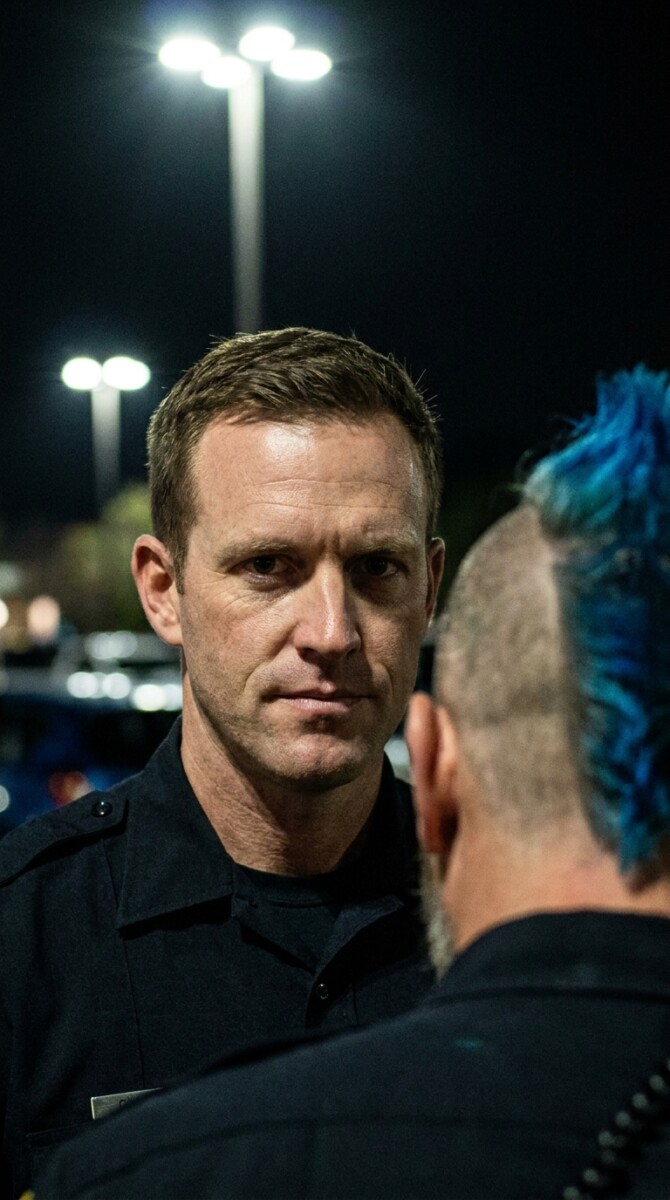
The parking lot was almost empty.
The fluorescent lights mounted on the concrete poles illuminated the asphalt with a cold glow, leaving small reflections on the parked vehicles. At that hour of the night, only a few businesses remained open, and the noise from the main avenue reached them faintly from several blocks away.
In the middle of that space, four men partially surrounded a patrol car.
The one who appeared to be their leader had blue-dyed hair styled into a mohawk. He wore a black sleeveless shirt and smiled as if the entire situation were a joke.
Standing in front of them was a man wearing a navy-blue shirt.
His name was Daniel Reyes.
He was thirty-five years old, with short brown hair and an expression so calm that it seemed completely out of place.
“There are four of us, and you’re alone,” said the blue-haired man.
Daniel didn’t even change his posture.
“And that’s supposed to mean something?”
The others began laughing.
The leader took another step forward.
“What’s wrong, officer? Are you worried now?”
Daniel held his gaze.
“You four really think you intimidate me?”
The man’s smile faded slightly.
“You’re alone. Think carefully.”
Daniel breathed slowly.
“I already have.”
That answer triggered another round of laughter, but something had changed.
Not because Daniel had made a threat.
Quite the opposite.
He didn’t seem interested in proving anything.
And people who are used to intimidating others often become uncomfortable when they realize the other person refuses to play their game.
What None of Them Knew
Daniel wasn’t just any police officer.
He had served on the force for nine years.
Before that, he had attended a military academy and later specialized in crisis intervention and conflict de-escalation.
Throughout his career, he had faced situations far more complicated than an argument in a parking lot.
But that didn’t mean he wanted to physically confront four men.
Daniel understood something many people confused:
being prepared for conflict and wanting conflict are two completely different things.
His priority was to keep the situation from escalating.
The patrol car the four men were surrounding wasn’t even his usual vehicle.
Daniel had finished his shift and was helping a fellow officer named Samuel Ortiz, who had briefly gone into a nearby pharmacy to pick up some medication.
When Daniel returned to the parking lot, he found the young men leaning against the police car, taking pictures and lightly tapping the hood to attract attention.
Daniel approached them.
“Gentlemen, I need you to step away from the vehicle.”
He hadn’t insulted anyone.
He hadn’t raised his voice.
The blue-haired man responded:
“Hey, officer, are you leaving already?”
And that was how everything started.
The Leader Had a Name
His name was Bruno Castillo.
He was twenty-nine years old.
The other three were his friends: Marcos, Elías, and Joel.
They weren’t a dangerous gang.
Nor had they arrived at the parking lot intending to attack anyone.
They had just left a concert and were in a good mood.
Too good a mood.
Bruno was the kind of person who enjoyed performing for an audience.
The more people watching him, the stronger his need became to appear dominant.
His friends laughed.
That encouraged him.
Every comment led to another.
Every calm response from Daniel was interpreted as another opportunity to continue.
Until it stopped being funny.
Daniel looked at all four men.
Then he discreetly glanced toward the pharmacy.
Samuel still hadn’t come out.
“Last time,” Daniel said. “Step away from the patrol car and continue with your night.”
Bruno laughed.
“Or what?”
Daniel didn’t answer.
Bruno moved a little closer.
“That’s what I thought.”
One of his friends, Marcos, stopped smiling.
There was something about the officer’s behavior that made him uncomfortable.
Not fear.
Not anger.
Calmness.
A calmness that seemed far too professional.
“Bruno,” he said. “That’s enough.”
The leader turned around.
“What?”
“Let’s go.”
“Now you’re scared too?”
Marcos shook his head.
“No. We’ve just made enough noise already.”
Bruno felt challenged.
And that made things worse.
“Nobody’s leaving.”
Daniel intervened.
“Your friend is making a good decision.”
Bruno turned back toward him.
“Stay out of it.”
Daniel almost smiled.
“We’re standing in front of my patrol car.”
A Decision Made in Seconds
Tense situations can change very quickly.
Daniel knew the warning signs.
A tightening jaw.
Hands changing position.
Someone looking around.
Friends no longer laughing.
That was why he decided to change his strategy.
Instead of remaining directly squared up with Bruno, he took half a step backward.
It wasn’t surrender.
It was creating space.
“Bruno,” he said.
The man widened his eyes.
“How do you know my name?”
Daniel discreetly pointed toward his shirt.
Across the chest it read:
BRUNO’S GARAGE — STAFF.
His friends let out a small laugh.
Bruno looked down and appeared embarrassed.
For the first time, the tension eased slightly.
Daniel took advantage of the moment.
“Listen. I don’t want to arrest anyone. I don’t want to argue with you. I just want you to step away from the car.”
Bruno crossed his arms.
“Then say please.”
Daniel looked at him.
“Please.”
His friends went silent.
Bruno hadn’t expected that answer.
He had tried to turn the situation into a battle of pride.
Daniel refused.
“Happy now?” the officer asked.
Marcos stepped in again.
“Come on, Bruno.”
This time Elías nodded too.
“Yeah. Let’s go.”
Bruno looked at his friends.
The support he needed to keep going was disappearing.
But he still didn’t want to back down in front of the officer.
“I don’t like the way you’re talking to me.”
Daniel answered:
“You don’t have to like it.”
Bruno’s smile disappeared.
“You just have to decide whether you want to go home tonight without turning something stupid into a real problem.”
Silence.
That sentence finally had an effect.
Samuel Came Out of the Pharmacy
The pharmacy’s automatic doors opened.
Samuel Ortiz appeared carrying a small white bag.
He was another police officer.
When he saw the situation, he stopped.
He looked at Daniel.
Then at the four men.
“Everything okay?”
Daniel immediately answered:
“Yes.”
The word surprised even Bruno.
Daniel could have said:
“No.”
He could have requested backup.
He could have turned the scene into a formal intervention.
He didn’t.
Samuel understood the signal.
“Perfect.”
He walked toward the other side of the vehicle.
Bruno looked at both officers.
The statement he had made only moments earlier—“There are four of us, and you’re alone”—had suddenly lost all meaning.
But Daniel didn’t use that opportunity to mock him.
“Have a good night,” he said.
Marcos was the first to step away.
Then Elías.
Joel followed him.
Bruno remained alone in front of Daniel.
For several seconds, they stared at each other.
Finally, Bruno stepped back.
“This doesn’t mean you scared me.”
Daniel answered:
“I wasn’t trying to.”
That confused him even more.
Bruno turned around and followed his friends.
The situation was over.
No punches.
No arrests.
No scene anyone would regret the next morning.
Or so they thought.
The Video
What none of them had noticed was that a woman had recorded almost the entire interaction from inside her car.
She hadn’t captured the very beginning.
But she had recorded the part where Bruno tried to intimidate the officer.
She had also captured something that ended up attracting far more attention:
Daniel’s absolute calmness.
The woman posted a clip on social media.
The video began circulating.
The title read:
“Four men try to provoke a police officer, and he refuses to take the bait.”
Within hours, it had thousands of views.
By the next day, hundreds of thousands.
Some comments praised Daniel.
Others insulted Bruno.
Some people said the officer should have reacted more aggressively.
That was precisely what Daniel found troubling.
When his supervisor showed him the video, Daniel read the comments for several minutes.
“What do you think?” the captain asked.
Daniel put the phone down.
“Too many people wanted to see a fight.”
The captain smiled.
“The internet.”
“Yeah.”
“They’re calling you ‘the Ice Cop.’”
Daniel shook his head.
“Terrible name.”
The captain laughed.
But Daniel remained serious.
“The important thing wasn’t that I stayed calm.”
“Then what was it?”
“That all of us went home.”
Bruno Saw the Video Too
Bruno was working at the garage when one of his employees approached him with a phone.
“Is this you?”
Bruno looked.
His stomach tightened.
The recording showed exactly what he remembered.
But watching himself from the outside was different.
His smile.
His movements.
His friends standing behind him.
The way he kept moving closer.
And Daniel refusing to react.
Bruno started reading the comments.
Mistake.
Some were cruel.
Others mocked him.
One said:
“You can tell he was only brave because he had people behind him.”
Bruno closed the app.
He remained in a bad mood for the rest of the day.
That evening, his sister Natalia called him.
“I saw you.”
“Don’t start.”
“What were you doing?”
“Nothing.”
“Bruno.”
“We were joking.”
“It didn’t look like a joke.”
“Because the video is edited.”
Natalia remained silent.
Then she said:
“Mom saw it too.”
That hurt.
“What did she say?”
“Nothing.”
Bruno almost wished she had insulted him instead.
The Mother Who Asked One Question
The next day, he visited his mother.
She was cooking.
Bruno walked in prepared to defend himself.
“I know you saw the video.”
His mother continued chopping vegetables.
“Yes.”
“It didn’t happen the way it looks.”
“Okay.”
Bruno frowned.
“Okay?”
“Yes.”
She continued working.
“Then explain it to me.”
Bruno began.
He said they were joking.
That the officer had been cold toward them.
That nobody wanted to hurt him.
That the internet exaggerated everything.
His mother listened.
When he finished, she asked:
“What were you trying to accomplish?”
Bruno fell silent.
“What?”
“When you kept moving closer to him. What did you want him to do?”
“Nothing.”
“Then why did you keep going?”
Bruno didn’t have a convincing answer.
His mother put down the knife.
“Your father used to do that.”
Bruno looked up.
He didn’t like the comparison.
His father had been a hot-tempered man obsessed with proving his authority.
Throughout Bruno’s childhood, he had started arguments with neighbors, drivers, employees, and strangers over ridiculous things.
Bruno had always sworn he would never become like him.
“I’m not Dad.”
“I didn’t say you were.”
His mother looked at him.
“I said what you did looked a lot like him.”
Bruno lowered his gaze.
That sentence broke through all his defenses.
Daniel Received a Strange Invitation
A week later, the department organized a small community talk about conflict de-escalation.
The video had received so much attention that several organizations wanted to interview Daniel.
He turned down almost all of them.
He didn’t want to become a celebrity.
But he agreed to participate in a talk with young people.
The moderator asked him:
“Were you afraid that night?”
Daniel answered:
“Yes.”
The audience seemed surprised.
“Seriously?”
“Of course.”
“But in the video, you look completely calm.”
Daniel smiled.
“Looking calm and feeling nothing are two different things.”
He explained that four people confronting one person could always represent a risk.
“Then why didn’t you react sooner?”
“Because reacting doesn’t always mean acting physically.”
He paused.
“Sometimes reacting means controlling what you can control.”
“What could you control?”
“My voice. My distance. My hands. My decisions.”
The moderator asked:
“And what couldn’t you control?”
“That Bruno wanted to act tough.”
Some people laughed.
Daniel added:
“But I could avoid helping him turn it into something worse.”
Bruno Appeared
When the talk ended, Daniel was gathering some notes when he noticed someone waiting near the exit.
Blue hair.
Bruno.
Daniel stopped.
“Did you bring anyone with you?”
Bruno shook his head.
“No.”
“That’s already progress.”
Bruno gave a small smile.
“Very funny.”
A few awkward seconds passed.
“What do you need?”
Bruno put his hands in his pockets.
“To talk.”
Daniel waited.
“I came to apologize.”
It clearly wasn’t easy for him.
Daniel didn’t answer immediately.
Bruno continued.
“I’m not going to say I was drunk because I wasn’t. And I’m not going to say my friends made me do it.”
He took a breath.
“It was me.”
Daniel nodded.
“That means something.”
“I saw the video.”
“So did I.”
“I looked ridiculous.”
Daniel smiled slightly.
“I’m not going to argue with that.”
Bruno let out a nervous laugh.
Then he became serious.
“Why didn’t you arrest me?”
Daniel thought for a moment.
“Because I didn’t need to.”
“You could have.”
“Probably.”
“Then why didn’t you?”
“Because my goal was to end the situation, not to win.”
That answer stayed with Bruno.
The Word “Win”
“Isn’t that the same thing?” he asked.
Daniel shook his head.
“No.”
They sat down on a couple of chairs in the hallway.
“If I had arrested you and you walked away convinced that I had humiliated you, maybe legally I would have resolved the situation that night.”
Bruno listened.
“But if I could simply get you to leave, that was better for everyone.”
“Then you won.”
Daniel shook his head again.
“We keep using that word.”
Bruno smiled.
“Fine.”
“There doesn’t always have to be a winner.”
Bruno thought about his life.
His arguments.
His relationships.
All the times he had insisted on having the last word.
Maybe that was exactly his problem.
He always needed to feel that someone else had lost before he could believe that he had won.
An Unexpected Proposal
Daniel learned that Bruno owned a garage.
“Do you work with young people?”
Bruno frowned.
“How do you know?”
“Your shirt.”
They both laughed.
Bruno’s garage employed four apprentices.
Two were eighteen.
One was nineteen.
Daniel asked:
“Would they like to visit the department’s technical training center?”
“What for?”
“We have a basic mechanics program for official vehicles.”
Bruno looked surprised.
“After everything that happened, you’re inviting me?”
“Not you.”
Daniel smiled.
“Your apprentices.”
Bruno shook his head.
“That was cold.”
“They say I’m the Ice Cop.”
Bruno started laughing.
It was the first time they could joke about what had happened.
The Garage
A month later, Daniel showed up at Bruno’s Garage.
This time, he was off duty.
Bruno was underneath a truck.
“Don’t tell me you’re here to arrest me.”
“I need brakes.”
Bruno slid out from under the truck.
“That’s less exciting.”
Daniel handed him the keys.
While they inspected the vehicle, they started talking.
Bruno explained that he had opened the garage five years earlier.
He hadn’t had much money.
He had started with borrowed tools.
“So you know what it means to start from the bottom,” Daniel said.
Bruno nodded.
“That’s why thinking about how I acted bothers me even more.”
“Why?”
“Because I hate it when someone treats my guys like they’re useless.”
Daniel looked at him.
“And that night, you did something similar to me.”
Bruno sighed.
“Yeah.”
“People are good at recognizing injustice when they’re the ones receiving it.”
“And bad at recognizing it when we’re the ones causing it.”
Daniel smiled.
“Exactly.”
Marcos Had Something to Say
One of the friends who had been there that night showed up.
It was Marcos.
When he saw Daniel, he became uncomfortable.
“Hi.”
“Hi.”
Bruno explained that Daniel was having his car repaired.
Marcos looked at the officer.
“I wanted to leave.”
Daniel nodded.
“I remember.”
Bruno looked at him.
“Do you want a medal now?”
Marcos laughed.
“I’m just saying.”
Then he became serious.
“I should’ve left.”
“Why?”
“Because if I had left, Elías and Joel probably would have left too.”
Bruno stopped joking.
It was true.
The friends had also kept the situation alive by staying there and laughing.
Marcos continued:
“We were all waiting for someone else to be the first person to say enough.”
Daniel answered:
“That happens a lot.”
“How do you stop it?”
“By being the first person.”
Simple.
But difficult.
Six Months Later
The video stopped trending.
The internet found other stories.
Daniel returned to his normal work.
Bruno continued running the garage.
But something had changed.
When he went out with his friends, Bruno stopped looking for arguments.
At first, they teased him.
“What happened to the tough guy?”
Bruno answered:
“He retired.”
He also began working more seriously with his apprentices.
One of them, Mateo, had trouble controlling his temper.
A customer made a rude comment, and Mateo wanted to respond.
Bruno stopped him.
“Leave it.”
“He disrespected me.”
“Yeah.”
“And?”
Bruno thought about the parking lot.
“You don’t have to accept every invitation to make a fool of yourself.”
Mateo looked at him.
“Who taught you that?”
Bruno smiled.
“An incredibly boring police officer.”
Two Years Later
Daniel received recognition from the department for his community work.
Not because of the video.
Because of a program he had helped develop alongside several local businesses.
One of them was Bruno’s Garage.
The program provided mechanical training to young people who had dropped out of school.
Bruno was sitting in the audience.
When Daniel walked onto the stage, he saw him.
He discreetly raised an eyebrow.
Bruno smiled.
After the ceremony, they met.
“Look who became important,” Bruno said.
Daniel answered:
“I still drive the same patrol car.”
“How disappointing.”
They shook hands.
Two years had passed since that night.
It felt like much longer.
A Question Bruno Still Had
They walked out into the parking lot.
Curiously enough, another parking lot.
Bruno leaned against his car.
“I’ve always wanted to ask you something.”
“Go ahead.”
“What would you have done if I had kept moving toward you?”
Daniel remained silent for several seconds.
“Whatever was necessary to stop the situation.”
“That doesn’t answer the question.”
“It’s the only answer you need.”
Bruno smiled.
“I knew you’d say something like that.”
Daniel looked toward the vehicles.
“You know what’s interesting?”
“What?”
“You still think the interesting part of that night was what might have happened physically.”
Bruno frowned.
“Wasn’t it?”
“No.”
Daniel turned toward him.
“The interesting thing was that it didn’t happen.”
Bruno fell silent.
He had never thought about it that way.
The Full Video
Years later, Daniel was invited to a police academy to speak with new officers.
He showed them the parking lot video.
The students watched.
One of them commented:
“I would’ve arrested the leader immediately.”
Daniel asked:
“Why?”
“He was threatening you.”
“Yes.”
“So you had grounds.”
Daniel nodded.
“Probably.”
“Then why didn’t you?”
Daniel paused the video at the moment Bruno was standing directly in front of him.
“Because having the authority to do something doesn’t mean it’s always the best option.”
The students listened.
“My goal that night was for nobody to end up hurt, arrested, or with one stupid decision affecting years of their life.”
He played the ending.
Bruno walking away.
Daniel getting into the patrol car.
“This is what I wanted.”
One of the students asked:
“Didn’t you feel like it looked as though you were letting him win?”
Daniel smiled.
That word again.
“Who won?”
The student didn’t know how to answer.
Daniel pointed toward the screen.
“Everyone went home.”
The Final Lesson
Bruno eventually began using the story with his own apprentices.
He didn’t hide the fact that he had been the man with the blue hair.
Some of them didn’t believe him.
“That’s you?”
“Yes.”
“You look like an idiot.”
“Thanks.”
They laughed.
Then Bruno would say:
“But look at the other man.”
They watched Daniel.
“What is he doing?”
“Nothing.”
“Exactly.”
Bruno paused the video.
“For years, I thought being strong meant making the other person back down.”
He walked in front of the young men.
“That officer taught me something without hitting me, without humiliating me, and without needing to prove to me who was stronger.”
One of them would ask:
“What?”
Bruno answered:
“That if you constantly need to prove that nobody can intimidate you, you’re probably already living intimidated.”
That always created silence.
Because it was true.
What Really Happened That Night
On the internet, the video seemed to tell a simple story.
Four men.
One police officer alone.
A confrontation.
A possible fight.
But those thirty seconds never showed everything.
They didn’t show Bruno’s mother reminding him of his father.
They didn’t show the apology.
They didn’t show the visit to the garage.
They didn’t show the youth program.
They didn’t show Bruno teaching others to avoid exactly the same mistake he had made.
And above all, they didn’t show Daniel’s most important decision.
The decision not to turn a provocation into a battle of pride.
That was the real reason the night ended well.
Because Daniel had training.
He had authority.
He had backup.
And yet he chose to use something far more difficult to master first:
self-control.
It took Bruno years to fully understand it.
But eventually, he did.
One night, after closing the garage, he found the old video on his phone again.
He saw himself with blue hair.
The arrogant smile.
His friends behind him.
The words:
“There are four of us, and you’re alone.”
Then he heard Daniel’s calm response.
Bruno smiled.
He put the phone away.
He looked around the garage he had built, at the spaces where his apprentices would return the next morning, and thought about how much he had changed since that night.
Then he understood something.
He had arrived at the parking lot believing that strength meant having more people behind you.
Daniel had been alone, yet somehow he had seemed more secure than all of them combined.
Not because he was more dangerous.
But because he had nothing to prove.
And perhaps that was the most uncomfortable—and most useful—lesson Bruno had ever learned:
the person who truly controls a situation isn’t always the one who shouts the loudest, makes the biggest threats, or gets the last word.
Sometimes, it’s simply the first person who decides not to lose control.