The music continued playing for a few seconds, but no one was really listening anymore.
Under the warm lights stretching across the patio, almost every guest had turned their attention toward the entrance.
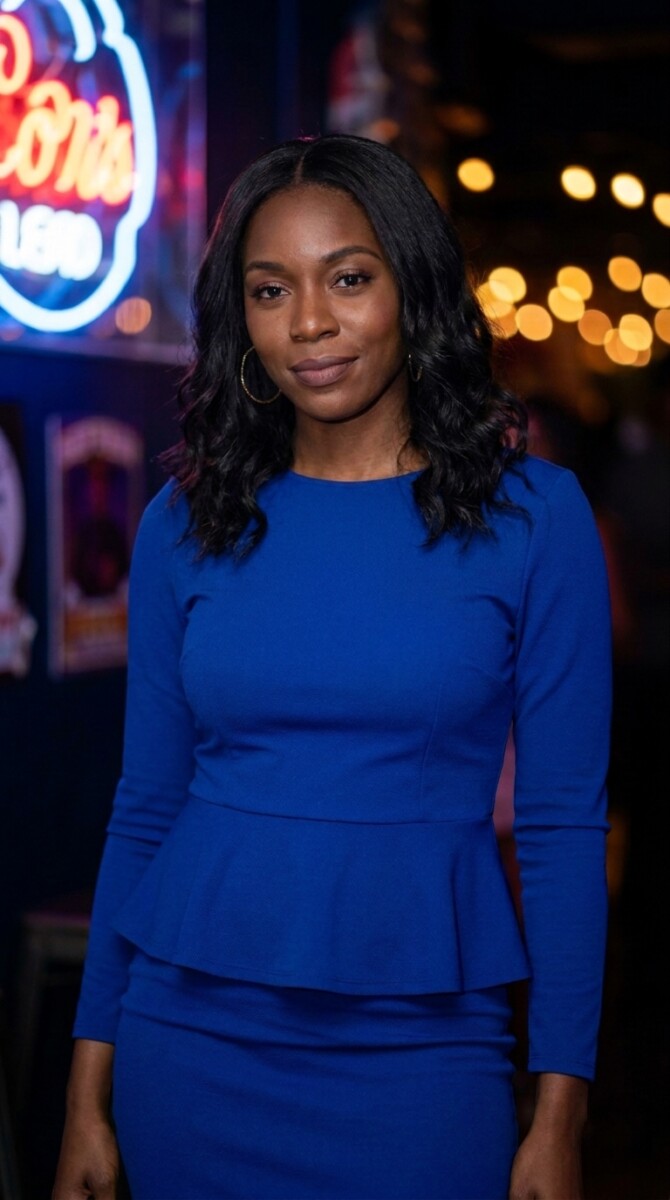
There stood Amara Lewis, a twenty-eight-year-old woman wearing an elegant royal-blue outfit, holding her burgundy handbag with both hands. Her posture remained upright, although the expression on her face had changed.
First, there had been surprise.
Then disbelief.
And finally, deep disappointment.
The security guard blocking her way had just spoken to her in a clearly discriminatory manner, making it obvious that he believed a Black woman like her was not welcome there.
Before Amara could respond, a blonde guest named Veronica Hale approached while laughing.
“Look at how she’s dressed,” she said mockingly. “This party is for important people.”
Amara tightened her grip on her handbag.
She did not answer.
Not because she had nothing to say.
But because she had learned many years ago that some people deliberately provoke others in hopes of getting a reaction they can later use against them.
Veronica kept talking.
Some guests lowered their eyes.
Others looked uncomfortable.
A few smiled nervously.
That was perhaps what hurt the most.
It was not only that two people were behaving that way.
It was that so many witnesses chose to remain silent.
Then a man’s voice came from behind the crowd.
“What is going on here?”
The conversations stopped.
A man in a navy-blue suit walked quickly toward the entrance.
It was Jonathan Mercer, the host of the party and owner of the residence.
Veronica immediately changed her expression.
“Jonathan, it’s nothing.”
He ignored her.
He looked at Amara.
Then at the guard.
“Why is she outside?”
The guard adopted a more formal posture.
“Mr. Mercer, I thought—”
“I didn’t ask what you thought. I asked why she is outside.”
The man hesitated.
Veronica stepped in.
“Jonathan, honestly, I don’t know why you’re making such a big deal out of this. We simply thought she might have come to the wrong event.”
Jonathan looked at her.
“‘We’?”
He said the word slowly.
Veronica began to realize something was wrong.
“Well… yes.”
Jonathan looked at Amara again.
She did not look angry.
She looked tired.
That affected him even more.
“Amara,” he said, “I’m sorry.”
Veronica stopped smiling.
“You know her?”
Jonathan slowly turned toward her.
“Yes.”
Then he looked at everyone gathered around them.
“And all of you should know her too.”
The Woman No One Recognized
Amara was not a celebrity.
She did not constantly appear in magazines.
She did not have millions of followers.
Nor was she interested in building a public image.
But within the business and philanthropic world, she was fairly well known.
Five years earlier, she had founded an organization called Open Horizon, dedicated to funding educational programs, college scholarships, and small businesses in underserved communities.
The organization had started with only twelve students.
Now it supported more than three thousand young people across several states.
But that night, Amara was not there to show off any of her accomplishments.
She was a special guest.
And not only that.
Her foundation was considering making one of the largest contributions of the evening.
Jonathan had organized the party to raise funds for the construction of a technology training center.
Amara had agreed to attend personally because she wanted to meet the people who would be managing the project.
The guard who had decided to prevent her from entering knew none of that.
Neither did Veronica.
And that was precisely the problem.
Jonathan looked at the guard again.
“Did you check the guest list?”
The man swallowed.
“No, sir.”
“Then why did you stop her?”
Silence.
“Did she ask to come in?”
“Yes.”
“Did she give you her name?”
“We didn’t get that far—”
Jonathan raised one hand.
“Enough.”
He took a deep breath.
His face was filled with indignation, but he did not want to turn the situation into another humiliating spectacle.
“I want to speak with you and the head of security inside in a few minutes.”
The guard nodded.
“Yes, sir.”
Veronica tried to intervene again.
“Jonathan, I think you’re overreacting.”
He looked at her.
“No.”
“I was only joking.”
“No.”
“I didn’t even say anything that serious.”
Amara spoke for the first time.
“Yes, you did.”
Her voice was not loud.
It did not need to be.
Veronica fell silent.
Amara continued.
“But the most interesting part isn’t what you said afterward.”
She looked toward the guard.
“It’s what happened first.”
Jonathan frowned.
“What did he say?”
Amara breathed slowly.
“He made it clear that I wasn’t welcome because I’m a Black woman.”
Jonathan’s expression completely changed.
Several nearby guests reacted with obvious discomfort.
The guard tried to speak.
“Sir, I—”
Jonathan raised his hand again.
“No.”
He looked directly at the supervisor who had just approached after noticing the conflict.
“Remove him from the entrance until we review exactly what happened.”
The supervisor nodded.
“Yes, sir.”
The guard walked away without arguing.
But Jonathan was not finished.
He turned toward Veronica.
“And you’re coming with me.”
Her eyes widened.
“What?”
“I want to speak with you privately.”
“Are you throwing me out?”
“Not yet.”
Jonathan looked at Amara.
“First, I need to ask her what she wants to do.”
Amara shook her head.
“I don’t need to decide who stays at your party.”
“After what happened—”
“Exactly.”
Amara calmly interrupted him.
“I don’t want this to end with two people simply walking out the door and everyone else convincing themselves that the problem has been solved.”
Jonathan watched her.
That was exactly the opposite of what he had expected.
Amara’s Story
Amara had grown up in a working-class neighborhood in Baltimore.
Her mother, Denise, was a nurse.
Her father, Caleb, repaired elevators.
They never had much money.
But there was one thing inside their home that her parents considered sacred:
education.
When Amara was nine years old, her father would come home exhausted from work and still sit down with her to review mathematics.
Her mother worked double shifts, but she never allowed Amara to use that as an excuse for not completing an assignment.
“We may not be able to give you everything,” Denise used to tell her. “But we can try to give you the tools to build it yourself.”
Amara earned a scholarship.
She studied economics.
Then she worked in consulting for several years.
She earned good money.
She had a stable career.
But she began noticing something that troubled her.
Many intelligent young people never received the same opportunities simply because they could not afford certain educational programs or because they did not know the right people.
That was how Open Horizon was born.
At first, she used part of her own savings.
Then she found donors.
The project grew.
But Amara never forgot something she had experienced during her professional rise.
Entering certain spaces could be difficult even when you had every qualification required.
She had attended meetings where people assumed she was an assistant.
Conferences where people asked whether she worked in catering.
Hotels where staff members spoke more politely to people who arrived behind her.
Most of the time, there was no openly offensive sentence she could point to.
There were looks.
Tones of voice.
Assumptions.
Small gestures.
That was why what happened at the entrance that night had not surprised her as much as Veronica might have imagined.
What disappointed her was realizing that it was still happening.
Jonathan Had to Face Something Uncomfortable
When Amara finally entered the patio, Jonathan walked beside her.
“I want to cancel the party.”
Amara looked at him.
“Why?”
“After this, I can’t pretend we’re celebrating a social cause.”
“And what would canceling it solve?”
Jonathan did not answer.
“We clear the tables, send everyone home, and tomorrow everyone says you had a terrible night.”
“What do you suggest?”
Amara looked around.
There were approximately one hundred and fifty guests.
Chief executives.
Lawyers.
Doctors.
Business owners.
People who proudly claimed to support equal opportunities.
Many of them had witnessed what happened.
“Continue with the event.”
Jonathan frowned.
“Seriously?”
“Yes.”
“Amara…”
“But change the program.”
“How?”
She smiled slightly.
“Give me ten minutes.”
The Conversation with Veronica
Before going onstage, Amara asked to speak with Veronica.
The blonde woman was sitting in a small side room.
She was no longer laughing.
Her gold handbag rested on her lap, and she looked deeply uncomfortable.
Jonathan wanted to accompany Amara.
She shook her head.
“Let us talk.”
She went inside alone.
Veronica looked up.
“I suppose you’re going to tell me to leave.”
Amara sat across from her.
“Do you want to leave?”
The question caught Veronica off guard.
“I don’t know.”
“That isn’t what I asked.”
Veronica took a breath.
“No.”
Amara nodded.
“Then tell me something.”
“What?”
“Why did you say all those things?”
Veronica crossed her arms.
“I was joking.”
Amara remained silent.
The silence lasted so long that Veronica herself felt compelled to continue.
“All right. It was a bad joke.”
“It didn’t sound like a joke.”
“Then I was being unpleasant.”
“Why?”
Veronica began to get irritated.
“What do you want me to say?”
“The truth.”
There was a pause.
“I thought you didn’t belong here.”
“Because of my clothes?”
Veronica did not answer.
Amara tilted her head slightly.
“My clothes probably cost less than yours, yes. Was that it?”
Silence.
“Because of my handbag?”
Nothing.
“Or because you saw a Black woman at the entrance to an exclusive event and immediately decided there was something strange about her being there?”
Veronica lowered her eyes.
She did not need to answer.
“There it is,” Amara said.
Veronica took a deep breath.
“I don’t consider myself racist.”
“Most people who do discriminatory things don’t wake up in the morning telling themselves that they are.”
The sentence was not aggressive.
That made it harder to dismiss.
“So what do you want from me?”
“Nothing.”
Veronica looked up.
“Nothing?”
“I don’t need an apology to feel better about myself.”
Amara stood.
“But maybe you need to think about why it was so easy for you to treat a stranger that way.”
She walked toward the door.
Veronica asked:
“Are you going to expose me in front of everyone?”
Amara stopped.
“I’m not going to say your name.”
“Why?”
“Because I want to talk about the problem.”
She looked back.
“Not turn you into entertainment.”
And she left.
The Speech No One Expected
Jonathan stepped onto the stage.
The guests were still tense.
The music had stopped.
“Before we continue,” he said, “I want your attention.”
He looked toward Amara.
“Tonight, we made a serious mistake at the entrance.”
There were murmurs.
“A guest was treated in a discriminatory manner.”
Jonathan paused.
“I’m not going to soften it.”
Several people placed their glasses down on the tables.
“The organization of this event is my responsibility. So is the staff working here. That is why I want to apologize publicly.”
Then he invited Amara onto the stage.
She walked forward.
She had prepared nothing.
She took the microphone.
“Good evening.”
Absolute silence.
“About twenty minutes ago, someone decided that I did not belong here.”
She looked around.
“What’s interesting is that tomorrow, when this story is told, some people will probably say, ‘How embarrassing. They didn’t know who she was.’”
Amara shook her head.
“But that would be the wrong lesson.”
Several people watched her closely.
“It wasn’t wrong to treat me that way because I happen to run a foundation.”
She paused.
“It would have been wrong even if I ran nothing.”
Applause began.
Amara continued.
“It would have been just as wrong if I were a housekeeper. If I were unemployed. If I had arrived by bus. If my dress cost twenty dollars.”
More applause.
“A person’s value does not increase when we discover their résumé.”
Jonathan lowered his gaze, clearly emotional.
Amara discreetly pointed toward the event banner.
“Tonight, we are here to raise money to create opportunities.”
She smiled with slight irony.
“Maybe we should begin by asking ourselves who we consider worthy of walking through the door.”
The Announcement That Changed the Party
After the speech, Amara did something unexpected.
Her foundation had been considering contributing one million dollars to the new technology center.
She confirmed the donation.
But she added one condition.
“I want the center to do more than offer scholarships.”
Jonathan asked:
“What do you propose?”
“An employment-access program.”
“For whom?”
“For young people who normally wouldn’t even make it to the interview.”
The project would include training.
Mentorship.
Paid internships.
And mandatory training for partner organizations on fair hiring practices.
Jonathan agreed immediately.
Several business leaders present also offered to participate.
The atmosphere began to change.
What had happened at the entrance was still uncomfortable.
But it no longer dominated the evening.
It had become part of a much larger conversation.
The Guard
Two days later, Jonathan reviewed the security footage.
The evidence was clear.
The guard, Michael Turner, had used discriminatory judgment when preventing Amara from entering.
Jonathan considered firing him immediately.
Amara asked for something first.
“I want to know who he is.”
Jonathan looked at her in surprise.
“Why?”
“Because firing him may be appropriate, but first I want to understand whether this was part of a pattern.”
They reviewed his employment history.
There had been no previous disciplinary actions.
He had worked in security for six years.
His evaluations were good.
But interviews with coworkers revealed that he occasionally made stereotypical comments.
Nothing as direct as what had happened that night.
Jonathan called him in.
Michael entered probably already knowing what was about to happen.
“Sit down.”
The man obeyed.
Amara was there.
Michael avoided looking at her.
“I want to apologize.”
Amara responded:
“Why?”
The question confused him.
“For what I said.”
“I already know that. Why did you say it?”
Michael remained silent.
“I don’t have a good answer.”
“Then think.”
Several seconds passed.
“I made an assumption.”
“Based on what?”
Michael lowered his head.
“On how I saw you.”
“Be more specific.”
His discomfort was obvious.
“Your race.”
It was the first time he had admitted it.
Amara nodded.
“Good.”
Michael looked up, surprised.
“Good?”
“That doesn’t mean what you did was good.”
She paused.
“It means you’ve finally stopped hiding it behind excuses.”
Jonathan finally spoke.
“Michael, you’re being removed from our events.”
The man nodded.
“I understand.”
“The security company will determine your employment status.”
Jonathan continued:
“But I’ve asked them to offer you a training program before any possible reassignment.”
Michael looked at Amara.
“You asked for that?”
“Yes.”
“After what I did?”
“Yes.”
“Why?”
Amara answered:
“Because if all we ever do is remove every person who has prejudice, we never teach anyone to question it.”
Then she added:
“But being given another opportunity does not mean you have the right to waste it.”
Michael nodded.
Veronica Made a Decision Too
Three weeks later, Amara received an email.
It was from Veronica.
It was not long.
It said:
“You probably don’t want to hear from me. I just wanted to tell you that I’ve spent weeks thinking about our conversation. I realized that I’ve used the word ‘class’ for years to justify something that was actually prejudice. I don’t expect you to forgive me. I’m trying to change it.”
Amara read the message.
She did not respond immediately.
Eventually, she wrote:
“Changing it matters more than convincing me.”
Nothing else.
They did not become friends.
That was not necessary.
One Year Later
The Open Doors Center opened exactly eleven months after the party.
The name had been Jonathan’s idea.
Amara had laughed when he suggested it.
“A little obvious.”
“Exactly.”
The building had technology laboratories.
Classrooms.
Career counseling spaces.
Entrepreneurship rooms.
The first group consisted of one hundred and twenty young people.
During the opening ceremony, a nineteen-year-old girl named Tasha approached Amara.
“Can I ask you something?”
“Of course.”
“Is the story about the party true?”
Amara smiled.
“Depends on which version you heard.”
“That they wouldn’t let you in.”
“That part is true.”
“And then you bought the party?”
Amara started laughing.
“Definitely not.”
Tasha looked disappointed.
“The story was better that way.”
“Real stories usually have smaller budgets.”
They both laughed.
“Were you angry?”
Amara thought for a moment.
“Yes.”
“Very angry?”
“Extremely.”
“But you didn’t look angry in the video.”
“Because being angry doesn’t mean you have to lose control.”
Tasha nodded.
“And what did you do with the anger?”
Amara pointed toward the center.
“Some of it ended up here.”
Jonathan Learned Something Too
The incident deeply affected Jonathan.
For years, he had considered himself an open-minded person.
He had donated to social organizations.
He promoted diversity in hiring.
He organized charitable events.
However, that night he understood something uncomfortable.
While he was inside talking about inclusion, someone was being discriminated against at the very door of his home.
Having good principles was not enough.
Systems had to be examined.
From that point forward, all of his events included clear protocols.
Accessible guest lists.
Trained staff.
Complaint procedures.
And something simple:
No one could be rejected based solely on their appearance.
It sounded obvious.
Apparently, it was not.
The Second Party
Two years later, Jonathan organized another gala.
Amara was invited.
When she arrived, she saw a sign at the entrance.
This time, it did not simply say:
PRIVATE PARTY.
Underneath it was another sentence:
“All guests will be welcomed with the same respect.”
Amara smiled.
A young security guard approached.
“Good evening. Your name, please?”
“Amara Lewis.”
The man checked the list.
“Welcome, Ms. Lewis.”
She walked inside.
Nothing extraordinary happened.
And that was exactly what mattered.
Michael Returned
Near the beverage area, someone approached her.
It took Amara a second to recognize him.
It was Michael.
He was no longer wearing a security uniform.
He wore a gray suit.
“Ms. Lewis.”
“Michael.”
“I wasn’t expecting to see you.”
“I wasn’t expecting to see you here either.”
He smiled nervously.
“I now work coordinating training for the security company.”
That genuinely surprised her.
“Really?”
“After completing the training, they offered me a position helping with the new officers.”
“Training them about what?”
Michael smiled with some embarrassment.
“Among other things… about exactly the mistake I made with you.”
Amara remained silent.
“I tell the story.”
“I hope you change my name.”
“Always.”
They both smiled.
“Why did you decide to do it?”
Michael thought for a moment.
“Because for weeks, I was convinced that you had destroyed my career.”
“And then?”
“I realized that I had put my career at risk all by myself.”
Amara liked that sentence.
“That is taking responsibility.”
Michael nodded.
“It took me some time.”
“It takes most people time.”
The Photograph That Actually Mattered
At the end of the evening, Jonathan asked for a photograph.
Amara assumed it would be the typical formal picture with donors.
But when she reached the garden, she found something different.
Young people from the center were there.
Security staff.
Servers.
Organizers.
Donors.
Drivers.
Cleaning staff.
The entire team.
“What is this?” she asked.
Jonathan smiled.
“A picture of the important people.”
Amara burst out laughing.
Veronica was there too.
Several months earlier, she had begun volunteering with a professional mentorship program.
She and Amara greeted each other with a nod.
They did not need to pretend they had developed a friendship that did not exist.
There was respect.
That was enough.
The photographer raised the camera.
“Everyone move closer together.”
Michael accidentally ended up standing beside Amara.
“This is awkward,” he whispered.
She smiled.
“Only if you make a comment.”
Michael laughed.
The photographer took the picture.
What Amara Said Years Later
Over time, the story of that first party appeared in interviews.
The same question always came up.
“How did you feel when they discovered who you were?”
Amara immediately corrected them:
“I already knew who I was.”
The interviewer would usually smile.
“I mean when they discovered who you were.”
“That wasn’t the important part.”
“Then what was?”
Amara would answer:
“Discovering who they were when they thought I didn’t matter.”
That was the real story.
It was not a story about a rich or influential woman being mistaken for someone “inferior.”
Because telling it that way preserved exactly the same problem.
The lesson was never:
“Be careful who you humiliate because they might be powerful.”
It was:
“Do not humiliate anyone.”
Not because they might punish you.
Not because they might own the party.
Not because they might have more money than they appear to have.
But because none of those things determine how much respect a person deserves.
Ten Years Later
The Open Doors Center had grown into a nationwide network.
Thousands of young people had participated in its programs.
Amara continued leading Open Horizon.
One day, she visited the original center.
A young woman working at reception immediately recognized her.
“Ms. Lewis, we have your photograph here.”
She pointed toward a wall.
The picture showed the second gala.
Dozens of people stood together.
Amara looked at it.
“I remember that.”
The receptionist pointed toward a woman standing near the center of the photograph.
“That’s my sister.”
Amara looked at her in surprise.
“Really?”
“Yes. She was part of the first group.”
“How is she doing?”
“She’s a software engineer.”
Amara smiled.
“Then she’s doing better than I am.”
They both laughed.
When Amara left, she passed the main entrance.
Above the doors was a phrase that had been installed years earlier.
She did not know who had suggested it.
It read:
“Never decide who belongs before knowing who they are.”
Amara stopped.
She thought about that night.
The guard.
Veronica.
Jonathan.
The laughter.
The silence of the guests.
Her own anger.
Much had changed since then.
Not because everyone had magically become perfect people.
That never happened.
Changing real prejudice was more complicated.
It required acknowledging it.
Learning.
Making mistakes.
Correcting them.
And trying again.
Amara knew that one gala had not solved discrimination.
Neither had one center.
Nor one conversation.
But she also knew that major changes are often built through small decisions.
Someone decides to speak.
Someone decides to listen.
Someone decides to acknowledge a mistake.
Someone decides not to repeat it.
That night, some people had tried to decide who belonged at a party based on skin color and appearance.
Years later, Amara understood that the best response would never have been proving that she was “more important” than the people who rejected her.
The right response was proving that no one should need to be important in order to be treated with dignity.
And that was the real reason she never forgot that door.
Not because they had tried to close it on her.
But because everything that happened afterward helped open many others.