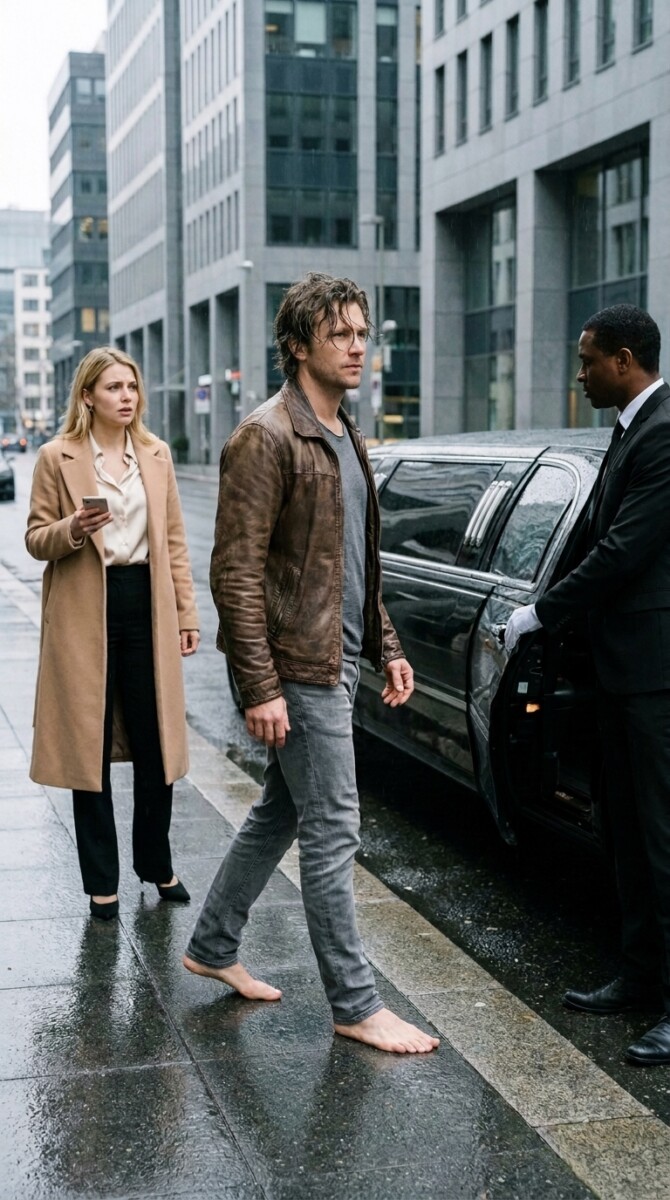
The rain continued to fall steadily, fine and almost elegant, over the gray sidewalk of the corporate district.
The limousine door remained open.
The driver waited silently, motionless, with the discipline of someone who had witnessed too many unexpected scenes to be easily surprised. In front of the vehicle, the blonde businesswoman remained frozen, her phone in one hand and her luxury handbag in the other, trying to process what had just happened.
The man she had looked down on only seconds earlier was not just some random stranger.
Nor was he a homeless man asking for help.
He was clearly someone important.
Very important.
And he had just looked at her with a calmness that was far more uncomfortable than any shout could have been.
“I know the truth now,” he had said.
Nothing more.
No insults.
No threats.
No explanations.
Just that sentence.
Then he moved as if he were about to get into the limousine.
“Wait,” she finally blurted out, taking a step forward.
He stopped, but did not immediately turn around.
The woman swallowed hard.
His confidence, that almost cold composure, was destroying in seconds all the superiority with which she had spoken to him before.
When he finally turned his face toward her, his expression remained just as restrained.
“I didn’t mean to offend you,” she said quickly.
The lie sounded so weak that even she seemed ashamed as soon as she heard herself say it.
He raised one eyebrow slightly.
“Of course you meant to.”
The woman lowered her eyes for a second. Then she tried to regain her composure.
“I… I didn’t know who you were.”
Then he spoke a sentence even more uncomfortable than the previous one.
“That is exactly the problem.”
The rain drummed a little harder against the roof of the limousine.
The businesswoman felt her face grow warm despite the cold.
For several seconds she wanted to insist, ask for another chance, explain that she had been having a bad day, that she had acted impulsively, that she was not usually like that.
But part of her knew that every one of those explanations would sound empty.
Because what had happened had not been an accident.
It had been a reflex.
A very revealing one.
He got into the vehicle without adding another word.
The door closed.
The limousine pulled away smoothly down the wet street, leaving the woman alone beneath the drizzle, those words echoing relentlessly inside her head.
“I know the truth now.”
And for the first time in a very long time, Valeria Montes did not feel powerful.
She felt exposed.
The Man Who Seemed to Have Nothing
The barefoot man’s name was Adrián Salvatierra.
He was thirty-four years old and appeared in very few magazines, although his name could be found on the boards of directors of several companies, investment funds, and major business ventures. He was neither a flashy tycoon nor a familiar face at luxury events. In fact, he avoided that world whenever he could.
Yes, he had inherited a significant portion of a business group from his grandfather.
But what distinguished him was not the inheritance.
It was what he did with it afterward.
While other young people from his social circle rushed to display cars, watches, and properties, Adrián developed a habit that made many people around him uncomfortable:
He watched how people behaved when they believed no one important was watching them.
It was not a game.
It was not some theatrical test.
It was a conviction.
His mother had repeated a simple idea to him for years:
“A person’s true manners are revealed most clearly by how they treat someone who can give them nothing in return.”
That sentence had stayed with him since childhood.
Perhaps that was why, as an adult, he avoided exaggerated introductions and distrusted people who were easily impressed by symbols of status. He was not especially interested in what people said when they knew who he was.
He cared about what they did when they believed he was nobody.
That afternoon, Adrián had not been there by coincidence.
And that was precisely what made everything much more delicate.
The Reason He Asked Her for “A Moment”
Valeria Montes was not simply another executive.
She was the Director of Strategy at Montes & Alder Capital, a rapidly expanding investment firm that was about to finalize a multimillion-dollar agreement with Adrián’s main corporate group.
For the previous two months, legal and financial teams had been negotiating a possible alliance.
On paper, everything looked perfect:
Growth.
International expansion.
Synergies.
Technological development.
New markets.
Too perfect.
And that was exactly what had begun to bother Adrián.
In the reports, Valeria was described as brilliant, ambitious, flawless, exceptionally well prepared, and one of the most trusted figures in the holding company led by her uncle, Eduardo Montes.
She had risen quickly.
Too quickly, according to some.
And although her results were undeniable, Adrián wanted to understand something far more important than her credentials:
What kind of person was she really?
Not because he had any romantic interest in her, as some people might have imagined after seeing them together on the street.
No.
His concern was far more serious.
Several voices within both companies had suggested that Valeria could become the public face of the new phase of the partnership.
Perhaps a direct partner.
Perhaps president of the new joint division.
Perhaps someone with enormous influence over sensitive decisions.
Adrián did not make those kinds of decisions based solely on résumés and polished presentations.
That was why he was there.
That was why he had approached her dressed carelessly, barefoot, soaked by the rain, and looking like an ordinary man.
Not to humiliate her.
Not to trick her in some cheap way.
Simply to observe an authentic reaction.
And he had already gotten one.
The Shame That Followed Her to the Office
Valeria arrived at the building still shaken.
She crossed the marble lobby quickly, barely greeted the reception staff, and entered the private elevator.
Her reflection in the metallic wall looked different.
Her hair was still perfect.
Her coat was still immaculate.
Her handbag was still the same.
But something in her expression had changed.
She looked nervous.
She could not remember the last time such a brief interaction had unsettled her so deeply.
When she entered her office, she closed the door harder than usual and placed her handbag on the desk.
She turned on her screen and opened her corporate email.
Hundreds of messages.
Meetings.
Forecasts.
Memorandums.
She tried to concentrate.
She couldn’t.
The scene kept returning again and again.
The man crouched on the wet sidewalk.
The way he had looked at her.
Her own cruel words.
The limousine.
The driver.
The open door.
And then that sentence.
She dropped into her chair and pressed her fingers against her temples.
A few minutes later, someone knocked.
“Come in,” she said.
Her assistant, Nora, entered. A woman in her thirties with a calm temperament and impeccable efficiency.
“Your uncle wants to see you in fifteen minutes in the north conference room.”
Valeria nodded.
Nora took half a step toward the door, then stopped.
“Is everything okay?”
Valeria hesitated.
“Yes. Why?”
Nora paused briefly.
“You look… different.”
Valeria forced a smile.
“I’m fine.”
Nora left without pressing the issue.
Valeria watched the door close.
And for the first time, she wondered something uncomfortable:
How many times had she spoken to other people in that same distant tone without ever noticing the effect it had on them?
The Meeting That Made Everything Worse
The north conference room was full.
Eduardo Montes sat at the head of the table. Lawyers, financial advisers, and two members of the executive committee sat around him.
On the large screen appeared the name of the partnership project involving Adrián’s group.
Valeria took her seat, trying to appear normal.
Eduardo started immediately.
“We have confirmation that Adrián Salvatierra wants to personally review the final structure before giving his approval.”
Valeria felt something twist inside her.
“When?” she asked.
“Tomorrow morning.”
One of the lawyers spoke.
“It will be a critical meeting. If everything goes well, the deal is practically secured.”
Eduardo looked at his niece.
“Valeria, I want you to lead the strategic presentation.”
“Of course.”
She tried to sound confident.
Eduardo continued.
“You need to impress him. He’s brilliant, but unpredictable. He doesn’t like empty speeches.”
Those words hit her like a personal warning.
He doesn’t like empty speeches.
Valeria swallowed.
For the rest of the meeting, she could barely concentrate.
Every mention of Adrián’s name made her tense.
She wanted to believe that what had happened on the street was irrelevant.
Just a strange episode.
Nothing more.
But she knew that was not true.
He had gone there to see her.
He had asked her for a moment.
And she had responded by measuring a person’s worth according to his appearance.
When the meeting ended, Eduardo stopped her.
“Stay for a second.”
Everyone else left.
He leaned slightly back in his chair and studied her.
“Is something wrong?”
“No.”
“You’re distracted.”
Valeria held her uncle’s gaze.
Eduardo was intelligent, elegant, politically precise, and extraordinarily skilled at detecting weaknesses in people.
“Does this have something to do with Salvatierra?” he asked.
Valeria felt her stomach tighten.
“Why would you ask that?”
Eduardo narrowed his eyes.
“Because you just reacted.”
She said nothing.
Eduardo rested his elbows on the table.
“Valeria, if there is something I need to know before tomorrow, I would rather hear it from you.”
She hesitated.
For years, she had told her uncle everything.
But something stopped her.
Perhaps pride.
Perhaps fear.
“Nothing happened,” she lied.
Eduardo continued looking at her for another second.
“I hope you’re right.”
What Valeria Did Not Want to Remember
That night, she could not sleep well.
She took off her coat, left her ankle boots beside the bed, and remained seated for a long time, staring at the city through the window of her apartment.
The lights of the buildings reflected against the glass as if the entire city were watching her.
Then came memories she usually refused to revisit.
Valeria had not been born rich.
That was a detail almost no one in her current social circle truly understood.
Yes, she belonged to the Montes family, but not to its most privileged branch.
Her father had been the less successful brother, an unstable man with poor financial judgment and little ability to keep businesses afloat.
Her mother died when Valeria was a teenager.
Her father accumulated debts and disappeared emotionally long before he disappeared physically.
It was Eduardo, her uncle, who rescued her from that quiet collapse.
He paid for her education.
Introduced her to the business world.
Taught her how to speak, dress, negotiate, and defend herself.
He gave her opportunities.
But he also passed on an obsession.
“Never allow yourself to look weak again,” he would tell her.
“Never let the world smell desperation on you.”
“Image matters.”
“People step on you if they think you’re beneath them.”
Valeria absorbed every one of those phrases.
Over time, she turned elegance, hardness, and control into armor.
It worked.
So well that eventually she could no longer tell where discipline ended and arrogance began.
Perhaps that was why the scene in the rain had shaken her so deeply.
Because she was not only ashamed of what she had said.
She was ashamed to realize that she had said it naturally.
Adrián Had Already Made a Decision
The following morning, before the meeting, Adrián arrived at the building dressed impeccably in a simple dark suit.
Nothing extravagant.
No trace of revenge on his face.
Two advisers and an attorney accompanied him.
When he entered the main conference room, everyone stood.
Valeria was already there.
Their eyes met for barely two seconds.
No smile.
No wink.
No mention of the street.
Just a formal greeting.
“Mr. Salvatierra.”
“Ms. Montes.”
She found his neutral tone almost more intimidating than open contempt.
If he had wanted to humiliate her, she probably could have handled that more easily.
But his cold courtesy made something worse very clear:
He had already classified her.
The presentation began.
Valeria discussed figures, expansion strategies, technological integrations, regional projections, and potential regulatory risks.
She did well.
Very well, in fact.
Her voice was clear.
Her analysis was solid.
Her answers were precise.
Adrián listened without interrupting much.
When they finished, he asked several intelligent questions.
Some were extremely difficult.
Valeria answered them.
The lawyers handled others.
The meeting progressed professionally.
But near the end, Adrián closed his folder and said:
“Before making a decision, I need to discuss something that does not appear in these documents.”
Silence took over the room.
Eduardo placed his hands on the table.
“What are you referring to?”
Adrián looked at Valeria.
Not cruelly.
Not with satisfaction.
Only with complete clarity.
“The culture of power surrounding this operation.”
Valeria immediately knew where he was going.
“Explain,” Eduardo said.
Adrián kept his eyes on Valeria.
“Yesterday I asked for a few minutes of informal conversation with one of the people who could ultimately occupy a central role in this partnership.”
No one spoke.
Valeria’s breathing became heavier.
Eduardo slowly turned toward her.
Adrián continued.
“I did not approach her as Adrián Salvatierra. I approached her as a stranger with no visible sign of status.”
The room remained motionless.
Then he added:
“And the response I received gave me very useful information.”
Eduardo was no longer looking at Adrián.
He was looking at his niece.
“Valeria,” he said dryly. “Would you like to say something?”
She felt pride and shame battling inside her chest.
She could try to defend herself.
She could say she had been manipulated.
She could minimize what happened.
She could deny the tone she had used.
But something inside her had grown tired of pretending.
She took a deep breath.
“I spoke to him with contempt.”
The admission fell across the table with the weight of shattered glass.
No one reacted immediately.
Valeria continued.
“I thought he was insignificant. I treated him badly. And I don’t have a good justification for it.”
Adrián watched her silently.
Eduardo closed his eyes for a second.
Then he spoke.
“Is that true?”
“Yes.”
The disappointment on her uncle’s face hurt more than any reprimand could have.
What Was Really at Stake
Everyone expected Adrián to cancel the partnership immediately.
It seemed like the most likely outcome.
Instead, he did something different.
“I want to be clear,” he said. “This is not about theatrical moralizing. I did not come here to play social experiments or pretend I have some kind of ethical superiority. I came to verify something important.”
He leaned slightly forward.
“Anyone who controls economic power also controls how people are treated. And I am not going to place assets, employees, and strategic decisions in the hands of someone who cannot treat people with dignity when she believes they are worth nothing.”
Valeria felt the severity of his words, but she could not argue with them.
Adrián continued.
“The numbers behind this partnership may be excellent. But if the underlying mentality is classist, humiliating, and hollow, sooner or later that contaminates everything else.”
No one in the room seemed willing to contradict him.
Eduardo finally spoke.
“I understand your position. Are you canceling the agreement?”
Adrián paused.
“Not necessarily.”
Several people looked up in surprise.
“The company has real value. So does the project. But the conditions are changing.”
Valeria raised her eyes.
Adrián opened another folder.
“The partnership will continue only if the leadership structure is modified.”
He looked at Eduardo.
“For the time being, Valeria will not become operational president of the joint project.”
The blow was clean.
He had not raised his voice.
There was no theatrical humiliation.
But the impact was enormous.
Adrián continued.
“Instead, I propose a period of evaluation, executive training, and direct work with areas related to social and human impact within both companies. If, after one year, she demonstrates not only technical ability but also sound human judgment, the decision can be reconsidered.”
Valeria remained still.
It was a punishment.
Yes.
But strangely, it was also something more.
It was an opportunity.
The Private Conversation
Hours later, the meeting ended.
The partnership was not terminated, but it had been redefined.
Eduardo left the room without speaking to his niece.
His disappointment was still visible.
Valeria stayed behind, slowly gathering her documents, more because she wanted to avoid everyone else than because there was any real need to organize them.
That was when Adrián returned.
They were alone.
She tensed.
“If you came back to finish the lesson, I think I’ve already understood enough,” she said.
He remained standing calmly.
“That’s not why I came.”
Valeria looked at him wearily.
“Then why?”
Adrián took barely a second to answer.
“Because I didn’t want you to misunderstand what happened today.”
She frowned.
“Confuse it with what?”
“Revenge.”
Valeria remained silent.
Adrián leaned slightly against the table.
“I could have destroyed you professionally today. It would have been easy. I had the perfect opportunity.”
She lowered her eyes.
She knew he was right.
“I didn’t do it because my goal was never to humiliate you.”
Valeria took a deep breath.
“Well, it hurt anyway.”
He nodded.
“I know.”
That honesty caught her off guard.
“Then what did you want?”
Adrián answered without embellishment.
“To know whether what I saw yesterday was a bad moment… or a way of being.”
Valeria slowly looked up.
“And what did you conclude?”
He held her gaze.
“That it was a way of being. But I don’t know whether it has to remain that way.”
That disarmed her in a completely different way.
It was not forgiveness.
It was not contempt.
It was somehow worse and better at the same time.
It was an honest assessment.
“I wasn’t expecting a second chance,” she admitted.
“I didn’t give it to you out of pity,” Adrián replied. “I gave it to you because admitting the truth in front of that entire table, when you could have lied, was already an important difference.”
Valeria felt a knot in her throat.
“I don’t know if that makes up for what I did.”
“It doesn’t.”
Again, the honesty.
“But it can be the beginning of something different.”
Eduardo’s Silence
The hardest part came that evening.
Eduardo called her into his office.
He did not shout.
He never shouted.
That made it worse.
“I prepared you for years,” he said.
Valeria did not answer.
“I gave you tools so no one could crush you.”
“I know.”
“Not so you could crush other people first.”
The words struck directly at the center of her defenses.
Valeria clenched her hands.
“I ruined everything.”
Eduardo shook his head.
“Not yet.”
She looked up, surprised.
“But you came close.”
He stood and walked toward the window.
“Your problem is not ambition. That has never concerned me. Your problem is that you started confusing dignity with distance, strength with coldness, and judgment with contempt.”
Valeria swallowed hard.
“I’m sorry.”
Eduardo turned around.
“It doesn’t do me much good for you to be sorry. I want to know what you’re going to do about it.”
The question hung between them.
And for the first time in a very long time, Valeria did not have an immediate answer.
The Most Uncomfortable Year of Her Life
The months that followed were profoundly different from anything Valeria had ever experienced.
The new structure of the project forced her to leave the strategic pedestal from which she had always operated.
She no longer spent all her time in glass-walled conference rooms working on high-level analyses.
Part of her job now involved supervising human operations:
Employee support.
Workplace environment.
Hiring processes.
Team development.
Community programs.
Internal relations.
At first, she experienced it as an elegant humiliation.
Then she began to observe.
To listen.
To learn.
She met employees who had spent years holding entire departments together without receiving meaningful recognition.
She spoke with receptionists, drivers, cleaning staff, administrative assistants, and maintenance technicians.
She discovered that many of the “small” problems senior executives ignored could ultimately damage the health of a company far more than several grand strategic decisions.
One morning, when she arrived at the building, she saw Nora—her assistant—helping a cleaning woman pick up several documents that had fallen from a maintenance cart.
Nora did it completely naturally, without feeling that helping somehow diminished her status.
Valeria watched the scene longer than necessary.
Years earlier, she would not even have noticed it.
Now she did.
Another day, during a visit to one of the company’s operational facilities, an older driver named Julián greeted her politely.
His uniform was worn, his hands were rough, and he spoke in a calm manner.
During lunch, he told her that he had worked for the company for fifteen years and that his greatest source of pride was seeing his daughter graduate from college thanks to the stability his job had provided.
The conversation moved Valeria for reasons she found difficult to explain.
Not because it was extraordinary.
Precisely because it wasn’t.
Valeria began to discover how much humanity she had overlooked during the years she had spent rushing to classify people according to appearance, position, and usefulness.
The Second Time It Rained
Almost a year later, rain returned to the corporate district.
Valeria was leaving the building without an umbrella, distracted as she reviewed a final report for the joint project.
She had stayed late.
She walked down the main steps and stopped beneath the entrance awning.
An older man, soaked by the rain, was trying to read an address from a crumpled piece of paper on the other side of the street.
Several executives walked past him without looking.
Valeria observed the scene.
For one brief instant, she saw a shadow of the person she used to be.
The old Valeria might have assumed that he was an inconvenience.
Someone who did not belong there.
Instead, she crossed the street.
“Excuse me. Do you need help?”
The man looked up with relief.
“I’m looking for this building, but I keep getting confused by the numbers.”
Valeria smiled gently, took the paper, and explained the correct route.
She even called security so that a guard could accompany him to the entrance he was looking for.
The man thanked her repeatedly.
She returned to the sidewalk feeling something strange.
Not pride.
Something closer to clarity.
At that exact moment, a black limousine stopped in front of the building.
Valeria recognized the vehicle before the door even opened.
Adrián stepped out.
He was carrying an umbrella, wearing a dark suit, and had the same calm expression.
He saw her.
And he also saw the older man walking away with the security guard.
Valeria smiled slightly, almost ironically.
“This time he wasn’t barefoot,” she said.
Adrián gave a faint smile.
“This time he didn’t need to be.”
They stood silently for a moment as the rain softly struck the pavement.
The Truth He Had Really Discovered
“I think I finally understand what you meant that day,” Valeria admitted.
Adrián looked at her.
“Which part?”
“That the problem wasn’t that I didn’t know who you were.”
She watched the drops falling from the edge of the building.
“The problem was who I was when I thought you were nobody.”
Adrián slowly nodded.
“Yes.”
They did not need to say much more.
Because the true continuation of that scene on the sidewalk had not been some dramatic punishment or public humiliation.
It had been something much more difficult:
The obligation to look at herself in the mirror without the makeup of success.
Valeria had once believed that the greatest embarrassment would be discovering that she had looked down on a powerful man.
But over time, she came to understand something far deeper:
The real shame was that she had been willing to look down on anyone who appeared to have no power.
Adrián did not need to say it again.
She already knew.
He had discovered the truth in the rain, yes.
But so had she.
And that truth changed much more than a business negotiation.
It changed the way she began walking through the world.
Because from that moment on, whenever someone asked her for a moment, Valeria no longer looked first at their clothes, shoes, handbag, or appearance.
She looked at their face.
She listened to their voice.
And she remembered a lesson that had arrived soaked by the rain, barefoot, and without warning:
True class is not found in a coat, a car, or an office.
It is found in how you treat someone who can give you nothing in return.
And that, in the end, was the only truth that truly mattered.