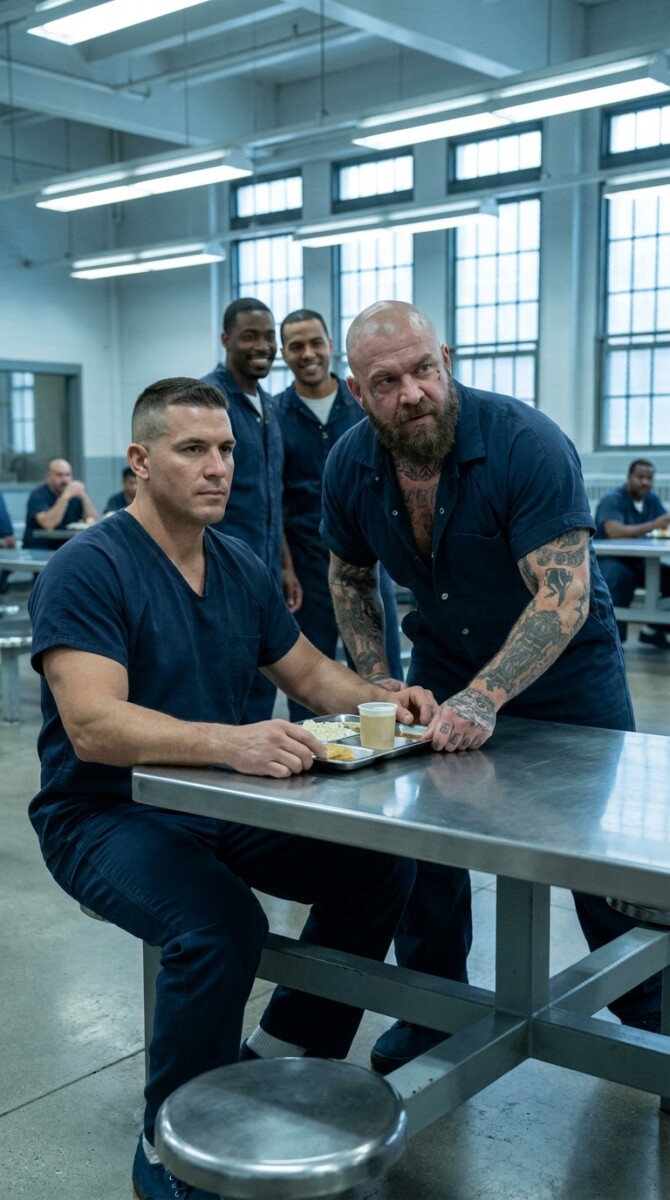
The punch did more than shake the steel table.
It shook the entire balance of the cafeteria.
For several seconds, the usual noise of trays, footsteps, and conversations disappeared as if someone had closed an invisible door over the entire room. The bald, tattooed inmate fell backward against a nearby table, causing two empty trays to collide and slide across the polished floor. Some prisoners stood up instinctively. Others remained completely still, their eyes fixed on the muscular man who, after reclaiming his food with a single icy stare, breathed steadily in front of the chaos he had just caused.
There was no smile on his face. No excitement. No childish gesture of victory.
Only determination.
The man’s name was Adrián Vega. He was thirty years old, with a physique that commanded respect even among men accustomed to toughness, and a way of looking at people that made one thing perfectly clear: he was not there to play along with the prison’s cheap hierarchies. He had arrived only a few days earlier at Blackridge Prison, a maximum-security facility where almost everything operated according to unwritten rules. There, food, space, silence, and even a simple chair could become symbols of power.
The other man, the bald, tattooed prisoner who was now trying to get back on his feet while rubbing his jaw, was known as Rojas. He had been in the prison for years. He had influence. Not because he was the smartest man there, but because he knew how to control others through fear, humiliation, and routine. He had made it his responsibility to show every newcomer that, inside that cafeteria, he decided the order of things.
Until that afternoon.
One of the guards shouted a sharp command.
—Back up! Everybody back up!
Two correctional officers rushed forward. One restrained Rojas before pride pushed him into attacking again. The other positioned himself between Adrián and the rest of the inmates. Yet the real confusion was not caused by the officers’ intervention, but by the collective reaction around them: no one knew exactly how the afternoon was supposed to continue after a man everyone considered dominant had just been knocked down in front of half the cellblock for stealing food from the wrong prisoner.
Adrián calmly bent down, picked up the tray that had been taken from him minutes earlier, and placed it back on the table.
That gesture, more than the punch itself, was what left an impression on everyone.
He had not run.
He had not started a fight for entertainment.
He had not tried to impress anyone.
He had simply taken back what belonged to him.
The officers escorted both men to the disciplinary area to question them separately. The walk there was silent. Adrián moved forward with his hands behind his back, offering no resistance, while thinking that in prison, one mistake could condemn a man to spend the rest of his sentence living on his knees.
He knew the punch would bring consequences.
What he did not yet know was whether those consequences would be worse than allowing people to walk over him from his very first day.
Inside an observation cell, with a concrete bench bolted to the wall and a harsh white light overhead, Adrián replayed the incident in his mind.
He was not impulsive by nature.
Before ending up in prison, he had spent years working as a warehouse assistant and occasionally coaching at a small neighborhood gym. His life had not been exemplary, but neither was he some kind of monster. He had committed a serious crime after a chain of bad decisions, dangerous friendships, and desperation that, as he himself admitted during his trial, had blinded him.
From the moment he entered prison, he had made one decision:
He would survive without turning into an animal.
But in Blackridge, surviving did not simply mean going to sleep and waking up the next morning.
It meant understanding that every gesture sent a message.
Giving up his food that day would not have meant losing a tray containing a hamburger, corn, and tasteless pasta.
It would have meant surrendering his place.
Two hours later, a prison lieutenant opened the gate and brought him into a narrow office where an old camera blinked from one corner.
They asked the usual questions: who had started the confrontation, why physical force had been used, and whether there had been any previous threats.
Adrián answered without drama.
—He took my food.
—And that justifies hitting him?
Adrián held the officer’s gaze.
—No. But letting him take it wasn’t going to solve anything either.
The lieutenant wrote something down.
He did not appear surprised.
In prisons like that one, official reports always said less than what had actually happened.
Rojas, on the other hand, lied.
He claimed Adrián had reacted uncontrollably, that everything had been a misunderstanding, and that he had only touched the tray by accident.
His story had one problem:
Too many witnesses.
And a reputation everyone already knew.
Even some of the prisoners who normally laughed at his jokes were beginning to look away when he spoke.
That same night, the punishment was decided: both men would spend seventy-two hours under restrictions, without recreational privileges and under observation.
It was not a severe punishment, but it was enough to send an institutional message:
The prison would not officially tolerate violence.
Still, everyone inside the cellblock understood that the real sentence was not written on paper.
The real consequences would come afterward.
When Adrián returned to his cell, his cellmate, a man in his fifties named Salcedo, looked up from the lower bunk.
—So you’re the new guy from the cafeteria —he said without irony.
Adrián did not answer immediately.
He sat on the upper bunk and rested his forearms on his knees.
—I guess so.
Salcedo gave him half a smile.
—Rojas has been waiting for someone to tell him no for months.
The words hung in the cell for several seconds.
Outside, they could hear keys, boots, sharp commands, and the constant hum of the ventilation system.
—Then why didn’t anybody do it? —Adrián asked.
Salcedo took his time before answering.
—Because not being afraid of a man is one thing. Being willing to deal with what happens afterward is something else entirely.
And he was right.
The next three days were filled with stares.
Stares in the hallway.
During headcount.
At breakfast distribution.
In the yard.
Some inmates watched Adrián with quiet respect.
Others watched him with curiosity.
Others were simply waiting for round two.
Prison survived on tensions like those, small stories that spread rapidly between closed walls and turned strangers into characters in the collective rumor mill.
Rojas did not approach him again immediately.
The punch had left a dark bruise beside his jaw, but the real injury was somewhere else:
He had lost authority.
His usual companions began displaying a more cautious kind of loyalty, as if they had suddenly remembered that fear works best when it appears unbeatable.
Once that illusion is broken, artificial respect begins to collapse.
Still, Adrián was not celebrating any victory.
The following week, while returning from the maintenance workshop, a young prisoner nicknamed Nico intercepted him near the laundry room.
—Hey —he said quietly—. Be careful tonight.
Adrián looked at him carefully.
—Why?
Nico swallowed.
—I heard two of Rojas’s guys talking. They want to provoke you in the yard. I don’t know if they just want to humiliate you or something more.
There was no drama in his warning.
Only genuine nervousness.
Adrián nodded.
—Thanks.
—Don’t mention me.
And he walked away.
That night, the yard felt more tense than usual.
Scattered groups.
Short conversations.
Too many watchful eyes.
Adrián stepped outside calmly and leaned near an interior fence.
It did not take long for two men associated with Rojas to appear: Mena, tall and bony, with the broken nose of a former street boxer, and Pardo, shorter and compact, wearing the expression of a dog that had not slept properly in days.
Mena approached first.
—People say you think you’re special.
Adrián refused to take the bait.
—People say a lot of things.
Pardo smirked.
—People who want to survive around here learn to watch their tone.
Adrián turned his head slightly and looked at both of them.
—I watched mine. The one who didn’t watch his was the guy who took my tray.
Around them, the noise in the yard dropped.
The situation could explode at any moment.
But just as Pardo took half a step forward, a deep voice stopped everything.
—Enough.
The man who spoke was Torres, a veteran inmate and former kitchen crew supervisor, respected by nearly everyone for one simple reason:
He rarely spoke.
And when he did, it was because something truly mattered.
He did not rule through fear.
He ruled through balance.
He approached slowly, without bodyguards or theatrics.
—There’s already been enough stupidity over a food tray —he said.— If you want to keep destroying the entire unit because of your pride, do it when the rest of us don’t have to pay for it.
Mena frowned.
—This doesn’t concern you, old man.
Torres looked at him the way one looks at a young man who does not understand the size of the problem.
—It concerns me because every time you people put on a circus, they close the yard, suspend visits, and punish everyone who had nothing to do with it.
That argument mattered.
In prison, interfering with visitation meant interfering with the last thread connecting many inmates to the outside world.
Pardo muttered something under his breath but stepped back.
Torres turned toward Adrián.
—You. If you really didn’t come here to play king, don’t give them more reasons to keep this going.
Adrián nodded.
—I didn’t come here for that.
Torres studied him for a moment and seemed to believe him.
From that day forward, the conflict stopped being merely a fight and became a quiet struggle over the moral direction of the cellblock.
Rojas still tried to maintain his influence, but no longer with the same confidence.
The men who had lowered their heads out of habit were beginning to question whether that habit still served them.
Interestingly, the first signs of change appeared in the cafeteria.
One ordinary afternoon, a newly arrived inmate left his bread on his tray while he went to get some water.
One of Rojas’s associates took it automatically, as if nothing had changed.
The newcomer stared at him nervously, unsure whether he should protest.
Before he could decide, another prisoner sitting two tables away spoke up.
—Leave it.
It was not Adrián.
It was not Torres.
It was simply an ordinary prisoner, one of those men who until then had never said anything.
The other inmate dropped the bread back onto the tray with irritation.
A guard barely noticed the exchange.
But the entire cafeteria did.
Things did not magically become better.
There were still tensions.
Shoving.
Insults.
Challenges delivered in low voices.
But something had changed.
Automatic abuse had lost its legitimacy.
Suddenly, many prisoners were beginning to understand that they did not have to normalize everyday humiliation.
Unable to accept his loss of control, Rojas became increasingly irritable.
He made mistakes.
He argued with officers.
He disobeyed simple instructions.
One morning, during a surprise inspection, several prohibited items were discovered in his bunk.
Someone —perhaps an enemy, perhaps a former ally who had grown tired of him— had apparently helped expose them.
He was temporarily transferred to another block while the matter was investigated.
The news spread quickly.
For many prisoners, it was merely another story from the week.
For Adrián, it marked the partial end of one threat.
But it was also proof of something more uncomfortable:
In prison, a power vacuum never stays empty for long.
Torres understood that.
That was why, one afternoon, he called Adrián over to a secluded table in the yard.
—Sit down.
Adrián did.
Torres slowly adjusted himself in his seat, as though every joint carried the weight of years spent behind bars.
—I’m going to tell you something you may not like —he began.— What you did in the cafeteria was understandable. Maybe even necessary. But if you think that makes you any different from Rojas, you’re wrong.
Adrián clasped his hands together.
—I don’t want his position.
—Good. Because that position rots people.
Torres nodded toward the inmates scattered around the yard.
—Most people in here live by two lies. The first is that the only way to survive is to dominate everyone else. The second is that allowing yourself to be crushed brings peace. Neither one works. The only way to last is knowing when to stand your ground… and when not to turn yourself into a spectacle.
Adrián remained silent.
It was not the kind of advice a man heard every day, especially not in a place like Blackridge.
—So what do I do? —he finally asked.
Torres rested his forearms on the table.
—Work. Stay firm. Don’t go looking for trouble. If someone tries to turn you into a symbol, don’t play along. And when you can help stop someone from being abused without pretending to be a hero… do it.
Adrián slowly nodded.
That was the beginning of a different phase.
Over the following weeks, Adrián began helping more often in the kitchen and supply area.
It was not a privilege.
The work was difficult, repetitive, and largely thankless.
But it offered one advantage:
It kept him busy and visible in a useful way rather than a theatrical one.
Several inmates, after realizing that he was not using the cafeteria fight to gather followers or intimidate people, began trusting him differently.
Nico, the young man who had warned him, occasionally came over to talk.
Salcedo continued offering brief but valuable observations.
Even some of the correctional officers seemed to watch Adrián with slightly less suspicion than before.
They certainly did not treat him like some model prisoner who had completely transformed his life.
But they did begin to see him as a man capable of making better choices.
One rainy afternoon, while dinner trays were being distributed, a minor incident revealed just how much had changed.
An elderly inmate nicknamed Don Emilio tripped and dropped his plate.
The food scattered across the floor.
A few prisoners laughed out of habit.
Others did not even look.
Don Emilio remained frozen, embarrassed, as though the real blow was not the loss of his meal but the humiliation of everyone seeing it happen.
Adrián set his own tray aside, picked up another available portion, and handed it to the older man without saying a word.
It was a simple gesture.
But several people saw it.
That night, Salcedo spoke from the lower bunk.
—Funny thing. Some men need to hit people to feel big. Others only need to refuse to become small.
Adrián stared at the dark ceiling of the cell.
—I just gave him something to eat.
—Exactly —Salcedo replied.— And in a place like this, that already says a lot.
Two months passed.
Rojas eventually returned to the unit, but he was no longer the same man he had been before.
He was still hard, temperamental, and proud, but the automatic arrogance had cracked.
One night, near the end of dinner, something almost unthinkable happened.
He approached the table where Adrián was finishing his meal.
Several prisoners immediately tensed.
Rojas stood there alone.
—I’m not here to fight —he said.
Adrián looked up without standing.
—Then talk.
Rojas tightened his jaw, as though each word cost him more than any punch ever could.
—That day… I went too far.
It was not an elegant apology.
There was no sudden redemption.
No dramatic music.
Only an awkward, rough, uncomfortable acknowledgment.
Adrián placed his fork on the tray.
—Yeah. You did.
Rojas nodded once.
—It won’t happen again.
Adrián watched him for two seconds that felt much longer.
—That’s better for you than it is for me.
Rojas let out a sharp breath, turned around, and walked away.
The prisoners nearby exchanged looks.
Some of them had expected more.
A challenge.
A public humiliation.
Something.
But nothing happened.
And that was precisely what made the moment powerful.
Not because two enemies suddenly became friends.
But because, for once, the story did not need to end in another chain of aggression.
As time passed, the fight over the food tray became one of those prison stories told to new arrivals in increasingly exaggerated versions.
Some claimed Adrián had knocked Rojas down with almost superhuman ease.
Others insisted that the entire cafeteria had erupted in applause.
The truth, as it usually is, was less spectacular and far more important.
The truth was that one man refused to accept an everyday humiliation.
And afterward, he chose not to turn that victory into a new form of abuse.
That changed things.
Not the entire system.
Not the harsh reality of incarceration.
Not the concrete walls, the bars, the cold rules, or the personal guilt every prisoner carried.
But it did change something inside the cellblock:
The belief that respect could only come from fear.
Adrián continued serving his sentence.
He did not become a saint or a legendary leader.
He had bad days, dark thoughts, and moments of exhaustion.
There was painful news from the outside world.
There were endless weeks.
There were difficult silences.
Still, from that afternoon in the cafeteria onward, he carried a new certainty with him:
Even in the most hostile place imaginable, a person can still decide what kind of man he wants to become.
And that decision carries weight.
More weight than a punch.
More weight than a reputation.
Even more weight than a tray of food.
Years later, when another generation of inmates occupied those stainless-steel tables and new conflicts threatened to repeat the old patterns, some prisoners still pointed toward the table where it had happened and quietly said:
—That’s where the atmosphere changed.
Not because the prison had suddenly become fair.
But because someone had shown that dignity, when it is neither surrendered nor used to crush someone else, can create a crack in even the hardest wall.
And in places like Blackridge, even a crack can mean a great deal.
Because through that crack, something almost everyone believed had been lost can enter:
The possibility that respect does not have to be taken by force.
It can be maintained through character.
That was, in reality, the true ending of the fight over the food.
Not the punch.
Not the fall.
Not the wounded pride.
But what came afterward:
The slow rebuilding of a different kind of order.
Fragile.
Imperfect.
But more human than the one that came before it.
An order in which fear no longer got the first seat at the table.