Chapter I: The Hammering Above the Frozen Blizzard
The snow showed no mercy on the slopes of the northern mountain range. In that valley wedged between gray stone ravines and inaccessible forests of ancient pine trees, winters were measured not in days or weeks, but by the depth of the ice that accumulated on the rooftops. The oldest villagers knew that when the clouds turned the color of molten lead and the wind came growling down from the highest peaks, the only sensible choice was to bolt the doors, stoke the fires, and wait for nature to finish unleashing its fury.
However, that year, the deathly silence of winter was interrupted by an unusual sound. A dry, metallic, rhythmic impact echoed through the dense white mist: the constant strike of an iron hammer against frozen wood.
Perched on a precarious handmade ladder built from birch logs, Carmen worked without rest. Her hands were covered by thick, worn leather gloves, her joints stiffened by the cold, and her complexion weathered by seventy years of mountain winds. She wore the same brown wool coat she had always worn, tied at the waist with a woolen cord, while her head was protected by a traditional scarf firmly knotted beneath her chin.
Every few minutes, the old woman pulled a thick, hand-carved pine stake from her canvas bag. She placed it against the beams of her cabin roof and, with three precise hammer blows, drove it deep into the structure, making sure the sharpened point projected upward at an angle toward the sky. The stakes formed a tight, threatening row along the entire roof, transforming the peaceful wooden dwelling into something resembling a fortress covered in spikes.
She had been working on it for months. From the end of autumn, when the first frosts painted the grass white, until the very heart of the blizzard, Carmen had never stopped carving and hammering wood.
Chapter II: The Villagers’ Distrust
The old woman’s persistence eventually caused alarm in the small village located half a kilometer farther down the valley. To the locals, Carmen’s cabin was a symbol of the valley’s history, but seeing a woman of her age perched several meters above the ground during a violent snowfall bordered on destructive recklessness.
One afternoon, when the sky threatened to darken earlier than usual, a group of men decided to climb the frozen trail and confront her. They were led by Julián, a broad-shouldered, strong-willed man regarded as the unofficial spokesman of the community. Several neighbors followed behind him, wrapped in thick coats and silently wrestling with their growing concern.
When they reached the edge of the property, marked by a low fence of logs half-buried beneath the snow, the men stopped. Up close, the scene looked even stranger: the cabin roof resembled the back of some legendary creature covered in spines.
“Carmen!” Julián shouted, raising one hand to shield his eyes from the ice crystals blowing through the air. “Stop this already! You’ve been hammering these things in for months!”
The old woman did not answer immediately. She delivered one final hammer blow, tested the firmness of the stake with the palm of her hand, and only then turned her head toward the fence.
“She’s going to end up destroying the roof structure before winter is over,” one of Julián’s companions muttered, crossing his arms. “Those holes are going to let water in when the thaw comes, assuming the weight of the snow collecting around those stakes doesn’t collapse the main beam first.”
Julián stepped forward, his boots sinking into the soft snow up to his shins.
“Don’t you understand that you’re ruining your own house?” the man insisted, trying to make his voice rise above the whistling wind. “Tell us what you’re doing. Who taught you to arrange the wood in such an absurd way?”
Carmen rested the hammer across her lap, breathed slowly as a dense cloud of vapor escaped her lips, and answered in a cold, sharp voice that chilled those present more deeply than the wind itself.
“My husband, Mateo.”
Chapter III: The Memory of Mateo and the Valley of the Past
Mateo’s name fell over the group with the weight of a stone dropped into a deep well.
Mateo had been a remarkable figure throughout the region. Dead for more than a decade, he had once been the finest tracker and lumberjack the northern trails had ever known. He knew mountain routes that appeared on no map, the ancient names of the streams, and the habits of the wildlife. He was a quiet man, respected but kept somewhat at a distance by the inhabitants of the modern village, because he belonged to the final generation that still remembered the old traditions of the high mountains.
“Mateo died years ago, Carmen,” Julián said, softening his tone slightly without hiding his frustration. “And Mateo would never have destroyed a roof this way. No carpenter in this valley, no matter how old-fashioned, would hammer spikes into a house like this.”
“Mateo knew things all of you chose to forget so you could sleep peacefully at night,” the old woman replied, turning back toward the roof to position the next piece.
“This is an old woman’s madness!” another villager shouted, a younger man beginning to lose patience because of the brutal cold. “We should climb up there and take the hammer away from her before she falls from the ladder and we end up dealing with a tragedy.”
Before anyone could take a step toward the ladder, an extraordinarily violent gust of wind swept down from the upper ravine. The force of the air made the surrounding pine trees creak with a deep groan and lifted an enormous curtain of snow from the ground, forcing all the men to cover their faces and step backward.
Chapter IV: The Discovery of the Rune
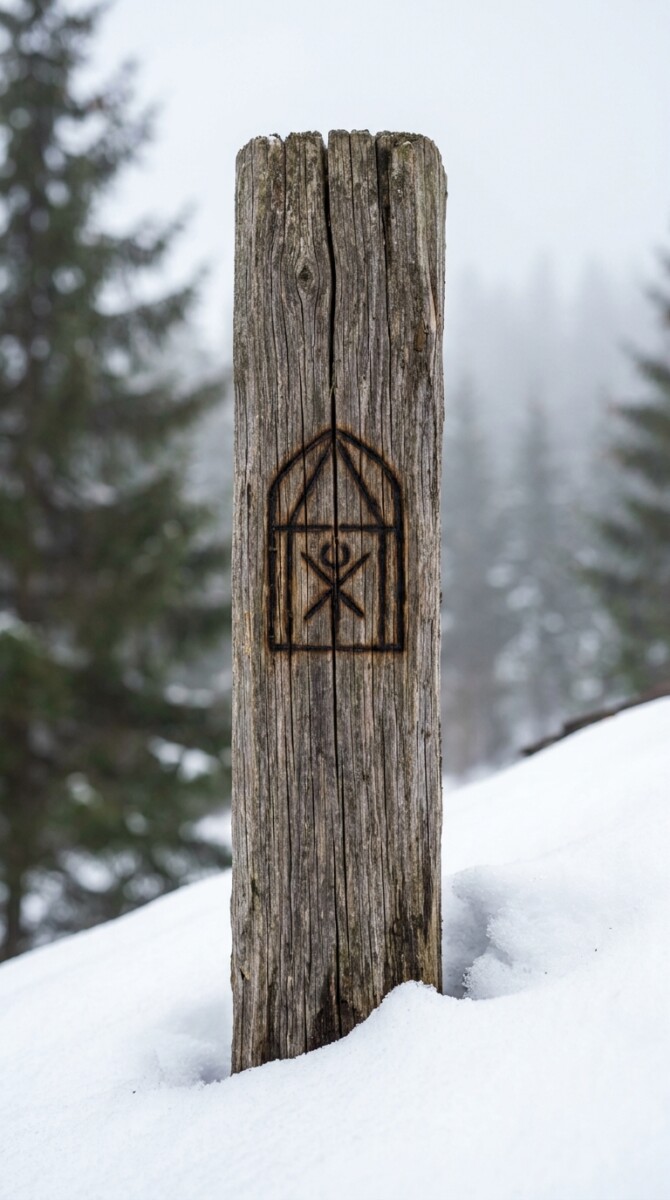
When the white wave of snow finally settled again, the landscape around the cabin had changed slightly. The blizzard had swept away the top layer of frost covering the edge of the property, exposing an old black-oak post that had remained half-buried near the fence.
One of the men in the group, an elderly farmer wearing a wool cap pulled down to his eyebrows and thick work gloves, noticed the newly exposed post. Something had been carved into the wood, darkened by time and weather.
The man in the cap slowly approached the post, knelt in the snow, and used his gloved hand to brush away the remaining ice covering its surface. When he removed the final layer of frost, he froze.
Deeply burned into the black oak was a complex and archaic symbol: a great protective arch surrounding perfectly interwoven geometric lines that guarded a central figure with its arms stretched outward and crossed at right angles.
          .---------------------.
         /                       \
        |         /-----\         |
        |        |   |   |        |
        |        | --+-- |        |
        |        |  /|\  |        |
        |        | / | \ |        |
        +-------------------------+
The man in the cap swallowed with difficulty. He rose unsteadily to his feet and took two steps backward without taking his eyes off the post.
“That symbol…” he whispered, his voice trembling.
“What now?” Julián asked, approaching the post impatiently. “It’s just an old territorial marker. Every old farm has carved boundary posts.”
“It isn’t a property marker,” the man in the cap interrupted, staring at Julián with wide eyes. “This seal disappeared from every map of the valley more than thirty years ago. We were told that the elders used it to mark hunting trails, but that wasn’t true.”
“What are you talking about?” Julián asked, suddenly affected by his companion’s tension.
“My grandfather told me a story when I was a child,” the farmer continued, pointing toward the carving with a trembling finger. “He said that during the Great Winter three decades ago, when the snow covered the rooftops and the village was cut off from the outside world for two months, strange things began coming down from the mountains. They weren’t wolves or bears. They were creatures of the mist that walked across the snow without leaving footprints and tried to enter the houses by climbing the walls.”
The men suddenly fell silent. The whispering wind now seemed like the echo of a thousand distant voices.
“My grandfather said that Mateo and the oldest hunters carved this same rune at the entrances to the mountain slopes to mark the sacred boundary,” the man added. “We were told the seal had been lost forever, that the threat had passed… but it hasn’t.”
Chapter V: The Truth Behind the Stakes
The farmer in the cap slowly raised his eyes from the post toward Carmen’s cabin. He studied the rows of sharpened wood, the angle of the spikes, and the density of the barrier the old woman had spent months constructing.
Suddenly, everything made sinister sense.
The stakes had not been placed there to support the snow, prevent collapses, or because of the delusions of a mind weakened by age. They formed an uninterrupted defensive perimeter over the only part of the house that could not be watched from the inside: the roof.
“This isn’t meant to repair the house,” the man in the cap whispered, his face turning deathly pale. “It’s meant to stop something from landing on top of it. Mateo didn’t teach Carmen how to protect the wood… he taught her how to survive what is coming.”
Julián looked at the post, then at the stakes, and finally at Carmen, who remained high on the ladder. The spokesman’s mocking, authoritative manner vanished completely, replaced by an icy sense of dread.
The old woman slowly climbed down the ladder. Her leather boots struck the hard snow with a dry crunch. She took a few seconds to adjust the belt around her coat, placed the heavy hammer into one of its large pockets, and walked toward the group of men standing motionless beside the property boundary.
The sun had begun disappearing behind the jagged peaks of the mountain range, staining the low clouds with a violent purple shadow. The temperature plunged within minutes, and the wind, which until then had blown furiously, suddenly stopped, plunging the valley into a thick and disturbing silence.
Chapter VI: The Final Warning
Carmen stopped two meters away from Julián. Despite her small frame, bent by age, she radiated an authority that no one in the village would have dared challenge at that moment.
“Mateo knew the cycle lasted thirty years,” the old woman said, looking each of the men directly in the eyes. “He did his part when he was young. It was my responsibility to prepare this house for the moment the sign appeared on the oak again.”
“Carmen…” Julián managed to say, his voice strained. “If what you’re saying is true, the village isn’t protected. The houses down below don’t have stakes on their roofs. Nobody has carved the runes along the boundaries.”
The old woman looked toward the mist beginning to gather among the pine forest, exactly where the trees became denser and darker.
“The cold isn’t the only thing that comes down from the summit when the storm erases the roads,” Carmen declared in an emotionless voice. “Don’t stand around here. Go back to your homes, lower the shutters, secure the door bolts, and no matter what happens, do not make the mistake of looking through the windows after nightfall.”
Without waiting for a response, Carmen turned around, walked steadily toward the entrance of her cabin, and crossed the threshold. Moments later, the heavy sound of an oak bar dropping into place echoed across the property.
The men were left alone in the growing darkness. From the depths of the mountains, where eternal snow ruled over the world, a long, high-pitched howl—one that had nothing to do with the wind—began to reverberate in the distance, announcing that night had finally arrived.