Prologue: The Architecture of Despair
San Lázaro State Penitentiary was not built to rehabilitate, but to forget. It was a monolith of reinforced concrete, rusted steel, and hopelessness, erected in the heart of an arid wasteland where the sun punished the earth with an almost personal cruelty. From the outside, it resembled a medieval fortress adapted to the twenty-first century; twelve-meter-high walls rose toward a perpetually clear sky, crowned by three overlapping rows of electrified barbed wire humming with lethal current. The four watchtowers, positioned at each cardinal point, housed elite marksmen whose high-precision rifles with telescopic sights were the only law hovering over the compound.
Inside, the prison was a closed and suffocating ecosystem, a city-state with its own rules, its own economy built on contraband and blood, and its own caste system. The oxygen in San Lázaro always seemed scarce, replaced by a perpetual miasma of stale sweat, chlorinated urine, dry dust, and the unmistakable metallic scent of fear and adrenaline. Here, time was not measured in hours or days, but in heartbeats, in the held breaths before a riot, in the tense silences that preceded a stabbing in the showers.
At three in the afternoon, during general recreation, the main yard became the amphitheater of this hell. It was a vast rectangle of cracked asphalt, where the fissures in the ground looked like the dried veins of a dead giant. The extreme heat created shimmering mirages above the surface, distorting the silhouettes of the more than eight hundred inmates wandering through it. In this hyperviolent ecosystem, weakness was a crime punishable by death, and absolute power was the only possible shield.
Chapter 1: The Leviathan of the Asphalt
For the past four years, the throne of San Lázaro had been occupied by one man: Aleksei Volkov, known to everyone simply as “The Russian,” although his accent had faded after decades spent in the local underworld. Volkov was not merely an inmate; he was a tectonic force, a leviathan of flesh, bone, and pure evil.
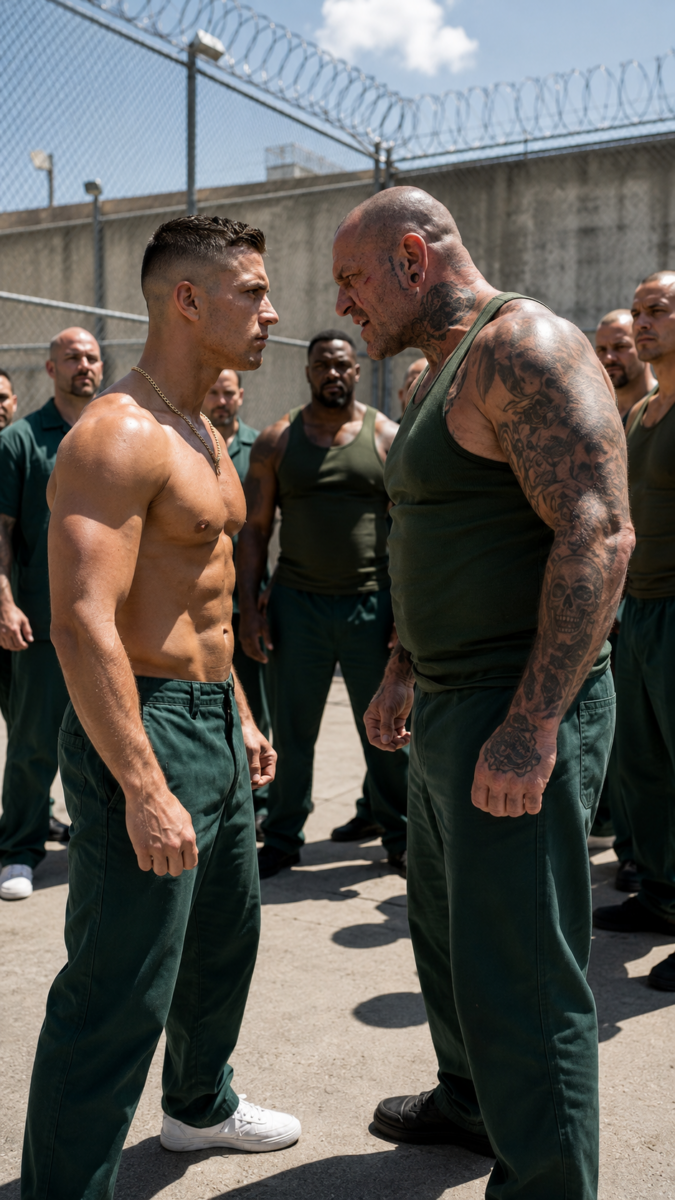
At forty-five years old, he stood one meter ninety-eight centimeters tall and weighed more than one hundred thirty kilos. His body was not that of a sculpted bodybuilder, but that of a cave bear: a layer of hardened fat covered dense, hypertrophied muscle forged by lifting concrete weights and breaking bones in underground fights. His completely shaved head revealed a thick, uneven skull, evidence of the countless bottles and metal bars that had smashed against him without managing to bring him down.
Volkov’s skin was a testament to his brutality. From his collarbones to his knuckles, it was covered in prison tattoos made with burned pen ink and rusty needles. Spiderwebs on his elbows marked years spent in solitary confinement, grinning skulls on his chest represented every man he had sent to the morgue, and Gothic letters on his neck spelled words incomprehensible to newcomers but capable of inspiring ancestral terror in veterans. His scarred face was framed by ears deformed from years of blows, their lobes stretched by thick black steel plugs.
Volkov did not need to shout to be heard; his mere presence seemed to change the atmospheric pressure of the yard. He ruled through paralyzing fear. He controlled the prison’s smuggling of narcotics, cell phones, and bladed weapons. If you wanted protection, you paid him a tithe. If you refused, his “dogs,” an entourage of five enormous thugs who served as his Praetorian Guard, made sure you regretted it while bleeding out in some blind corridor beyond the reach of security cameras. Volkov was untouchable, a demigod of ultraviolence crowned beneath the barbed wire.
Chapter 2: The Vengeful Ghost
That same afternoon, while the heat melted the soles of shoes against the asphalt, a deafening metallic screech interrupted the dense monotony of the yard. The heavy mechanical gates of the Intake Block slowly opened. It was the most vulnerable and intense moment of the day: the arrival of the “new guys.”
Among the herd of terrified, disoriented men hunched into themselves emerged a figure who completely defied the archetype of prey. His name in the prison records was Damián.
Unlike the other newly admitted inmates, who stared at the ground to avoid eye contact with the predators, Damián walked with a majestic, almost spectral straightness. He was not a giant like Volkov. He was twenty-six years old, stood one meter eighty, and had a lean build—but his slenderness was deceptive. Having removed the suffocating green uniform shirt because of the extreme heat, his bare torso was exposed for everyone to see, revealing a physique sculpted not by gym vanity, but by the Spartan rigor of extreme tactical conditioning.
Every muscle in his back, shoulders, and abdomen was tense, but not with the stiffness of fear. It carried the kinetic elasticity of a compressed spring. His body was a biological weapon honed to perfection, the result of years spent in covert operations units the government would never acknowledge. But Damián was not in San Lázaro on an official mission.
He was there for a personal vendetta.
His face was an unreadable mask of cold stone. His eyes, such a dark brown they appeared almost bottomless, scanned the yard not with the panic of a victim but with the precision of military radar identifying targets. He did not process faces; he processed threats, escape routes, attack angles, and blind spots.
But what truly made Damián the absolute center of attention for all eight hundred men in the yard, what stopped conversations mid-sentence and froze time itself, was the object resting against his bare chest.
Hanging from his neck, gleaming with suicidal insolence beneath the scorching sun, was a thick chain of solid 24-karat gold. Its heavy Cuban-style links flashed with a blinding golden brilliance. In a prison where men killed for an extra plate of rice or a painkiller, displaying jewelry of such unimaginable value was equivalent to covering yourself in blood and jumping into a pool full of great white sharks.
It was an insult to the scarcity of the place.
It was a signed death sentence.
What no one knew was that the chain was not an ornament of vanity. It was the final earthly connection to his younger brother, brutally murdered six months earlier by a cartel faction operating from inside San Lázaro under the protection and direct orders of Aleksei Volkov.
Damián had entered the prison with a single purpose: to destroy Volkov’s empire from its foundations.
And the chain was the pure-gold bait designed to lure out the beast.
Chapter 3: The Leviathan Approaches
The murmur of the yard abruptly ceased, as though someone had cut the main cable to the world’s speakers. Every eye turned toward the center of the asphalt.
From his privileged position near the basketball courts, Volkov stopped speaking mid-conversation. His small eyes, buried deep in sockets surrounded by scar tissue, caught the golden flash from eighty meters away. His thick neck cracked as he turned his head and fixed his predatory gaze on the newcomer.
A slow, grotesque smile completely devoid of human empathy spread across the giant’s face.
He had found the month’s entertainment.
“Look at that beauty, boys,” Volkov murmured, his voice deep as distant thunder, vibrating inside the chests of his bodyguards. “Fresh meat. And it comes wrapped in gold.”
His lieutenants, an assortment of tattooed men with toothless smiles, let out low, guttural laughs. They began cracking their knuckles and assuming intimidating postures. They knew exactly how the procedure worked.
The Russian would tear apart the newcomer’s pride, take the jewelry from him, melt it down or wear it as a trophy, and establish in front of the entire prison that even the air they breathed belonged to him.
Volkov pushed himself away from the wall and began walking toward the center of the yard. His steps were heavy and deliberate, the soles of his military boots echoing against the concrete. As he advanced, flanked by his personal guard, the sea of green-clad inmates opened before him with pathetic urgency.
Dangerous men—killers and thieves in their own right—shrank away and lowered their eyes to avoid provoking the Colossus.
The asphalt cleared completely, creating a corridor of silence connecting Volkov directly to Damián.
Despite seeing a mountain of lethal muscle and five thugs approaching, each ready to kill him with a single command, Damián’s heart rate did not change. His breathing remained deep, diaphragmatic, and controlled.
Four seconds inhaling.
Four seconds holding.
Four seconds exhaling.
He was in “The Zone.”
The heat disappeared.
The noise disappeared.
Only the mathematics of distance and time remained.
Damián stopped walking precisely at the geometric center of the yard. He did not seek the protection of a wall to prevent himself from being surrounded.
He planted himself in the open.
He spread his feet shoulder-width apart, distributing his weight evenly. His arms hung loosely beside his ribs, apparently relaxed, but his hands were slightly open, ready to become claws, blades, or hammers in a fraction of a second.
Chapter 4: The Diplomacy of Violence
Volkov stopped only twenty centimeters from Damián.
The proximity was obscene, invasive, deliberately designed to trigger instinctive panic in any normal human being. The giant blocked the sun, casting an enormous shadow over the younger man.
The stench of stale sweat, unfiltered tobacco, and dirty leather coming from Volkov struck Damián like a physical wall.
The Russian’s five thugs spread into a perfect semicircle behind Damián, sealing off every possible escape route and blocking the view of the guards in the towers, providing cover for what was about to happen.
Volkov looked down, his nostrils widening as he tried to smell fear on his prey.
But there was nothing.
Damián’s stare was a wall of black ice, reflecting the grotesque face of the criminal leader without blinking.
The giant slowly raised his enormous right hand, a block of hardened flesh with scars across every knuckle, and extended an index finger thicker than a child’s wrist. He pointed it directly at the center of Damián’s sternum, only millimeters from the gleaming gold.
“Nice chain, new guy,” Volkov growled.
His voice was not loud, but it carried a baritone resonance that vibrated through the heavy air. It was an order disguised as an observation.
“Take it off.”
The silence in the yard was absolute.
Eight hundred prisoners held their breath as they watched.
Everyone knew the script.
The newcomer was supposed to turn pale, stammer pathetic apologies, lower his head in absolute submission, undo the clasp with trembling hands, and surrender the gold like a servant handing over his lands to a conquering king.
But Damián did not move.
His chest rose and fell with infuriating slowness.
He tilted his head one degree to the right with an expression of clinical curiosity, like a scientist studying a particularly noisy but harmless specimen behind safety glass.
“What for?” Damián replied.
Two words.
Two simple words spoken in a clear, monotone voice completely devoid of emotion.
But within the context of San Lázaro, those two words carried the explosive force of a fragmentation grenade.
Surprise flashed briefly across Volkov’s bloodshot eyes, immediately replaced by uncontrolled homicidal rage.
No one.
Absolutely no one in four years had ever answered him with a question.
His thugs behind Damián exchanged confused glances, their muscles tightening as they waited for the order to tear the insolent newcomer apart.
Volkov’s face became congested, turning a purplish red. He clenched his jaw until his teeth ground together.
“So I can be the first to wear it, you piece of shit,” Volkov spat, saliva flying from his lips and landing on Damián’s bare shoulder, though Damián did not even blink. “Buy yourself another one. In here, if I like something, I take it.”
Volkov took a tiny step forward, shoving his barrel-like chest against Damián in an attempt to break his balance.
“And that gold chain… is already mine.”
Damián maintained eye contact.
Any trace of curiosity disappeared from his face, replaced by a death mask. His eyes became darker still.
“Then…” Damián murmured, lowering his voice to a lethal, raspy whisper only Volkov could clearly hear, “come and get it.”
Chapter 5: The Physics of Destruction
That was the point of no return.
Volkov’s overwhelming arrogance collided with an unbreakable wall of defiance, and the only possible response his primitive mind could produce was total annihilation.
Volkov roared, an animalistic, guttural sound that echoed off the concrete walls, and launched his attack.
It was a massive right hook, driven from the hip and loaded with the full weight of his one hundred thirty kilos.
A strike designed not merely to knock Damián unconscious, but to tear his head from his shoulders, shatter his jaw, and fracture his cervical vertebrae.
To the untrained eyes of the prisoners, Volkov’s fist became a lethal blur moving at terrifying speed for a man of his size.
For Damián, the world slowed into a sequence of sharp, calculable frames.
Combat telemetry activated:
Volkov’s right shoulder drops prematurely.
His planted left foot is too rigid, positioned at a forty-five-degree angle, limiting his ability to rotate quickly.
The hook’s arc is wide and telegraphed, completely exposing his centerline and center of gravity.
It is an attack based entirely on emotional fury, devoid of technical discipline.
Instead of retreating, instead of raising his arms into a useless guard that would have been shattered by brute force, Damián moved forward.
In a millisecond, he executed a pivoting slide step.
He lowered his center of gravity by slightly bending his knees and tilted his torso to the left, literally slipping beneath Volkov’s enormous arm.
The giant’s fist, carrying the force of a freight train, sliced through empty air only millimeters from Damián’s ear.
The momentum of the missed blow, combined with Volkov’s massive body weight, drove the criminal leader uncontrollably forward, completely destabilizing his stance.
In that instant of absolute vulnerability, the one-hundred-thirty-kilo giant was suspended in lethal imbalance, his lower and central torso completely exposed, with no ability to defend himself.
Damián did not waste that fraction of a second.
He did not attack the face, which was resistant and protected by bone.
He attacked the body’s autonomous systems.
With a fluid, explosive movement generated by perfect hip rotation, Damián drove his right arm upward in a rising palm strike, using the heel of his hand like a battering ram of solid bone.
The impact was surgical, landing precisely on Volkov’s solar plexus, directly in the small soft cavity beneath the xiphoid process of the sternum.
The sound of the impact was dry and deep, like a rubber mallet striking a water-filled drum.
The internal damage was catastrophic and instantaneous.
The kinetic force transferred directly into the celiac plexus, a dense network of sympathetic nerves. The impact caused a violent and massive spasm in Volkov’s diaphragm.
The giant’s lungs momentarily collapsed, expelling every molecule of oxygen from his body in an agonizing, rasping hiss.
His legs, thick as oak trunks, lost all neurological tension, temporarily disconnected by the shock to his central nervous system.
But Damián was not finished.
He knew a man that size could recover through sheer physical resilience if given even one second.
Before Volkov could begin falling from the lack of air, Damián chained the second movement of the combination together with astonishing fluidity.
He used his left arm to seize and violently pull the thick right arm Volkov had extended, using the giant’s own shirt as a grip.
At the same time, Damián delivered a low, sharp sweeping kick, driving his shin directly into the back of Volkov’s left leg, just behind the knee.
The joint, already compromised by the imbalance and the strike to the solar plexus, collapsed inward with a wet crack.
Chapter 6: The King Falls, Silence Reigns
Gravity did the rest.
Aleksei “The Russian” Volkov—the untouchable demigod, the absolute terror of San Lázaro—collapsed like a demolished building.
His one hundred thirty kilos slammed into the hard concrete asphalt with a dull crash that sent a small cloud of hot dust into the air.
Volkov fell heavily onto one knee and then onto his hands, his enormous head hanging low, unable to support himself.
His face had turned an alarming bluish-purple.
He gasped desperately, his eyes bulging with the animal panic of suffocation.
A strand of thick saliva hung from his trembling lips.
He tried to inhale, but his paralyzed diaphragm refused to obey.
He was the living image of powerlessness, shattered and humiliated upon his own concrete altar.
Damián, meanwhile, returned to his original stance with a smooth, elastic motion.
He stepped back half a pace, recovering his perfect center.
His hands returned to a relaxed position at his sides.
His bare chest rose and fell with the exact same calm, methodical rhythm it had maintained two minutes earlier.
Not a single additional bead of sweat appeared on his forehead.
The entire confrontation, from Volkov’s attempted punch to his complete collapse, had lasted exactly 2.4 seconds.
The silence that seized the main yard was not merely an absence of sound.
It was a physical vacuum.
A palpable disbelief that could almost be tasted in the hot air.
Eight hundred hardened criminals blinked, attempting to process visual information their brains refused to accept.
The giant—the monster who decided who lived and who died—was on his knees, choking and drooling before a young man who had not even closed his fists.
Volkov’s Praetorian Guard, the five thugs who had formed a semicircle behind Damián, stood frozen in paralyzing shock.
Their primitive minds, accustomed to functioning under the protection of their leader’s supposed invincibility, short-circuited.
It took them nearly three seconds to react.
When their pack instinct finally pulled them out of their stupor, their first impulse was to rush Damián and avenge the humiliation.
But Damián, without turning his head, moved only his dark pupils toward them, fixing them with a stare so lethal and devoid of humanity that they stopped dead in their tracks.
The thugs felt an unnatural cold run down their spines.
They realized that if they attacked this man, they would suffer the same fate within fractions of a second.
Then a metallic click from above shattered the spell.
From all four watchtowers, the guards had witnessed the kingpin’s downfall.
The sharp sound of assault-rifle bolts being cocked in unison could clearly be heard.
Red targeting lasers danced across the asphalt, crossing threateningly over the group.
One wrong move would unleash a storm of bullets.
The thugs changed their objective.
Instead of attacking Damián, they dropped to the ground beside Volkov.
“Boss! Breathe, Russian, breathe!” one of them shouted, grabbing Volkov by his enormous shoulders and trying to keep him upright as the giant coughed spasmodically and recovered fragments of oxygen through miserable grunts.
“Don’t move! Nobody move! The guards up there have us in their sights!” ordered the gang’s second-in-command, raising his hands toward the towers in surrender while his leader remained on his knees, coughing up blood and bile.
Volkov, his lungs burning and his ego reduced to ashes, managed to raise his bloodshot eyes toward Damián.
His voice, once thunderous, had become a broken, high-pitched wheeze.
“You… are dead…” Volkov stammered through bloodied teeth, humiliated before his empire. “I’m going to… rip your head off…”
Damián’s expression did not change.
He looked down at him with the cold superiority of an executioner observing the corpse of his prey.
He felt no need to throw an insult back at him or strike a victorious pose.
In that hell, words were the currency of the weak.
Actions dictated reality.
Slowly, Damián raised his right hand.
With deliberate calm that froze the blood of everyone watching, he brought his fingers to the center of his chest.
He gently grasped the thick solid-gold chain.
He adjusted it meticulously, making sure the thickest link rested perfectly centered over his sun-bronzed sternum.
Then he lowered his hand and looked once again at the fallen giant and the sea of prisoners staring at him with terror and reverent awe.
The sun continued scorching the concrete.
The rifles remained aimed from the towers.
And the walls of San Lázaro remained standing, relentless.
But the molecular structure of power within the yard had been irreversibly altered.
The reign of brute force and shouted terror had been decapitated.
In 2.4 seconds, silence, lethal technique, and cold calculation had crowned themselves upon the asphalt.
That day, a new king claimed his throne without firing a weapon and without uttering a single threat, beneath the relentless weight of a link of blood and gold that no one in that prison would ever dare covet again.