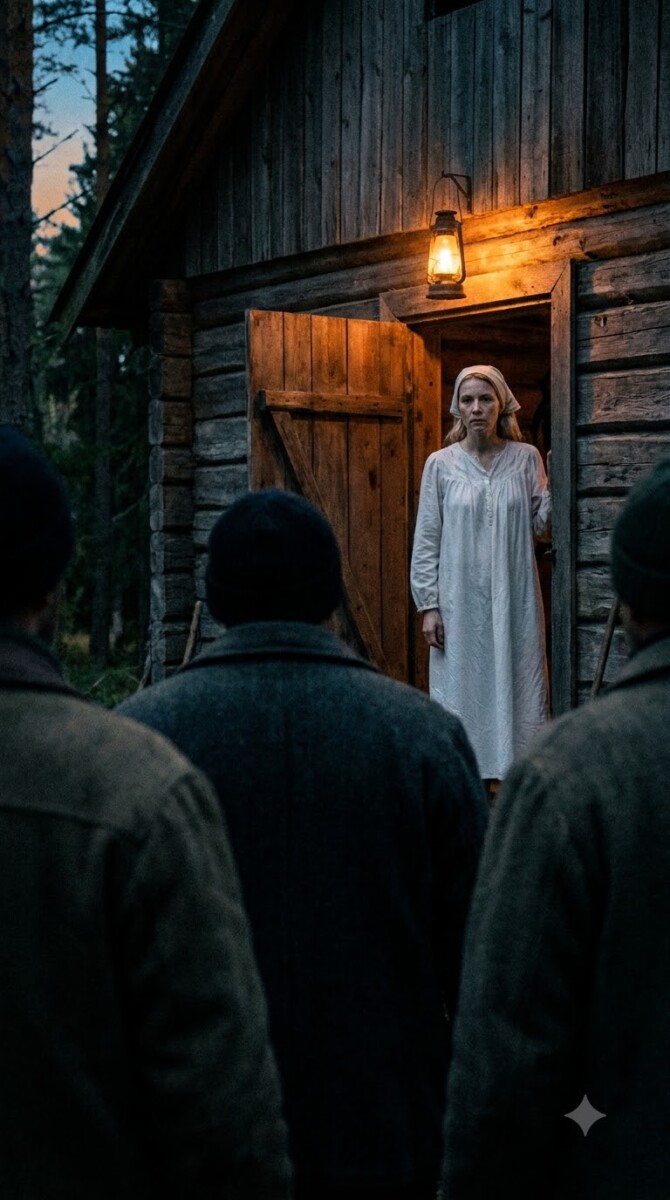
Elena Vargas had lived alone in that cabin for almost four years.
Not because she hated people.
Not because she wanted to disappear.
She had simply reached a point in her life when silence felt safer than company.
The cabin stood at the edge of a dense forest, almost forty minutes from the nearest town. It was an old wooden structure with a stone fireplace, two bedrooms, a small kitchen, and a porch overlooking a narrow road that disappeared between the trees.
During the day, the place felt peaceful.
At night, it was different.
Wind moved through the branches.
The old timber creaked.
Animals made sounds that could easily be mistaken for footsteps if a person had enough imagination.
Elena had learned to ignore all of it.
That was why, on that particular night, she immediately knew the sound outside did not belong to the forest.
Footsteps.
More than one person.
She sat up in bed.
She was wearing a long white nightgown and a headscarf loosely covering her hair.
She checked the clock.
1:17 a.m.
Three firm knocks struck the front door.
Elena remained still.
Then came three more.
Not desperate.
Not frantic.
Controlled.
That worried her more.
She moved quietly toward the side window.
From there, beneath the weak porch light, she saw three men.
The first was tall and broad, with tattoos visible along his neck.
The second had a thick beard and carried a large black duffel bag.
The third stood several steps behind them, constantly watching the road.
Elena opened the door only a few inches, leaving the chain attached.
“What do you want?”
The tattooed man raised both hands.
“We just need a roof for tonight.”
Elena frowned.
“Why here?”
He glanced back toward the dark road.
“Because no one else will open the door for us.”
That was not exactly comforting.
Her eyes shifted toward the bearded man.
Toward the bag.
It was large.
Too large to contain only clothes.
“What are you carrying in there?”
The bearded man answered calmly.
“Something that won’t be here tomorrow.”
Elena studied him.
All three seemed to expect the door to close.
Instead, she removed the chain.
“Come in.”
The leader looked surprised.
Elena opened the door.
“But that bag doesn’t leave my sight.”
For several seconds no one spoke.
Then the tattooed man gave a faint smile.
“Deal.”
They entered.
Elena closed the door.
And immediately understood that whatever had just entered her home was not simply three men looking for shelter.
The tattooed man introduced himself as Marco.
The bearded one was Esteban.
The quiet man was Lucas.
Elena did not ask for last names.
They did not ask for hers.
That arrangement seemed reasonable.
Marco looked around the room.
Stone fireplace.
Old bookshelves.
Two armchairs.
A wooden dining table.
Family photographs.
Nothing expensive.
“Nice place.”
“It works.”
Esteban placed the duffel bag beside the fireplace.
Elena immediately pointed toward the table.
“Not there.”
He looked at her.
“Why?”
“Because I said it stays where I can see it.”
Esteban moved it without arguing.
Lucas continued checking the windows.
Elena noticed.
“Are you expecting someone?”
Marco answered too quickly.
“No.”
She glanced toward Lucas.
“He seems to disagree.”
Lucas let the curtain fall.
“Habit.”
“What kind of habit?”
Marco stepped in.
“Ma’am, we appreciate you letting us stay. We don’t want to cause you trouble.”
Elena gave a small smile.
“People usually say that when they already brought trouble with them.”
Esteban almost laughed.
Marco did not.
“We’ll leave before sunrise.”
Elena pointed toward the kitchen.
“There’s coffee.”
“We don’t need anything.”
“I do.”
She walked away.
While preparing the coffee, Elena watched the men through the reflection in the dark kitchen window.
Marco leaned toward Esteban.
Whispered something.
Esteban shook his head.
Lucas checked the front door again.
The bag remained beside the table.
Elena placed four cups down.
“If you’re staying here, sit.”
Marco sat first.
The others followed.
Elena remained standing.
“Where did you come from?”
“The north.”
“That covers a lot of territory.”
“It’s enough information.”
“Then don’t ask why I live here.”
Marco smiled.
“I wasn’t planning to.”
Elena watched him carefully.
Despite his intimidating appearance, his hands were trembling slightly.
Not fear exactly.
Exhaustion.
Esteban had dried mud up to his knees.
Lucas’s right sleeve was torn.
None of them looked like men who had simply gotten lost.
Elena pointed toward the bag.
“Money?”
Silence.
“Documents?”
Nothing.
“Something dangerous?”
Marco looked up.
“We don’t want to hurt you.”
“That still isn’t an answer.”
Esteban finally said:
“It can’t hurt you.”
Elena narrowed her eyes.
“That eliminates very few possibilities.”
Then something moved inside the bag.
A soft thump.
Everyone froze.
Another sound followed.
Elena stared at Marco.
“Open it.”
“No.”
“Then leave.”
“We can’t.”
“You said you only wanted shelter.”
“We do.”
“Then open the bag.”
Marco watched her for several long seconds.
Finally, he sighed.
“Esteban.”
The bearded man crouched.
Slowly opened the zipper.
Elena stepped back.
She expected anything.
Money.
Weapons.
Electronics.
Something stolen.
She did not expect a dog.
A young German shepherd lifted its head from inside the bag.
A blanket covered most of its body.
One front leg was bandaged.
Elena blinked.
“A dog?”
The animal whimpered softly.
Esteban opened the bag completely.
“He’s hurt.”
Elena’s surprise became anger.
“You’re carrying an injured dog in there?”
“The bag is ventilated.”
“That does not make this a good idea.”
She knelt.
“Easy.”
The dog stopped moving.
He stared at her.
Then Elena noticed the collar.
Black leather.
A small metal tag.
She pushed aside the fur and read one word.
ARGO.
Her face changed immediately.
Marco saw it.
“What?”
Elena slowly stood.
“Where did you find this dog?”
The men exchanged looks.
Marco answered:
“On the road.”
“Where?”
“About twenty kilometers from here.”
Elena shook her head.
“You’re lying.”
Marco stood.
“How would you know?”
She touched the tag.
“Because I know this dog.”
Now they were the ones surprised.
Argo had belonged to Elena’s brother.
Andrés Vargas.
A man she had not seen in almost five years.
Andrés had worked as a private investigator.
Not the glamorous kind people saw in movies.
He handled fraud.
Missing people.
Corporate disputes.
Background investigations.
Cases people wanted solved quietly.
Elena never liked his work.
Too many secrets.
Too many dangerous clients.
Too many nights when Andrés called and refused to say where he was.
Five years earlier, they had a terrible argument.
Andrés had asked Elena to leave the country temporarily.
He claimed one of his investigations had become dangerous.
She accused him of paranoia.
He accused her of not taking him seriously.
She told him she was tired of rearranging her life around his fear.
He told her she would understand one day.
That was the last real conversation they had.
Three weeks later, Andrés disappeared.
His apartment had been emptied.
His phone stopped working.
His bank accounts went untouched.
Police found no evidence of violence.
Some investigators believed he had deliberately left.
Others suspected one of his cases had followed him home.
Elena never knew.
Argo disappeared with him.
Until tonight.
She looked at Marco.
“That dog belonged to my brother.”
Marco went still.
“What was your brother’s name?”
“Andrés Vargas.”
Lucas cursed quietly.
Elena immediately looked at him.
“You know that name.”
Lucas said nothing.
She stepped closer.
“You know my brother.”
Marco finally spoke.
“Yes.”
Elena felt something cold move through her chest.
“Where is he?”
Marco looked toward the dog.
“That’s why we’re here.”
Elena immediately locked the front door.
Not to trap them.
To make sure nobody else entered before she understood what was happening.
She pointed toward the table.
“Sit.”
Marco hesitated.
“Now.”
Something in her voice made all three obey.
Elena sat opposite them.
“Start talking.”
Marco looked toward Lucas.
Then Esteban.
Finally he said:
“We worked with Andrés.”
“Doing what?”
“Security.”
“That tells me nothing.”
Marco took a breath.
“Your brother was investigating a financial network.”
“What kind of network?”
“Companies moving money through fake construction contracts.”
Elena frowned.
“That sounds like one of his normal cases.”
“It stopped being normal when he found out the companies were connected to people who had access to law enforcement records.”
She stared.
“And?”
“And someone discovered he was investigating them.”
Elena’s hands tightened.
“Five years ago?”
“Yes.”
“Is that why he disappeared?”
Marco shook his head.
“No.”
Her heart accelerated.
“Then what happened?”
“He disappeared because he wanted them to think he was dead.”
Silence.
Elena stared at him.
“No.”
“It’s true.”
“My brother has been alive?”
“Yes.”
“For five years?”
“Yes.”
Her anger exploded.
She stood.
“He let me believe he was dead?”
Marco remained seated.
“He believed it protected you.”
Elena laughed bitterly.
“Everyone who lies claims it was protection.”
She turned away.
Five years.
Five birthdays.
Their mother’s memorial.
The sale of the family house.
Every moment she had wondered whether Andrés had suffered somewhere.
He had been alive.
Marco continued carefully.
“He wanted to contact you.”
“But?”
“He kept finding evidence that your name was being searched.”
“By who?”
“We don’t know exactly.”
“That answer is getting old.”
“I know.”
Elena turned back.
“Where is he now?”
Marco’s expression changed.
That was when she realized they had not come simply to deliver Argo.
Something had happened.
“Where is my brother?”
Marco looked toward the black bag.
Then toward her.
“He was with us yesterday.”
“Was?”
“Yes.”
“Where is he now?”
“We don’t know.”
Elena stared.
“You lost him?”
Lucas finally spoke.
“We were attacked.”
Marco immediately looked at him.
Lucas ignored the warning.
“We were moving through the northern forest road.”
“Andrés had information someone wanted.”
“We were supposed to reach a safe house.”
“Two vehicles followed us.”
“Shots?”
Elena asked.
Lucas shook his head.
“No.”
“They tried forcing us off the road.”
“We split up.”
“Andrés took Argo and the files.”
“Then?”
“His vehicle crashed near the river.”
Elena covered her mouth.
“Was he inside?”
“No.”
“We found blood.”
Marco added quickly:
“Not much.”
“Enough to know he was injured.”
Elena looked toward Argo.
“Then how did you get the dog?”
“Argo came back to us hours later.”
“Alone.”
“With that.”
Esteban reached into his jacket.
He removed a small object.
A brass key.
Attached to it was a faded blue ribbon.
Elena stared.
She knew that key.
It belonged to the cabin.
Not this cabin.
Another one.
The old Vargas hunting cabin.
The place where Andrés and Elena spent summers as children.
Their father had sold most of the surrounding land years ago, but the tiny building still technically belonged to the family.
Elena had not been there in fifteen years.
Marco placed the key on the table.
“Andrés tied this to Argo’s collar.”
“He wanted us to come here?”
“Not exactly.”
“This key doesn’t open this house.”
“I know.”
“So why are you here?”
Marco looked around.
“Because Argo led us here.”
That changed everything.
Elena looked toward the dog.
Argo was resting now.
Breathing slowly.
She knelt beside him.
“Did Andrés send you?”
The dog obviously did not answer.
But his eyes remained fixed on her.
Elena gently examined the bandaged leg.
“Who wrapped this?”
“Esteban.”
“You know veterinary care?”
“My wife is a veterinarian.”
“Was.”
Elena glanced up.
Esteban corrected himself.
“She died three years ago.”
Elena softened slightly.
“Sorry.”
He nodded.
The bandage had been applied reasonably well.
Still, Argo needed proper treatment.
“There’s a veterinarian in town.”
Marco shook his head immediately.
“No.”
“Why?”
“We don’t know who is looking for us.”
“You think someone is watching every veterinarian?”
“We don’t know.”
Elena stood.
“There it is again.”
Marco looked tired.
“You want certainty.”
“We don’t have it.”
“What we have is a missing man, an injured dog, a key, and people who already tried finding us.”
That was fair.
Elena hated it.
But it was fair.
Then Argo moved.
He struggled to stand.
Esteban tried calming him.
The dog ignored him.
He limped toward Elena.
Then toward the hallway.
Stopped.
Looked back.
Elena frowned.
“What?”
Argo moved again.
Toward a bookshelf.
Then scratched weakly at the floor.
Marco stood.
“What is he doing?”
Elena stared.
“He remembers this house.”
Andrés had brought Argo here years earlier.
Before his disappearance.
She suddenly remembered.
One weekend.
Andrés had shown up unexpectedly with the dog.
He spent almost an entire day repairing something beneath the library floor.
At the time, he claimed termites had damaged a support board.
Elena believed him.
Now she walked toward the exact place.
Moved a rug.
Found a small section of floor that looked slightly different.
Marco crouched.
“Do you have tools?”
“Yes.”
They lifted the plank.
Beneath it was a narrow metal box.
Elena stared.
“Andrés.”
Inside was a flash drive.
A notebook.
And an old photograph of Elena and Andrés as children.
On the back, written in Andrés’s handwriting:
If Argo brings you here, it means I couldn’t. Trust the dog before you trust anyone carrying him.
Elena slowly looked at the three men.
The room became silent.
Marco read the note over her shoulder.
“That’s encouraging.”
Elena immediately took the flash drive.
“Andrés is telling me not to trust you.”
Lucas nodded.
“Probably.”
That surprised her.
“You agree?”
“If I were him, I would write the same thing.”
Marco looked annoyed.
“Helpful.”
Lucas shrugged.
“We appeared at her house at one in the morning carrying her brother’s injured dog in a black bag.”
“When you describe it that way…”
Esteban muttered.
“It sounds terrible.”
Elena almost smiled.
Almost.
Then she opened the notebook.
Most pages contained numbers.
Dates.
Initials.
Company names.
Nothing she understood immediately.
But the final page was different.
A message.
Elena, if you’re reading this, do not give the drive to Marco until he tells you what happened in San Aurelio. If he lies, leave.
Elena looked up.
Marco’s expression changed.
She closed the notebook.
“What happened in San Aurelio?”
Nobody answered.
“Interesting.”
She stood.
“Andrés apparently expected that reaction.”
Marco looked toward Lucas and Esteban.
Then said:
“We should tell her.”
Lucas nodded.
Esteban looked uneasy.
“Everything?”
“Everything.”
Marco turned toward Elena.
“San Aurelio was where your brother discovered one of us had been compromised.”
Her eyes narrowed.
“One of you?”
“Yes.”
“Who?”
Marco looked toward Esteban.
The bearded man lowered his head.
Elena immediately stepped backward.
Esteban raised his hands.
“I didn’t betray Andrés.”
“Then what?”
“My brother did.”
Esteban’s younger brother, Javier, worked for the same security contractor that Andrés had been investigating.
According to Esteban, Javier originally believed he was doing ordinary corporate work.
Transport.
Surveillance.
Document retrieval.
Then he realized his employer was using security teams to intimidate whistleblowers and manipulate investigations.
Javier secretly contacted Esteban.
Esteban introduced him to Andrés.
For months, Javier fed them internal information.
Then San Aurelio happened.
Andrés planned to meet Javier at an abandoned warehouse near the port.
Javier never arrived.
Instead, men connected to the company appeared.
Someone had leaked the meeting.
Andrés immediately suspected Esteban.
“You expect me to believe your brother was the traitor instead?”
Elena asked.
“No.”
Esteban shook his head.
“My brother was dead by then.”
Elena froze.
“What?”
“Police found his body two days later.”
“Accident?”
“Officially.”
“You don’t believe that.”
“No.”
Marco continued.
“After San Aurelio, Andrés stopped trusting everyone.”
“Even us.”
“But he eventually discovered the leak came from someone else.”
“Who?”
Marco looked toward the flash drive.
“That’s what we were trying to prove.”
“Andrés believed the person behind everything was connected to the company’s legal division.”
“Name?”
“He never told us.”
“Why?”
“He said names were dangerous until evidence was complete.”
Elena laughed bitterly.
“That sounds like him.”
Andrés had always behaved as if information itself could explode.
Maybe sometimes it could.
They connected the flash drive to an old laptop Elena kept disconnected from the internet.
The drive was encrypted.
It asked for a password.
Everyone looked toward Elena.
“What?”
Marco said:
“He probably used something personal.”
She tried birthdays.
Wrong.
Their father’s name.
Wrong.
Their mother’s favorite place.
Wrong.
Then Elena noticed the childhood photograph again.
She turned it over.
At the bottom, beneath the message, Andrés had drawn a tiny mountain.
She remembered.
When they were children, their father used to take them hiking.
Andrés hated climbing.
Every time he complained, Elena would say:
Last one to the summit washes dishes.
She typed:
SUMMIT.
Wrong.
Then:
LASTONETOTHESUMMIT.
Wrong.
She laughed.
“He always hated losing.”
She typed the phrase Andrés used after reaching first:
NOTWASHINGDISHES
The drive opened.
Lucas stared.
“Seriously?”
Elena smiled.
“You didn’t know my brother at twelve.”
Folders appeared.
Hundreds.
Invoices.
Photographs.
Audio files.
Bank records.
Names.
Then one folder:
IF I’M MISSING.
Elena opened it.
A video file.
Andrés appeared on screen.
Older.
Bearded.
Tired.
But alive.
Elena stopped breathing.
“Hello, Elena.”
Her eyes immediately filled.
“If you’re watching this, I probably failed to return when I said I would.”
She touched the screen.
Andrés continued.
“I’m sorry.”
“I know disappearing the first time hurt you.”
“I told myself it was necessary.”
“Maybe it was.”
“Maybe I was a coward.”
Elena cried silently.
Marco looked away.
Andrés continued:
“The people with me are not your enemies.”
“At least they weren’t when I recorded this.”
Lucas muttered:
“Comforting.”
Even Elena almost laughed through tears.
Then Andrés became serious.
“The real danger is someone named Rafael Mendez.”
Marco’s face changed.
“You know him?”
Elena asked.
Marco nodded.
“Attorney.”
“Former federal prosecutor.”
“Now private counsel for several security companies.”
Andrés continued on screen:
“Rafael built the legal structure that protected the financial network.”
“He used privileged investigations, shell companies, and former officials to bury complaints.”
“If you give the evidence to local authorities first, there is a chance he learns before the case is secured.”
Elena looked toward Marco.
“What do we do?”
Andrés answered from the recording as though he knew she would ask.
“Take copies to three places.”
“A federal financial-crimes unit.”
“A journalist named Clara Bennett.”
“And Judge Samuel Ortega.”
Marco whispered:
“He planned redundancy.”
Andrés smiled faintly on screen.
“Marco, if you’re watching, yes, I planned redundancy.”
Everyone looked at each other.
Lucas laughed quietly.
Even from a recording, Andrés was still several steps ahead.
Then his expression darkened.
“One more thing.”
“If Argo returns without me, don’t assume I’m dead.”
“Look beneath the old bridge before sunrise.”
The video ended.
Elena stood instantly.
“What bridge?”
Marco already knew.
“The Vargas bridge.”
The old bridge near the hunting cabin.
The brass key suddenly mattered.
Andrés had not sent them only toward evidence.
He had sent them toward a location.
Possibly toward himself.
It was almost three in the morning.
Marco wanted Elena to remain behind.
She refused immediately.
“He’s my brother.”
“It could be a trap.”
“Then you can stay here.”
Marco sighed.
“That wasn’t what I meant.”
Esteban checked Argo.
“He can’t come.”
The dog attempted to stand anyway.
Elena knelt.
“You’ve already done enough.”
Argo whined.
She touched his head.
“We’ll bring him back.”
They left Lucas at the cabin with the dog.
Elena, Marco, and Esteban drove toward the old Vargas property.
The road narrowed through the forest.
Rain had begun.
Not heavy.
Enough to make everything shine beneath the headlights.
For twenty minutes, nobody spoke.
Then Elena asked:
“How long have you known Andrés?”
Marco answered:
“Seven years.”
“So before he disappeared from my life.”
“Yes.”
“Did you know he had a sister?”
“Yes.”
“Did he talk about me?”
“Constantly.”
Elena looked out the window.
“What did he say?”
Marco smiled.
“That you were stubborn.”
“Accurate.”
“That you made better coffee than him.”
“Also accurate.”
“That you hated his job.”
“Yes.”
“And that leaving you without an explanation was the thing he regretted most.”
Elena’s anger weakened.
Not disappeared.
Changed.
She could be relieved he was alive and furious he stayed away.
Both could exist.
They reached the old property at 4:06 a.m.
The hunting cabin stood several hundred meters from the bridge.
The brass key opened the door.
Inside, someone had been there recently.
Food wrappers.
Medical supplies.
A portable radio.
Maps.
And blood on a towel.
Elena’s heart pounded.
“Andrés?”
No answer.
Marco checked the rooms.
Empty.
Then Esteban pointed toward the river.
“The bridge.”
They ran.
The old wooden bridge crossed a shallow ravine.
Storm damage had destroyed part of it years earlier.
Beneath the remaining structure was a maintenance cavity where workers once stored tools.
Marco climbed down first.
“Elena!”
She hurried.
Inside the dark space lay a man wrapped in an emergency blanket.
Unconscious.
Bearded.
Blood dried along his forehead.
Elena recognized him instantly.
“Andrés.”
She dropped beside him.
Touched his face.
“Wake up.”
Nothing.
“Please.”
Marco checked his pulse.
“He’s alive.”
Elena started crying.
After five years, the first certainty she received was enough.
Alive.
They contacted emergency services anonymously at first, then reconsidered.
Andrés needed proper care.
The evidence on the drive also changed the situation.
They no longer had only suspicion.
They had enough material to involve authorities beyond the local network Andrés feared.
Marco contacted Judge Samuel Ortega directly.
The name from the video.
Ortega responded.
That surprised Elena.
Within an hour, federal investigators and medical personnel arrived.
No dramatic shootout.
No men appearing from the trees.
Just professionals, questions, evidence preservation, and an ambulance carrying Andrés away.
Reality was quieter than fear had made it.
But the danger had been real.
Investigators later confirmed two vehicles connected to Rafael Mendez’s security associates had followed Andrés the previous night.
The crash was not random.
Still, authorities were careful.
They did not claim attempted murder before evidence supported it.
The records showed surveillance and pursuit.
The exact intentions required investigation.
That distinction mattered.
Andrés woke the following evening.
Elena was sitting beside his hospital bed.
He opened his eyes slowly.
Looked at her.
Then closed them again.
“No.”
Elena stared.
“No?”
He opened one eye.
“You’re going to yell.”
She laughed and cried simultaneously.
“You disappeared for five years.”
“I know.”
“You let me think you were dead.”
“I know.”
“You sent your dog as a messenger.”
“That was efficient.”
She hit his shoulder lightly.
He winced.
“Careful.”
“You deserve worse.”
“Probably.”
Then she hugged him.
Andrés stopped joking.
He held her tightly.
“I’m sorry.”
Elena cried against his shoulder.
“I hate you.”
“I know.”
“I missed you.”
“I know.”
“Stop saying you know.”
He smiled.
“That one I deserved.”
For several minutes, the investigation did not matter.
The hidden money.
Rafael.
The drive.
Nothing.
They were simply brother and sister again.
Andrés explained the missing years slowly.
His disappearance had been intentional at first.
He discovered someone was monitoring his family.
He believed Elena could become leverage.
So he erased himself.
Changed locations constantly.
Worked through intermediaries.
Watched Elena from a distance more than once.
That revelation angered her.
“You were near me?”
“Yes.”
“How near?”
“Your mother’s memorial.”
Elena froze.
“You were there?”
“Across the cemetery.”
She looked away.
“You should have come to me.”
“I was afraid.”
“Of putting me in danger?”
“Yes.”
“Did it work?”
Andrés looked toward the hospital window.
“I don’t know.”
That was the most honest answer.
Perhaps hiding protected her.
Perhaps it only stole years.
Both possibilities would remain.
Rafael Mendez was eventually arrested after investigators verified the records.
The case turned out larger than Andrés understood.
Several companies had used fake consulting agreements and security contracts to move money while intimidating employees who questioned irregularities.
Some officials had ignored warning signs.
Others were directly involved.
The case took years.
Not every allegation was proven.
Andrés accepted that.
“The truth isn’t whatever sounds worst.”
he told Elena.
“It’s whatever survives verification.”
She smiled.
“You’ve become boring.”
“Occupational hazard.”
Marco, Esteban, and Lucas cooperated fully.
Javier’s role as a whistleblower was also confirmed.
His death was reinvestigated.
Evidence supported that his fatal crash had likely been accidental, though circumstances surrounding his movements before it remained suspicious.
Esteban struggled with that answer.
He wanted certainty.
Sometimes evidence offered only probability.
He eventually learned to live with that.
Argo recovered.
His leg had been badly injured but not permanently damaged.
The veterinarian who treated him laughed when Elena explained part of the story.
“This dog walked several kilometers injured?”
“Yes.”
“Then guided three men to your house?”
“Yes.”
“And then showed you the floor?”
“Yes.”
The veterinarian looked at Argo.
“You’ve had an exhausting week.”
Argo wagged his tail.
Elena took him home after discharge.
Andrés protested.
“He’s my dog.”
Elena stared.
“You disappeared for five years.”
“He brought you back.”
“You have visitation rights.”
Marco laughed.
Andrés looked offended.
Argo stayed mostly with Elena.
Nobody seriously challenged the arrangement.
The cabin changed after that night.
For years Elena had used isolation as protection.
Now the place became something else.
Andrés visited.
Marco occasionally came by.
Esteban brought his late wife’s old veterinary books for Elena after she became unexpectedly obsessed with canine first aid.
Lucas repaired the damaged floor.
Argo slept beside the fireplace.
The black duffel bag was burned.
Not because it contained dark evidence.
Because Argo refused to go near it after recovering.
Esteban said:
“I think he hated the transportation.”
Elena replied:
“Reasonable.”
She eventually asked Andrés the question she had avoided.
“Why did Argo lead them to me?”
Andrés smiled.
“Training.”
“What?”
“I taught him years ago.”
“If we were separated and he couldn’t find me, he was supposed to go to one of three safe places.”
“This cabin was one.”
Elena stared.
“You trained your dog to find me?”
“Yes.”
“Without telling me?”
“Yes.”
“That is both impressive and deeply irritating.”
“Most things I do are.”
Fair.
Years later, the story became distorted online.
People claimed the black bag contained stolen money.
Others said it held a body.
One version said Elena herself had been secretly working with the criminals.
The truth was less sensational.
The bag held an injured dog.
But that dog carried the first real connection Elena had received from her brother in five years.
The dangerous secret was not inside the bag.
It was everything surrounding the people carrying it.
A hidden investigation.
A missing man.
A damaged network of trust.
And evidence powerful people wanted buried.
The twenty-second version always stopped at the perfect moment.
Three threatening strangers stand outside an isolated cabin.
“We just need a roof for tonight.”
Elena asks:
“Why here?”
The leader answers:
“Because no one else will open the door for us.”
Then she looks toward the black duffel bag.
“What are you carrying in there?”
The bearded man replies:
“Something that won’t be here tomorrow.”
Elena opens the door anyway.
“Come in. But that bag doesn’t leave my sight.”
The obvious question becomes:
What are these men hiding?
A dog.
Argo.
Injured, exhausted, but alive.
And sometimes the least frightening answer opens the door to the most complicated truth.
Argo led Elena to the hidden evidence.
The evidence led her to her brother.
Her brother led investigators toward the people he had spent years trying to expose.
But Elena never forgot another part of that night.
She had opened the door.
Not because she trusted the men.
She did not.
Not because she was fearless.
She wasn’t.
She opened it while keeping boundaries.
Watching.
Questioning.
Refusing to surrender judgment.
That became important to her later.
Trust did not require blindness.
Caution did not require closing every door.
Sometimes the safest decision was not simply yes or no.
Sometimes it was:
Come in—but the bag stays where I can see it.
And years afterward, whenever Andrés teased her about letting three suspicious strangers into an isolated cabin at one in the morning, Elena always gave the same answer.
“I wasn’t trusting them.”
Andrés would smile.
“You opened the door.”
Elena would look toward Argo sleeping peacefully near the fireplace.
“Yes.”
“Luckily, I trusted the dog.”