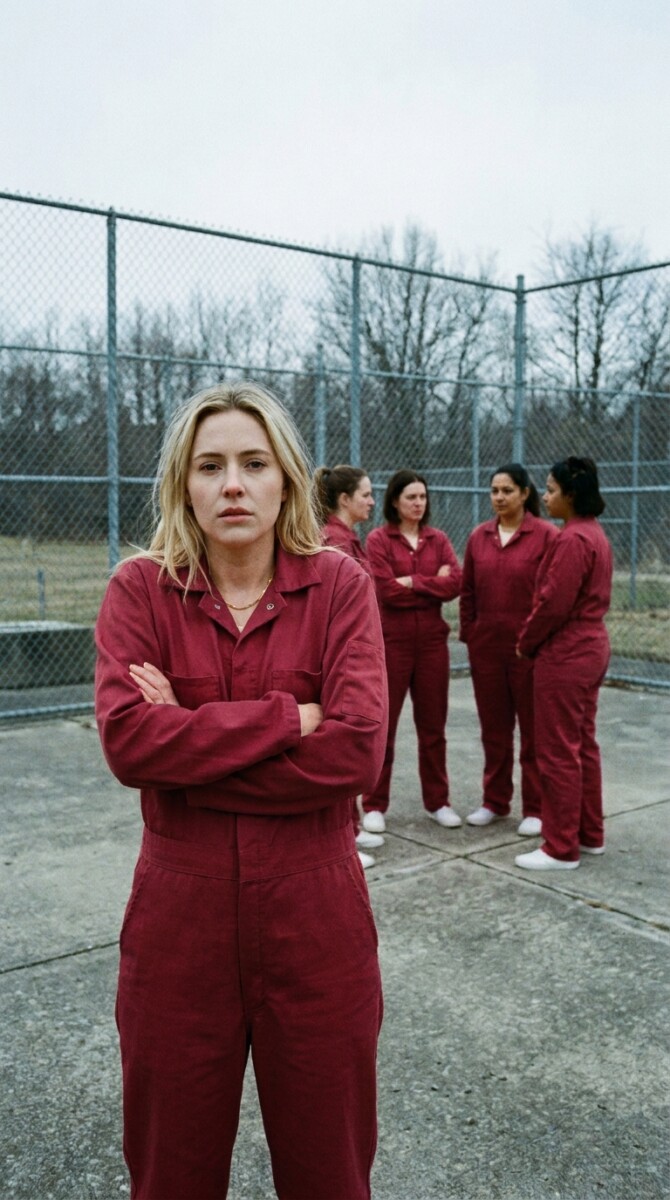
Valentina had been in that place for only four days, and she had already learned one rule no one bothered to explain out loud:
Everyone watched the newcomers.
It did not matter whether they were walking toward the dining hall, sitting alone, talking too much, or choosing to remain silent.
Every gesture seemed to become information.
Who was afraid.
Who pretended not to be.
Who was willing to give in.
And who seemed willing to make life difficult for themselves simply to prove they would not.
Valentina had decided from the first day that she would try not to participate in any of those games.
She was twenty-five years old, with blonde hair tied back simply and an expression that almost always seemed calmer than she actually felt.
She wore the same orange jumpsuit as the other women, but around her neck she had kept a small gold necklace.
It was not particularly thick.
Nor did it look especially expensive.
But it had a small pendant she almost never stopped touching.
Sometimes, when she thought no one was watching, she squeezed it between her fingers.
That morning, she was walking through the outdoor yard when a woman stepped in front of her.
Valentina had seen her before.
Everyone called her Sonia.
Somewhere in her thirties.
Braided hair.
Several visible tattoos on her face.
Confident posture.
Always accompanied.
Sonia smiled when she noticed the necklace.
“Pretty little necklace.”
Valentina stopped.
“Thank you.”
The woman tilted her head slightly.
“I’m going to take it from you.”
Two women nearby laughed quietly.
Valentina breathed slowly.
“Don’t start with that.”
Sonia’s smile faded slightly.
“With what?”
“That.”
“I don’t think you understood.”
Valentina held her gaze.
“I understood perfectly.”
Sonia stepped closer.
“Then give it to me.”
Valentina shook her head.
“No.”
That single word was enough to change the atmosphere.
Several nearby conversations grew quieter.
A woman sitting a few yards away looked up.
Another stopped walking.
Not because a necklace was anything extraordinary.
But because Sonia was not used to hearing no.
She did not raise her voice either.
She did not need to.
“You’re new,” she said.
“I know.”
“Then you should learn quickly.”
Valentina touched the pendant.
“I’m not giving this necklace to anyone.”
“Is it that important?”
Valentina looked at her.
“To me, yes.”
Sonia smiled again.
“Then now I want it even more.”
One of her companions appeared behind her.
Then another.
Then a fourth.
Valentina watched them position themselves around her.
Not completely surrounding her.
But close enough for the message to be clear.
Sonia was not alone.
Valentina was.
One of the women laughed.
“Four against one.”
Valentina looked at her.
“I know how to count.”
“We’ll see if you keep talking like that when you’re on the ground.”
Valentina did not answer immediately.
Sonia studied her face, searching for any sign of fear.
She did not find the reaction she expected.
What she saw was exhaustion.
And something close to sadness.
“Why are you smiling?” Sonia asked.
Valentina lowered her hand from the necklace.
“Because this conversation feels familiar.”
“What does that mean?”
Valentina answered:
“I’ve already seen people try to earn respect the same way.”
Sonia crossed her arms.
“And how did that end?”
Valentina looked directly at her.
“Badly for everyone.”
Before ending up there, Valentina worked as an assistant in a small family repair shop.
It was not glamorous work.
She answered calls.
Organized invoices.
Helped with orders.
Sometimes she even cleaned parts when they were short-staffed.
The shop belonged to her older brother, Adrián.
He had been the most important person in her life since they were children.
Their father died when Valentina was eight.
Their mother died several years later.
Adrián ended up filling far too many roles at once.
Brother.
Guardian.
Advisor.
Protector.
And sometimes a kind of improvised father learning everything as he went.
The gold necklace had belonged to him.
It was not expensive.
He had bought it with his first paycheck.
Years later, he added a small pendant.
A tiny piece engraved with a date.
The day the two of them left the foster home where they had lived during a difficult period.
Adrián gave it to Valentina and said:
“So you remember that we survived together.”
She had worn it ever since.
That was why it was not simply jewelry.
It was memory.
The problem was that Adrián also had one enormous flaw.
He confused protection with confrontation.
If someone spoke badly about Valentina, he reacted.
If someone made her uncomfortable, he stepped in.
If someone argued with her, Adrián appeared ready to prove that no one could disrespect her.
For years, Valentina believed that was love.
Until one night, when a small argument escalated too far.
There was no tragedy, but there were serious consequences.
Adrián was charged after impulsively intervening in a fight that could have been avoided.
Valentina remembered perfectly what he told her months later.
“I thought I was defending you.”
“I know.”
“But you asked me to leave.”
Valentina had cried.
“Yes.”
Adrián lowered his eyes.
“And I didn’t listen to you.”
That conversation changed the way Valentina understood strength.
She did not want to become like her brother.
She did not want to repeat the same mistake.
So now, surrounded by Sonia and her three companions, she remembered his words.
“When everyone expects you to react, sometimes the hardest decision is choosing for yourself what is actually worth it.”
Sonia extended one hand.
“Last chance. The necklace.”
Valentina shook her head.
“No.”
“Then we’re going to have a problem.”
“We already do.”
“What?”
Valentina answered:
“You think that in order for you to feel strong, I have to feel small.”
The sentence created an uncomfortable silence.
One of the women in the group stopped smiling.
Sonia frowned.
“You talk too much.”
“Probably.”
“And what are you going to do?”
Valentina looked around.
Then back at Sonia.
“Nothing I’ll regret tomorrow.”
Sonia burst out laughing.
“Now you’re a philosopher?”
“No.”
Valentina touched the necklace.
“I just learned some things too late.”
A whistle sounded from the far end of the yard.
A supervisor was walking toward them.
Sonia looked in her direction.
Valentina did too.
“What’s going on here?” the woman asked.
Sonia answered first.
“Nothing.”
The supervisor studied the way they were positioned.
Four women around one.
“Doesn’t look like nothing.”
Valentina breathed.
She could accuse them.
She could exaggerate.
She could create a larger situation.
But she knew doing that purely for revenge would not solve much either.
“We’re talking,” she said.
The supervisor looked at Sonia.
“About what?”
Valentina answered:
“My necklace.”
The supervisor frowned.
“What about it?”
Sonia shrugged.
“I only said it was pretty.”
Valentina looked at her.
Sonia held her gaze.
The supervisor understood there was more to it.
“Separate.”
No one argued.
Sonia started walking away with the other three.
Before leaving, she looked at Valentina.
“This isn’t over.”
Valentina replied:
“For me it is.”
Sonia walked away.
During lunch, a woman named Marta sat across from Valentina.
She looked to be around forty.
Calm.
She had been there a long time.
“You don’t know what you just did.”
Valentina kept eating.
“Said no.”
“Exactly.”
“Is that so unusual?”
Marta laughed.
“With Sonia, yes.”
Valentina looked up.
“Why?”
“Because she’s spent years building a reputation.”
“By taking things from people?”
“Sometimes.”
Marta lowered her voice.
“But it isn’t really about what she takes.”
Valentina understood immediately.
“It’s about proving she can.”
Marta nodded.
“Exactly.”
Valentina looked toward a distant table.
Sonia was sitting there with her group.
“So the necklace never mattered.”
“Not much.”
Valentina squeezed the pendant.
“To me, it does.”
Marta studied her.
“Who did it belong to?”
Valentina hesitated.
“My brother.”
“Did he die?”
“No.”
“Then where is he?”
Valentina lowered her eyes.
“He had problems too because he tried solving things in the worst possible way.”
Marta understood not to ask further.
“Did he teach you how to defend yourself?”
Valentina smiled.
“He taught me something better.”
“What?”
“Not to repeat his mistake.”
Two days later, Sonia returned.
This time alone.
Valentina was sitting down reading.
Sonia stood in front of her.
“Move.”
Valentina closed her book.
“Why?”
Sonia pointed toward the seat.
“I want to sit there.”
Valentina looked around.
Several other seats were empty.
“There are others.”
Sonia smiled.
“I want that one.”
Valentina immediately understood.
Another test.
Another way to see whether she had won something or lost something.
“I’m using it.”
“I can see that.”
“Then wait.”
Sonia leaned closer.
“Again?”
Valentina sighed.
“Yes.”
“You enjoy making things difficult.”
“No.”
Valentina held the book.
“I enjoy finishing what I’m doing.”
Sonia remained there for several seconds.
“Aren’t you afraid?”
Valentina looked up.
“Yes.”
That answer completely confused Sonia.
“What?”
“Yes, I’m afraid.”
Sonia seemed unsure what to do with that honesty.
Valentina continued:
“Being afraid and letting fear decide for you are two different things.”
Sonia gave a short laugh.
“That sounds nice.”
“It doesn’t always feel nice.”
“Then why are you still sitting there?”
Valentina thought.
“Because getting up just to prove that you can force me isn’t going to solve anything.”
Sonia fell silent.
“And what if I make you get up?”
Valentina looked directly at her.
“Then that will be your decision.”
Sonia stopped smiling.
For a moment, she looked genuinely angry.
Then she did something unexpected.
She sat in the chair beside Valentina.
Valentina looked at her.
“What?”
“Nothing.”
“Aren’t you going to say anything?”
“I’m reading.”
Sonia burst out laughing.
“You’re unbearable.”
Valentina returned to her book.
“I’ve been told that too.”
From that moment on, something strange happened.
Sonia stopped going after her.
They did not become friends.
They barely spoke.
But whenever they crossed paths, they simply watched each other.
Until one afternoon, Sonia pointed at the necklace.
“What’s so special about it?”
Valentina looked at her.
“Now you’re asking?”
“I’m asking.”
Valentina touched the pendant.
“It belonged to my brother.”
“Did he die?”
“No.”
Sonia smiled.
“Everybody asks the same thing.”
Valentina looked at her.
“You have the face of someone carrying a memory.”
Valentina remained silent.
Then she spoke.
“When we were children, we were practically alone.”
Sonia listened.
“He raised me.”
“And the necklace?”
“He bought it with his first paycheck.”
Valentina showed her the small pendant.
“There’s a date engraved on it.”
Sonia looked without touching it.
“What date?”
“The day we left the last foster home where we lived.”
Sonia lost every trace of mockery.
“That’s why you wouldn’t give it up.”
“Yes.”
“I thought you were trying to act tough.”
Valentina shook her head.
“No.”
“Then why didn’t you say that?”
Valentina answered:
“Because I shouldn’t have to explain why something I own is valuable before someone respects that I don’t want to give it away.”
Sonia went completely still.
“That really did sound philosophical.”
Valentina started laughing.
“Shut up.”
Sonia smiled.
It was the first conversation they had ever shared without tension.
Over time, Valentina began learning things about Sonia.
The tattoos on her face intimidated many people.
So did the way she walked.
But behind that image was a woman who had spent years trying not to appear vulnerable.
Her childhood had been unstable.
She had lived in homes where learning to protect your belongings was almost mandatory.
“If you left something lying around,” she said one afternoon, “it disappeared.”
“And?”
“I learned to take things first.”
Valentina looked at her.
“That explains a lot.”
“Don’t analyze me.”
“You started it.”
Sonia laughed.
“Then I got here.”
She looked across the yard.
“And it worked the same way.”
“What did?”
“If everyone is afraid of you, nobody tries to take anything from you.”
Valentina replied:
“But you ended up taking things from other people.”
Sonia fell silent.
“Yes.”
“Then you became exactly the kind of person you were trying to protect yourself from.”
Sonia looked at her.
Valentina thought she had gone too far.
But the woman did not respond with anger.
She simply lowered her eyes.
“Maybe.”
Days later, a new young woman arrived.
She looked terrified.
She walked while staring at the floor.
One of the women from Sonia’s group approached her.
“Nice shoes.”
The young woman looked up.
“Thank you.”
“Give them to me.”
Valentina watched from a distance.
She thought Sonia would allow the same old behavior.
But before the newcomer could answer, Sonia spoke.
“Leave her alone.”
Her companion turned.
“What?”
“You heard me.”
“Since when?”
Sonia crossed her arms.
“Since now.”
The woman laughed.
“Valentina tamed you.”
Sonia gave her such a serious look that the laughter stopped.
“This has nothing to do with her.”
Valentina smiled from a distance.
She knew that was not true.
But she said nothing.
The other woman walked away.
The newcomer thanked Sonia.
Sonia replied:
“You don’t have to thank me.”
Then she looked toward Valentina.
Valentina raised her eyebrows slightly.
Sonia shook her head as if saying:
Don’t even think about it.
Valentina could not help laughing.
Weeks later, Sonia sat beside her.
“I think I don’t like you.”
Valentina closed the book.
“That seems contradictory.”
“Things were easier before.”
“Before me?”
“Yes.”
“What did you do?”
“Whatever I wanted.”
“That doesn’t sound complicated.”
Sonia sighed.
“Now I think too much.”
Valentina smiled.
“Terrible.”
“Horrible.”
They both laughed.
Sonia looked at the necklace.
“Do you know what I really thought on the first day?”
“What?”
“That if I took it from you in front of everyone, no one would question me again for months.”
Valentina nodded.
“I figured.”
“You know what bothered me?”
“That I said no?”
“No.”
Sonia looked at her.
“You didn’t seem like you were trying to beat me.”
Valentina remained quiet.
“Everyone who challenges me wants to prove they’re better.”
Sonia gestured toward the yard.
“You just wanted to keep your necklace.”
“That was exactly it.”
“That confused me.”
Valentina answered:
“Maybe because you turned too many simple things into competitions.”
Sonia laughed.
“Another deep line.”
“I’ll charge you for the next one.”
Months later, Valentina received a letter.
She recognized the handwriting immediately.
Adrián.
She sat alone to read it.
Her brother was doing better.
He had started working.
He was participating in a reintegration program.
But the most important part was in the final lines.
“I’ve thought a lot about that necklace. For years I believed I gave it to you so you would remember that I would always protect you. Now I think I was wrong. I gave it to you so you would remember that you had already survived many things on your own.”
Valentina had to stop reading.
Her eyes filled with tears.
Sonia appeared.
“Everything okay?”
Valentina folded the letter.
“Yes.”
“Doesn’t look like it.”
Valentina smiled through tears.
“My brother.”
“Is he okay?”
“Yes.”
Sonia looked toward the necklace.
“Does it have something to do with that?”
Valentina nodded.
“He says we misunderstood what it meant.”
“So what does it mean?”
Valentina held the pendant.
“That I don’t need anyone to become violent for me in order to prove they love me.”
Sonia remained quiet.
“That applies to a lot of things,” she finally said.
Valentina looked at her.
“Yes.”
A year later, the day came for Valentina to leave.
Marta hugged her.
Several other women said goodbye.
Sonia was last.
They stood facing one another.
“So you’re leaving.”
“Yes.”
“Good.”
Valentina smiled.
“How emotional.”
Sonia crossed her arms.
“Don’t expect tears.”
“Never.”
Sonia looked at the necklace.
“You still have it.”
“Of course.”
“I never managed to take it from you.”
Valentina laughed.
“That will remain one of your greatest failures.”
Sonia smiled.
Then she became serious.
“Thank you.”
“For what?”
“For telling me no.”
Valentina went still.
Sonia continued:
“No one ever did it without trying to turn me into their enemy.”
Valentina extended one hand.
Sonia took it.
Then pulled her closer and hugged her.
“When you get out,” Valentina said, “find me.”
Sonia stepped back.
“For what?”
“So you can return all the things you never stole from me.”
Sonia started laughing.
“Get out of here.”
Valentina walked away smiling.
Adrián was waiting outside.
The moment she saw him, Valentina began to run.
They hugged for a long time.
He looked at the necklace.
“You kept it.”
Valentina nodded.
“Always.”
Adrián touched the pendant.
“Did it get you into trouble?”
She smiled.
“A little.”
“What did you do?”
Valentina looked at him.
“Nothing you would have done in the past.”
Adrián laughed.
“Then you learned.”
“Both of us did.”
They walked toward the car.
Before getting in, Valentina looked back toward the building.
She thought about Sonia.
The first threat.
The four women surrounding her.
Everything that could have happened.
And how differently it had ended.
Years later, Valentina began working for an organization that helped women returning to the workforce.
She was not a psychologist.
Nor a lawyer.
Her job was simple.
Connecting people with companies willing to offer them a second chance.
One day, she received an application.
Name: Sonia Herrera.
Valentina smiled.
When Sonia appeared at the office, she was no longer wearing the orange jumpsuit.
She wore jeans.
A black shirt.
Her hair was still braided.
The tattoos were still there.
So was the strong attitude.
“Nice place,” Sonia said.
Valentina looked up.
“Pretty little necklace.”
Sonia started laughing.
“Don’t start.”
They hugged.
“Need work?” Valentina asked.
“Yes.”
“What can you do?”
“A lot of things.”
“Steal shoes?”
“Very funny.”
Valentina smiled.
“We have a logistics company looking for staff.”
Sonia sat down.
“Do you think they’ll take me?”
Valentina answered:
“I think they need to meet you first.”
“And if they judge me because of this?”
She pointed toward her tattoos.
Valentina thought.
“Then there will be other companies.”
Sonia looked at her.
“That simple?”
“No.”
Valentina smiled.
“But you’re not alone either.”
Sonia lowered her eyes.
“Thank you.”
Valentina touched the necklace.
“I’m just paying back an old debt.”
“What debt?”
“The one where I learned that some people need someone to tell them no without stopping treating them like human beings.”
Sonia shook her head with a smile.
“You still talk like a philosopher.”
Valentina started laughing.
“And you still complain.”
Months later, Sonia found a job.
At first, she struggled.
Some people stared too long.
Others asked uncomfortable questions.
But she no longer reacted the way she once had.
When something bothered her, she spoke.
When someone crossed a boundary, she said so.
Without threats.
Without trying to control anyone.
Without turning every disagreement into a battle.
One day she called Valentina.
“You know what happened?”
“What?”
“A coworker took my mug.”
Valentina waited.
“And?”
“I asked her to give it back.”
“Impressive.”
“Shut up.”
“Did you get it back?”
“Yes.”
“Without four people standing behind you?”
Sonia started laughing.
“You’re unbearable.”
“I’ve been told.”
The necklace was still around Valentina’s neck.
Over time, the gold lost some of its shine.
The little pendant had scratches.
But she never wanted to replace it.
Because it no longer represented only Adrián.
It now represented that afternoon too.
The yard.
The four women.
The fear.
And the decision not to let fear or pride choose for her.
For a long time, Valentina believed standing firm meant proving she could face anyone.
Later, she understood something different.
There are times when the greatest display of strength is simply saying:
“No.”
Without humiliating anyone.
Without seeking revenge.
Without turning the other person into an enemy forever.
A “no” can protect a necklace.
A boundary.
A story.
A piece of your dignity.
But it can also become the first crack in a dynamic that has been going wrong for years.
Sonia had tried to take Valentina’s necklace to prove in front of everyone that she was still in control.
Instead, she discovered that the hardest kind of control was not control over other people.
It was control over herself.
And Valentina understood that the necklace had never needed to be defended through a fight in order to preserve its value.
Because the true meaning of the necklace was never in the gold.
It was in the story it carried.
Two siblings who had survived together.
One woman who learned to set boundaries without repeating the mistakes of the past.
And another who discovered that she could receive respect without demanding fear.
That was why, years later, whenever someone asked Valentina why she still wore that old little necklace when she could easily buy a new one, she always gave the same answer:
“Because some things aren’t valuable because of what they cost.”
“They’re valuable because of everything they remind you that you’ve already survived.”