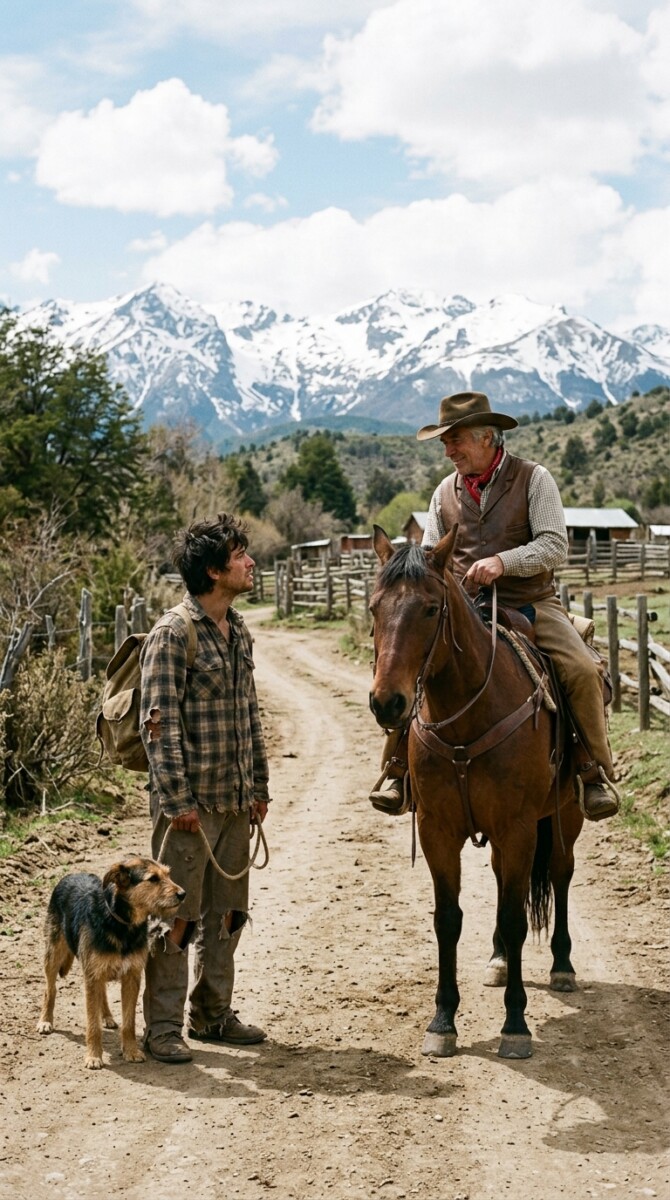
Mateo had been walking for almost two days when he saw the first corral.
The sun beat down harshly on the dirt road, and every step seemed to require more effort than the last. He was twenty-five years old, with completely disheveled dark hair, an old shirt covered in dust, and pants so worn that the knees had already begun to tear.
A small backpack hung from his shoulder.
There was not much inside.
Two shirts.
An empty bottle.
A photograph of his mother.
A notebook.
And a few coins that were not enough to buy almost anything.
Walking beside him was Bruno, a brown mixed-breed dog that had been accompanying him for months.
Mateo did not know exactly when Bruno had decided to follow him.
One afternoon, the dog simply appeared behind him on a road and never left again.
“Hold on a little longer,” Mateo murmured, looking at the dog. “We’ll find something somewhere.”
Bruno wagged his tail.
Mateo smiled weakly.
It was strange.
At that moment, the dog seemed to have more energy than he did.
Mateo had left his hometown months earlier in search of work.
His mother had recently died, and the accumulated debts eventually made it impossible to keep the small family home.
Mateo had tried to find work in construction.
Repair shops.
Farms.
Anywhere.
Sometimes he worked for several days.
Other times, several weeks.
But nothing lasted.
He had no university degree.
No connections.
He only knew how to work.
And he was willing to do it.
The problem was finding someone willing to give him a chance.
When he saw cows behind a wooden fence, he felt hope.
A little farther ahead stood a ranch.
It was not enormous, but it looked prosperous.
There were several corrals, a wooden stable, tools neatly arranged beneath a shed, and a small house with a red roof in the distance.
Mateo carefully opened the gate.
“Good morning!” he called.
No one answered.
He kept walking.
Then he saw a woman milking a cow beneath a wooden structure.
She appeared to be around fifty years old.
Brown hair tied back.
Work blouse.
Heavy apron.
Boots covered in mud.
Mateo approached slowly so he would not startle her.
“Excuse me.”
The woman looked up.
The moment she saw him, her expression changed.
Her eyes moved over Mateo’s worn clothing.
Then the backpack.
Then the dog.
“What do you want?”
Mateo swallowed.
“Ma’am, could you please give me a glass of milk?”
She raised her eyebrows.
“Give you one?”
Mateo nodded.
“Yes, ma’am. I’ve been walking a long time.”
The woman continued milking the cow.
“We don’t give things away here.”
Mateo fell silent.
He could understand.
Maybe many people passed by asking for things.
He did not want to argue.
“I can work for it.”
The woman looked at him again.
“Work?”
“Whatever you need.”
He pointed toward the corral.
“I can clean, carry feed, repair fences… anything.”
The woman shook her head.
“I don’t need help.”
Mateo took a deep breath.
He looked at the container filling with fresh milk.
Then at Bruno.
“What about a little water?”
“There’s a river several miles away.”
Mateo felt something close to shame.
Not because he had asked.
But because he realized how easily someone could look at his need as though it were an inconvenience.
“All right.”
He adjusted his backpack.
“Thank you anyway.”
The woman did not respond.
Mateo left the corral.
Bruno followed him.
When they reached the road again, Mateo sat beneath a tree.
“Well,” he said, looking at the dog, “looks like we’re not having breakfast today either.”
Bruno rested his head on Mateo’s leg.
Mateo laughed.
“Don’t look at me like that. You weren’t much help either.”
He pulled out the empty bottle.
Looked at it.
Put it away again.
Then he stared toward the mountains.
He did not know where to go.
For the first time since beginning the journey, he felt like giving up.
Maybe he should return to his hometown.
But to what?
He no longer had a house.
No job.
No close family.
Mateo closed his eyes.
He heard the sound first.
Hooves striking the dirt.
He opened his eyes.
An older man was approaching along the road on a dark horse.
He looked to be around sixty.
Gray hair.
Wide-brimmed hat.
Leather vest.
Work shirt.
A red scarf tied around his neck.
When he saw Mateo sitting beneath the tree, he slowed down.
“Good morning.”
Mateo stood.
“Good morning, sir.”
The man looked at the dog.
Then at Mateo.
“Heading somewhere?”
Mateo smiled.
“I’m trying.”
The stranger laughed softly.
“That answer means you have no idea.”
Mateo could not argue.
“More or less.”
The man dismounted.
“My name is Amancio.”
“Mateo.”
They shook hands.
Don Amancio looked at the young man’s clothes.
Not with contempt.
With curiosity.
“You traveling alone?”
Mateo pointed at the dog.
“Technically, there are two of us.”
Don Amancio smiled.
“And have the two of you eaten?”
Mateo looked down.
He did not want to ask again.
“We’re fine.”
Don Amancio studied his face for a moment.
“That answered my question.”
Mateo looked up.
The old man took hold of the horse’s reins.
“Come with me.”
“Sir, I don’t want to bother you.”
“Did I ask if you wanted to bother me?”
Mateo smiled slightly.
“No.”
“Then walk.”
“But I don’t have money.”
Don Amancio began walking.
“I didn’t ask you about money either.”
Mateo remained still for several seconds.
Then he followed him.
Don Amancio’s ranch was a little over half a mile away.
It was much smaller than the first one.
A rustic house.
A stable.
Three horses.
Several chickens.
A small garden.
And fields that seemed to stretch all the way to the mountains.
As soon as they arrived, a woman came out of the house.
“Amancio, who is that?”
“A young man I found walking.”
She looked at Mateo.
“He’s hungry.”
“I didn’t say—”
Don Amancio interrupted him.
“You didn’t need to.”
The woman smiled.
“I’m Rosa.”
“Mateo.”
Doña Rosa pointed toward the table on the porch.
“Sit down.”
Mateo obeyed.
Minutes later, they placed a plate in front of him filled with beans, rice, stewed meat, and warm tortillas.
Mateo simply stared at it.
“Is something wrong?” Rosa asked.
He shook his head.
“No.”
He picked up the fork.
He tried to eat slowly.
He could not.
Don Amancio watched him from the other chair.
“Take it easy. No one is going to take the plate away from you.”
Embarrassed, Mateo slowed down.
“Sorry.”
“You don’t have to apologize for being hungry.”
That sentence remained engraved in his memory.
Rosa also placed food in a bowl for Bruno.
The dog devoured everything.
Mateo smiled.
“I think he was hungrier than I was.”
“You both looked like you needed it,” she replied.
After finishing, Mateo stood.
“Where are the tools?”
Don Amancio frowned.
“What tools?”
“To work.”
“Who said you have to work?”
“You gave me food.”
“Yes.”
“Then I have to pay for it.”
The old man shook his head.
“No.”
Mateo looked confused.
“Sir…”
Don Amancio stepped closer.
“Listen to me, young man. If one day you have plenty, share with someone else. That will be the payment.”
Mateo did not answer.
No one had ever said anything like that to him.
“I still want to help.”
Don Amancio smiled.
“That’s different.”
He pointed toward a fence.
“That section has needed repairs for weeks.”
Mateo examined it.
“I can fix it.”
“Then tomorrow.”
“Tomorrow?”
“Yes.”
“And tonight?”
Don Amancio pointed toward the stable.
“There’s a small room behind it. It isn’t pretty.”
Mateo’s eyes widened.
“I can’t accept all of this.”
“Why?”
“You don’t even know me.”
Don Amancio shrugged.
“Sometimes you know enough about a person by watching how he treats a dog when he has no food himself.”
Mateo looked at Bruno.
The dog was completely asleep beneath the table.
That night, Mateo slept under a roof for the first time in weeks.
One day became three.
Three days became a week.
Mateo repaired the fence.
Then he fixed a door.
Then he helped with the horses.
Don Amancio quickly discovered that the young man was good with his hands.
“Who taught you?”
“My father.”
“Where is he?”
Mateo fell silent.
“He died when I was seventeen.”
“I’m sorry.”
“Thank you.”
“And your mother?”
Mateo lowered his eyes.
Don Amancio understood.
“Recently?”
Mateo nodded.
The old man did not ask anything else.
That was another thing Mateo appreciated.
Don Amancio knew when to speak.
And when simply to be there.
After two weeks, Mateo said he had to leave.
Doña Rosa almost became angry.
“Leave for where?”
“There’s a large city a few hours away.”
“Do you have work there?”
“Not yet.”
“Then why go?”
Mateo smiled.
“Because I can’t live off you forever.”
Don Amancio appeared behind her.
“Who said you’re living off us?”
“You gave me a room. Food.”
“And you’ve worked every day since you arrived.”
Mateo remained silent.
Don Amancio continued:
“Stay a little longer.”
“I need to build my own life.”
The old man nodded.
“That I understand.”
He went inside the house and returned with an envelope.
Mateo immediately shook his head.
“No.”
“You don’t even know what it is.”
“Money.”
“Correct.”
“I can’t take it.”
Don Amancio placed the envelope in his hand.
“I’m paying you for your work.”
“You already paid me.”
“Food and a place to sleep are not wages.”
Mateo tried to return it.
Don Amancio closed Mateo’s fingers around the envelope.
“Keep it.”
Mateo took a deep breath.
“One day I’ll pay you back.”
“No.”
“Yes.”
“I don’t want you to come back to return money.”
Mateo looked up.
Don Amancio smiled.
“Come back when things are going well for you. That will be enough.”
Mateo arrived in the city with Bruno, a backpack, and very little money.
He found work unloading boxes in a warehouse.
He slept in a room shared with three other workers.
It was not easy.
But he was no longer lost.
Later, he got a job with a transportation company.
He discovered that he had a talent for organizing routes.
His supervisor promoted him.
Mateo began studying business administration at night.
He did not quit his job.
He did not have that luxury.
He worked during the day.
Studied at night.
Slept little.
Saved as much as possible.
Years later, he became a minority partner in a small distribution company that was struggling financially.
Mateo had spent years observing the mistakes in the industry.
Inefficient routes.
Trucks traveling empty.
Poor fuel management.
Neglected customers.
He proposed changes.
They worked.
The company began to grow.
By the time he was thirty, Mateo was already managing operations.
At thirty-three, he bought a larger share.
At thirty-five, he owned a regional agricultural logistics company.
He did not become wealthy overnight.
There was no miraculous stroke of luck.
It took ten years.
Ten years of waking up early.
Making mistakes.
Losing contracts.
Learning.
Hiring people who were better than he was in areas he did not master.
And always remembering one sentence:
“If one day you have plenty, share with someone else.”
He had heard it only once.
He never forgot it.
Mateo helped dozens of workers during those years.
He created a small emergency fund for employees facing family crises.
He established technical scholarships for workers’ children.
He hired people other companies rejected because they had no experience.
When a manager asked why he did so many things that were not strictly necessary, Mateo replied:
“Because someone once did something unnecessary for me when I had nothing.”
But there was still one unfinished matter.
Don Amancio.
Mateo had tried to write to him.
The first letters arrived.
Doña Rosa answered twice.
Then the replies stopped.
Mateo called old phone numbers.
They no longer worked.
The mailing address eventually stopped appearing correctly.
Time kept moving.
Work.
Growth.
Problems.
Responsibilities.
And that visit kept being postponed.
Until one day Mateo found the old envelope Don Amancio had given him.
He kept it empty inside a drawer.
On the back, the old man had written:
“Whenever you can help someone, do it.”
Mateo closed the drawer.
He looked at his assistant.
“Cancel my meetings on Friday.”
“All of them?”
“All of them.”
“Traveling?”
Mateo smiled.
“Something that has been waiting far too many years.”
On Friday, he left before sunrise.
He drove a black pickup truck.
Beside him sat Julián, one of his longest-serving employees.
He had worked with Mateo since the early years of the company.
“Is it much farther, boss?”
Mateo looked at the road.
“No.”
He smiled.
“We’re almost there.”
Julián looked toward the mountains.
“I’ve never been around here before.”
“I have.”
“For business?”
Mateo shook his head.
“Many years ago.”
“What’s here?”
Mateo held the steering wheel with both hands.
“This is where a man gave me food when I had nothing.”
Julián looked at him.
He was not used to hearing Mateo talk about that period of his life.
“The same man you told me about once?”
“Don Amancio.”
“The one from the glass of milk?”
Mateo laughed.
“Not exactly. The glass of milk was someone else.”
“So what are you going to do?”
“Find him.”
“And then?”
Mateo thought.
“I don’t know yet.”
They drove several more miles.
The roads looked familiar, although many things had changed.
Some fences were new.
There were more houses.
A small gas station stood where empty land had once been.
Mateo slowed down.
“It’s around here.”
He pointed toward a curve.
“After that, the ranch should appear.”
They turned.
Mateo smiled.
He recognized the large tree beneath which Don Amancio had found him.
“That one.”
“What?”
“That’s where I was sitting.”
Julián looked at it.
“How long ago?”
“Almost eleven years.”
They continued.
Finally, the entrance to the ranch appeared.
Mateo stepped on the brake.
His smile disappeared.
A huge sign had been nailed beside the fence.
AUCTION
Mateo froze.
Julián pointed.
“Boss, look at that!”
“I see it.”
He stopped the truck.
Got out.
The place was still there.
But it looked different.
The paint on the house was worn.
Part of the fence had collapsed.
The stable needed repairs.
There were no horses in the main corral.
Mateo walked toward the sign.
Beneath it was information about an upcoming auction.
“No.”
Julián got out too.
“What happened?”
Mateo shook his head.
“I don’t know.”
They approached the house.
Mateo knocked on the door.
Nothing.
He knocked again.
“Don Amancio?”
Silence.
His heart began beating faster.
“Doña Rosa?”
He heard footsteps.
The door slowly opened.
A woman around forty appeared.
“Yes?”
Mateo removed his sunglasses.
“Excuse me. I’m looking for Don Amancio.”
The woman studied him.
“Who’s asking?”
“Mateo.”
Nothing happened.
“Mateo Valverde.”
The woman’s expression changed.
“Mateo?”
“Yes.”
“The young man with Bruno?”
Mateo felt a lump in his throat.
“Yes.”
She opened the door wider.
“I’m Elena.”
“His daughter?”
She nodded.
Mateo remembered that Don Amancio had once mentioned a daughter who lived far away.
“Where is he?”
Elena lowered her eyes.
Mateo felt fear.
“Is he alive?”
“Yes.”
Mateo exhaled.
“Thank God.”
“But he’s sick.”
“What happened?”
She invited them inside.
Don Amancio had suffered several health problems during the previous years.
Nothing sudden.
An accumulation of things.
Treatments.
Hospitalizations.
Medication.
Then came a drought that damaged part of the production.
After that, they lost livestock.
The family borrowed money trying to keep the ranch alive.
The debts grew.
Doña Rosa died two years earlier.
That loss emotionally broke Amancio even further.
His daughter returned to care for him.
But financially, it was already too late.
“They’re auctioning the property next week,” Elena explained.
Mateo looked around.
Photographs covered one wall.
A younger Don Amancio.
Rosa.
Elena.
Horses.
Family celebrations.
That place was not merely land.
It was one family’s history.
“Where is he?”
“In his room.”
Elena walked toward a door.
“Dad.”
A weak voice replied:
“Yes?”
“Someone came to see you.”
Mateo entered.
Don Amancio sat beside a window.
Much thinner.
Hair completely white.
But the same eyes.
The old man looked at Mateo without recognizing him.
“Good afternoon.”
Mateo almost could not get the words out.
“Good afternoon, Don Amancio.”
The old man narrowed his eyes.
Mateo smiled.
“Do you still ask strangers whether they’ve eaten?”
Don Amancio froze.
His eyes widened.
“No…”
Mateo began crying before he could stop himself.
“Yes.”
The old man tried to stand.
“Mateo?”
Mateo quickly crossed the room.
He knelt in front of him.
Don Amancio held Mateo’s face in both hands.
“Boy…”
They embraced.
“Look at you,” the old man kept saying. “Just look at you.”
Mateo laughed through tears.
“I took too long.”
“But you came.”
“I should have come sooner.”
Don Amancio shook his head.
“You came.”
For him, that was enough.
They talked for hours.
Mateo told him about his work.
The company.
Bruno, who had lived many years and died old, peaceful, and surrounded by people who loved him.
Don Amancio cried when he heard.
“Good dog.”
“The best.”
The old man smiled.
“And are you married?”
“Not yet.”
“All that success and you’re still slow with the important things.”
Mateo burst out laughing.
“You haven’t changed.”
“Older. Not less wise.”
For the first time since arriving, Mateo felt something close to peace.
Until he looked out the window again and saw the sign.
“Why didn’t you look for me?”
Don Amancio immediately knew what he meant.
“To ask you for money?”
“To ask me for help.”
“No.”
“Why?”
“Because I helped you so you could keep moving forward, not so you could become my bank.”
Mateo pressed his lips together.
“You told me to come back when things were going well.”
“And you came back.”
“You also told me to help someone when I could.”
Don Amancio looked at him.
“That I did.”
Mateo smiled.
“Then don’t take the opportunity away from me.”
The old man understood.
“Mateo…”
“How much do you owe?”
“No.”
“Elena will tell me.”
“Boy.”
Mateo took his hand.
“That morning, I asked for a glass of milk and someone shut the door on me.”
Don Amancio remained silent.
“Then you found me.”
Mateo took a deep breath.
“You didn’t ask who I was. You didn’t ask for guarantees. You had no idea if I would ever be able to repay you.”
“You were hungry.”
“Exactly.”
His eyes filled with tears again.
“And for you, that was enough.”
Don Amancio lowered his gaze.
“Now you need help.”
“It isn’t the same.”
Mateo smiled.
“You’re right.”
The old man looked up.
“Now I can actually do something.”
The next day, Mateo met with the bank and legal representatives.
He did not arrive shouting.
He did not demand special treatment.
He asked for documents.
Reviewed every debt.
He discovered that saving the property was possible, but simply paying everything off without a plan could place the ranch in the same position again a few years later.
So he did something different.
His company needed to expand agricultural operations in the region.
The ranch had the right location, land, and access to strategic roads.
Mateo proposed forming a partnership.
The debt would be refinanced and later covered through a structured agreement.
The family would keep ownership of the property.
Part of the land would be modernized.
Production would be restored.
And Elena would receive a real ownership stake in the new operation.
Don Amancio did not want to accept at first.
“That’s too much.”
Mateo shook his head.
“It isn’t charity.”
“Of course it is.”
“Then let’s call it a terrible emotional investment.”
The old man laughed.
Mateo continued:
“The ranch can produce.”
“It needs a lot of money.”
“I have a company that needs exactly what this land can offer.”
Don Amancio looked at him.
“Are you telling me the truth?”
Mateo smiled.
“Almost all of it.”
“What part are you leaving out?”
Mateo leaned closer.
“Even if it were a terrible investment, I still wouldn’t let them auction this place.”
Don Amancio began laughing.
The laughter turned into tears.
The auction was canceled once the appropriate agreements were completed.
The AUCTION sign disappeared.
Mateo insisted on removing it himself.
He pulled it off the fence.
Stared at it for a few seconds.
Then kept it.
Julián watched him.
“What do you want that for?”
Mateo smiled.
“So I don’t forget.”
“Forget what?”
“That you can arrive somewhere too late.”
“But you got here in time.”
Mateo looked toward the house.
“Barely.”
Over the following months, the ranch changed.
But it did not lose its identity.
Mateo was very clear about that.
No turning it into something unrecognizable.
They repaired the stables.
Installed better water systems.
Improved milk production.
Hired local workers.
Created direct transportation routes for fresh products.
Elena began managing the operation with professional support.
And Don Amancio went back to sitting on the porch every morning.
He no longer worked the way he once had.
His health did not allow it.
But he supervised everything.
Especially Mateo.
“That’s installed wrong.”
“Don Amancio, the engineer says it’s correct.”
“The engineer hasn’t lived here for sixty years.”
“Here we go again.”
“Listen to me.”
Mateo smiled.
“I’m listening.”
Sometimes they argued for ten minutes.
Usually Don Amancio was right about some things and completely wrong about others.
But Mateo never grew tired of listening to him.
One day, a pickup truck arrived at the ranch.
Mateo was reviewing documents when Elena called him.
“Someone is asking for you.”
He went outside.
The woman who stepped out of the vehicle looked familiar.
It took him several seconds.
Then he remembered.
The first ranch.
The woman with the milk.
She was older now.
But it was her.
“Mateo?”
“Yes.”
The woman looked uncomfortable.
“I don’t know if you remember me.”
Mateo remained silent.
“Many years ago, you came to my ranch.”
“I remember.”
She lowered her gaze.
“You asked for milk.”
“Yes.”
“And I told you we didn’t give anything away.”
Mateo nodded.
The woman looked ashamed.
“I heard what you did for Amancio.”
Mateo waited.
“I only wanted to apologize.”
That surprised him.
“It’s been many years.”
“I know.”
“Why now?”
She breathed.
“Because for years, I told that story differently.”
Mateo frowned.
“How?”
“I told myself I had been cautious. That you couldn’t help just anyone.”
Her eyes filled with tears.
“But when I learned who you became and what Amancio did afterward… I realized I had plenty of milk that morning.”
Mateo remained silent.
“It would have cost me nothing to give you one glass.”
She pressed her lips together.
“And I still said no.”
Mateo thought back to that morning.
For years, he had carried resentment.
He no longer did.
“Thank you for coming.”
“Do you forgive me?”
Mateo smiled.
“Yes.”
The woman looked up.
Mateo added:
“Besides, if you had given me that milk, maybe I never would have met Don Amancio.”
They both looked toward the porch.
The old man sat there watching them.
Mateo smiled.
“And that would have been a much greater loss.”
Years later, the ranch was profitable again.
But Don Amancio’s real legacy was not found in the accounts.
Mateo created a small employment program there.
People going through difficult situations could work temporarily, receive food, basic housing, and training.
Nothing handed out without structure.
Nothing humiliating.
Just an opportunity.
On the first day of every new group, Mateo repeated the same sentence:
“No one has to apologize for being hungry.”
Don Amancio heard him say it once from the porch.
“I said that.”
Mateo turned.
“Yes.”
“Then pay me royalties.”
Everyone started laughing.
Mateo walked toward him.
“A glass of milk?”
Don Amancio smiled.
“Now yes.”
Mateo went inside.
He returned with two glasses.
They sat together.
The mountains rose in the distance.
The sun was beginning to set.
“You know something?” Don Amancio said.
“What?”
“I never thought you would come back.”
Mateo looked at him.
“I did.”
“Liar.”
Mateo laughed.
“All right. For a few years, I didn’t know if I would either.”
“Life gets busy.”
“Too busy.”
Don Amancio held the glass between both hands.
“But you came back.”
Mateo nodded.
“I came back.”
The old man looked at the restored fields.
“And you brought too much with you.”
Mateo shook his head.
“No.”
He looked at Don Amancio.
“I only returned a glass of milk.”
The old man smiled.
And neither of them needed to say anything else.
Because both knew it had never really been about milk.
It was about what one person can mean in another person’s life when they decide to help at exactly the right moment.
Don Amancio had seen a hungry young man sitting beside a road.
He could have kept riding.
He did not.
Years later, Mateo found an old man about to lose the work of his entire life.
He could have kept driving too.
He did not.
That was the real repayment.
Not money.
Not land.
Not a debt carefully counted for years.
But a simple chain of kindness:
Someone helps you when you have nothing.
You build something with that opportunity.
And when you finally have the ability to help someone else, you remember where you came from.
Because the true value of receiving a helping hand is not that you owe the person who helped you forever.
It is that someday, you may be able to extend your own hand to someone else.
And Mateo never again forgot the morning when he asked for a simple glass of milk, was rejected, and ended up finding, only a few miles later, something far more important:
a man who believed in him before he had absolutely anything to prove.