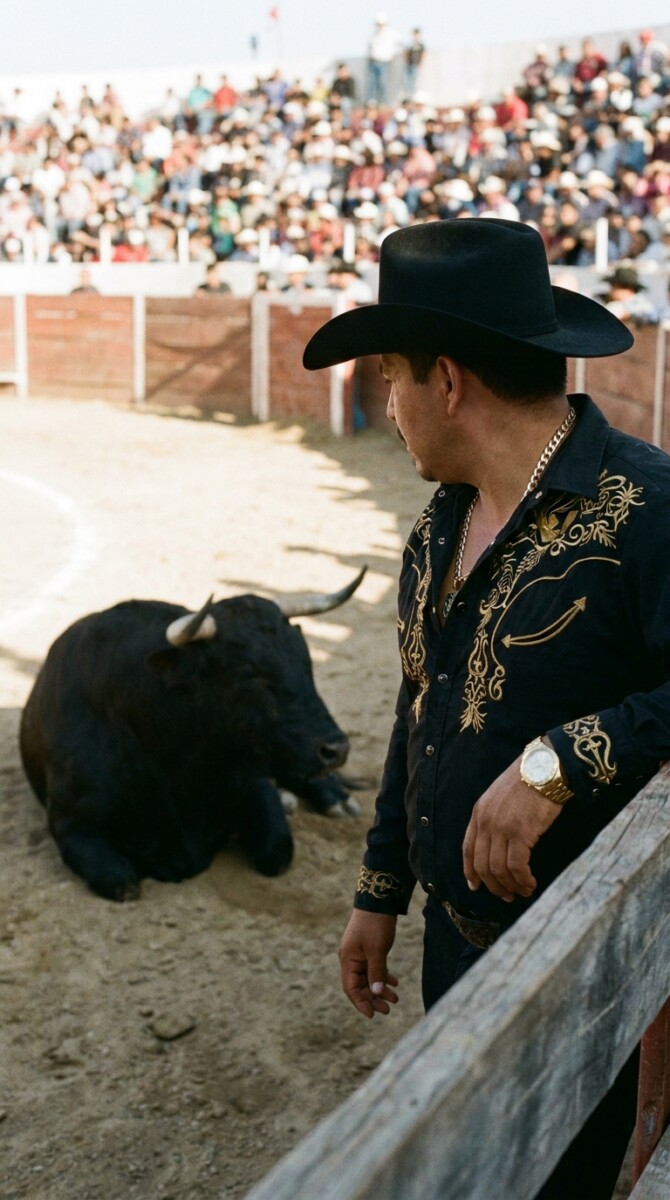
The afternoon sun beat down intensely on the bullring of San Miguel, yet no one left their seat.
The stands were packed.
Men in hats, women shielding their faces with fans, boys standing on the tips of the benches to get a better view, and vendors moving through the aisles with soft drinks, empanadas, and bags of salted peanuts.
The atmosphere was festive, noisy, and filled with anticipation.
Everyone felt that something unusual was about to happen.
In the center of the ring, resting on the hot sand, lay a large black bull.
It did not seem aggressive at that moment.
It remained lying down, breathing heavily, moving its tail slightly from time to time as if the crowd did not matter to it.
Still, its presence alone commanded respect.
One look at its horns and the size of its body was enough to understand why no one wanted to get close.
Standing beside the fence, wearing a black cowboy hat, a black shirt with gold details, and a thick gold chain shining across his chest, was Rogelio Barrera, a man known throughout the region for his extravagance.
People said he had more money than he knew what to do with, that he enjoyed attracting attention, and that whenever he became bored, he turned any gathering into a spectacle.
In one hand, he held a thick bundle of cash, waving it through the air so everyone could see it.
“One hundred thousand dollars!” he shouted, his voice echoing across the entire arena. “One hundred thousand dollars for whoever has the courage to step into the ring and dance in front of that bull!”
The crowd exploded into murmurs and exclamations.
Some laughed, believing the idea was insane.
Others whistled excitedly.
An elderly man sitting in the front row shook his head and said loudly enough for several people around him to hear:
“No one is going in there. Not for a hundred thousand. Not even for a million.”
A young man sitting beside him replied:
“Some people risk their lives for much less.”
And that simple, harsh sentence remained hanging in the air like an uncomfortable truth.
Because San Miguel had many beautiful things: green fields, hardworking people, evenings filled with music, and lively town squares.
But it also had hardship, debt, postponed dreams, and entire families surviving with barely enough.
One hundred thousand dollars was not just any amount of money.
For some, it was entertainment.
For others, it was the possibility of changing everything.
Rogelio smiled, enjoying the tense silence that had taken over the stands.
“What’s wrong?” he provoked. “People around here talk so much about courage, and now no one wants to show up?”
The crowd murmured again.
Several people looked toward the ring, then at the bull, then at the bundle of money.
No one moved.
That was when someone stood up among the rows of seats in the southern section.
He was a young man in his twenties, shirtless, with dark hair, sun-tanned skin, and an athletic build.
He did not look wealthy or like someone accustomed to being in front of a crowd.
He wore simple blue jeans, worn boots, and a calm expression that contrasted sharply with everyone else’s tension.
At first, people looked at him in surprise.
Then the whispers began.
“Who is that?”
“I think he’s from the La Cañada neighborhood.”
“That kid is crazy.”
The young man slowly walked down the steps.
He did not show off.
He did not raise his arms.
He did not look for applause.
He simply walked with steady steps until he stood in front of the wooden fence, only a few yards from Rogelio Barrera.
“I’ll do it,” he said.
Rogelio looked him up and down, amused.
“You?” he asked with an incredulous laugh. “You can’t possibly do that, kid.”
The crowd let out a few nervous laughs.
But the young man did not flinch.
“You said you would give one hundred thousand dollars to whoever did it. You never said the person had to be famous, rich, or old. You only asked who was willing.”
That answer changed the expressions of several people in the stands.
They no longer looked at him as if he were crazy.
Now they looked at him with curiosity.
Rogelio narrowed his eyes.
He was not accustomed to anyone answering him that way, calmly and without fear.
“What’s your name?” he asked.
“Mateo.”
“Well, Mateo… talking out here is one thing. Stepping into the ring is another.”
“I know.”
Rogelio lifted the bundle of money slightly.
“And why do you want to do it? Pride? Trying to prove how brave you are in front of the whole town?”
Mateo remained silent for several seconds before answering.
When he spoke, his voice no longer sounded challenging.
It sounded deeply sincere.
“Because my mother needs surgery,” he said. “Because my younger sister left school to help at home. Because I’ve been working from sunrise to sunset for years and it still isn’t enough. If you’re willing to throw that kind of money around like it’s a joke, then I’m willing to earn it like my life depends on it.”
The words fell heavily over the arena.
The laughter disappeared.
Even Rogelio lost, for a moment, the smug expression that seemed permanently carved onto his face.
In the stands, a woman crossed herself.
A man with a thick mustache murmured:
“The boy is serious.”
Mateo did not look away.
“So tell me, sir. Is your challenge real, or did you come here just to make fun of other people’s hardship?”
That touched a dangerous nerve in Rogelio.
He was proud, yes, but he also hated being made to look bad in front of others.
And in that moment, he understood that if he backed down, he would look like nothing more than a coward disguised as a boastful millionaire.
“My challenge is real,” he finally answered. “If you step into the ring and dance in front of that bull, the money is yours.”
Mateo nodded once.
He asked for no further explanation.
He did not negotiate.
He did not make any dramatic gesture.
He simply walked toward the wooden fence.
At that moment, a woman’s voice shouted from the stands:
“Mateo, no!”
Everyone turned.
A slim young woman in a simple dress, with dark braids, was hurrying down the steps.
Her face was filled with anguish.
“Mateo, please, don’t do it!” she cried as she reached the railing.
Mateo looked at her, and for the first time his expression softened.
“Rosa…”
She was his sister.
She grabbed his arm desperately.
“It isn’t worth it.”
“Yes, it is,” he answered quietly.
“Not if something happens to you.”
Mateo looked toward the ring, then back at her.
“Mom needs that surgery.”
Rosa swallowed hard, her eyes filling with tears.
“We’ll find another way.”
Mateo gave her a sad smile.
“We’ve been trying to find another way for years.”
There was no accusation in his voice.
Only exhaustion, resignation, and a determination born from love.
The young woman lowered her eyes.
She knew he was telling the truth.
Since their father’s death, Mateo had carried responsibilities that should never have fallen on someone so young.
He had left school.
Worked on ranches.
Carried sacks.
Repaired fences.
Cleaned stables.
Done a little bit of everything to support his sick mother and younger sister.
He had never complained.
He had never asked anyone to feel sorry for him.
But the money was never enough.
And now the opportunity was right there.
Absurd.
Dangerous.
But real.
“Promise me you won’t do anything reckless,” Rosa whispered.
Mateo squeezed her hand.
“I promise I’m not going in there to play with my life. I’m going in with a clear head.”
Rogelio, watching the scene, felt a strange discomfort in his chest.
He would never have admitted it, but he was beginning to feel uneasy.
This had stopped feeling like a simple stunt for the amusement of the crowd.
It had become something more human.
More serious.
Still, the spectacle was already underway.
And the entire town held its breath.
Mateo placed both hands on the fence, pushed himself upward, and jumped over it with agility.
He landed firmly on the sand, bending his knees to absorb the impact.
The crowd gasped.
The bull, still lying down, moved its head slightly.
The young man made no sudden movement.
He did not run.
He did not wave his arms.
He stood still for several seconds, studying the animal.
Since childhood, he had worked in the countryside with his father.
He knew how to read certain signs in animals: the movement of their ears, their breathing, the shift of weight before standing, the tension in the neck.
He was no expert in fighting bulls.
But he did know that panic was the fastest way to make a mistake.
The stands had gone completely silent.
Mateo slowly moved across the sand.
One step.
Two.
Three.
The bull raised its head slightly.
Mateo stopped.
He breathed.
Then he smiled faintly, as if he were about to begin a real dance instead of an absurd test in front of an entire town.
Then he started moving.
It was not a mocking or exaggerated dance.
His steps were short, controlled, almost playful, measured carefully.
He moved with rhythm while maintaining distance, turning his body lightly, as if he wanted to show both respect and confidence at the same time.
His boots lifted small clouds of dust with each step, and the sunlight pulled golden flashes from the sand.
People began whispering.
“He knows what he’s doing…”
“Look at him…”
“He isn’t provoking the bull… he’s reading it…”
The bull slowly pushed itself up on its front legs.
Then it rose completely.
Rosa covered her mouth.
Rogelio tightened his grip on the money without realizing it.
Mateo kept moving, never taking his eyes off the animal.
He made a short turn.
Took two steps forward.
One step back.
Marked the rhythm with his boots.
Shifted his body to one side.
It looked like a dance made of courage and caution at the same time.
The bull snorted.
It pressed one hoof into the sand.
But it did not charge.
Something about the young man’s movements seemed to keep it alert and curious without driving it toward aggression.
The entire audience was hypnotized.
No one was breathing normally.
No one looked away.
Then Mateo did something unexpected.
He placed one hand over his heart, bowed his head respectfully toward the bull, and marked one final firm step in the sand.
Then he slowly backed away without turning his back on the animal, staying calm until he reached the fence again.
The arena exploded.
The cheers were deafening.
Applause.
Whistles.
Shouts.
People rose from their seats.
Rosa openly cried.
A group of young men began chanting Mateo’s name.
Even some of the older men, normally serious and unwilling to show emotion, applauded loudly.
Mateo jumped back over the fence just as the bull lay down again in the sand as if nothing extraordinary had happened.
Rogelio stared at him with his mouth open.
For several seconds, he did not know what to say.
Not only had the challenge gone well.
It had gone in a way that left him speechless.
The young man had not acted recklessly.
He had been calm, brave, and carried himself with a quiet presence that commanded respect.
The crowd began shouting one phrase:
“The money! The money! The money!”
Rogelio finally reacted.
He raised one hand and tried to quiet the crowd, though it took several attempts.
He walked toward Mateo and looked at him with new attention.
“You did it,” he admitted.
Mateo, still breathing heavily but maintaining control, replied:
“Now you can do your part.”
A playful murmur moved through the audience.
Rogelio swallowed.
Then he smiled with a mixture of wounded pride and genuine admiration.
“You’re right.”
Without another thought, he lifted the bundle of cash, called over one of his assistants, and ordered him to bring the briefcase containing the rest of the money.
Minutes later, in front of the entire arena, he placed the one hundred thousand dollars into Mateo’s hands.
The crowd went wild again.
Rosa hugged her brother tightly.
“You did it…”
Mateo closed his eyes for a moment, as though only then did he fully understand the real weight of what had just happened.
But the story did not end there.
When the excitement began to calm down, Rogelio signaled for someone to bring him a microphone.
He walked toward the center, looked at the crowd, then at Mateo, and finally at the bull, which was still resting peacefully in the sand.
“I came here today to put on a show,” he said, with a sincerity that surprised everyone. “And maybe I also came here to feed my ego. I’m not going to lie. But this young man just taught me something in front of the entire town.”
Silence followed.
“I thought courage was about showing off who was willing to risk more. But real courage…” He looked at Mateo. “…sometimes looks more like carrying the weight of a family on your shoulders and still walking toward fear without losing your dignity.”
The crowd applauded again, this time with a different kind of emotion.
Rogelio continued:
“So in addition to the hundred thousand dollars, I will pay for this young man’s mother’s surgery. And I will also pay for his sister’s education if she wants to continue studying.”
The roar from the stands was even louder than before.
Rosa burst into tears.
Mateo looked at Rogelio, unable to find the words.
Perhaps for the first time in a very long time, the weight of the world seemed to loosen slightly from his shoulders.
Rogelio approached and held out his hand.
“Forgive me if I turned your hardship into a spectacle.”
Mateo hesitated for a second, then shook his hand.
“If you keep your word, then it won’t have been an empty spectacle.”
Rogelio nodded.
“I will.”
That night, Mateo’s name traveled throughout all of San Miguel.
Some called him brave.
Others called him a lucky fool.
Some said the bull had simply been too calm.
Others insisted that only someone with nerves of steel could have done what he did.
But everyone agreed on one thing:
It was a moment no one would forget.
When Mateo and Rosa arrived home, at a modest house near the edge of town, their mother was sitting beside the window wrapped in a light blanket.
She had already heard part of the news before they arrived because a neighbor had come running to tell her through tears and excitement that her children were coming home “with a miracle in their hands.”
“What did you two do?” the woman asked, still unable to believe it.
Rosa knelt beside her and took her hands.
“Mom… Mateo did it.”
The woman looked at her son.
He was covered in dust, exhausted, his eyes bright and a strange calmness on his face.
“What did you do, son?”
Mateo sat in front of her, took a breath, and placed the money on the humble kitchen table.
“I bought us time,” he said first. “I got your surgery. I got Rosa back into school. And, God willing, I got us a chance to stop surviving and start living a little better.”
His mother began to cry silently.
“You shouldn’t have risked yourself like that…”
Mateo smiled gently.
“Maybe not. But it’s over now. And it worked out.”
During the following days, everything changed with a speed that seemed almost unbelievable.
Rogelio kept his word.
He not only covered the surgery, but also arranged for the family to see a medical specialist in the capital.
He helped Rosa enroll in school again and offered Mateo a steady job managing one of his ranches, with a decent salary and real opportunities to grow.
Many people in town believed Rogelio had done it only to improve his public image.
Maybe there was some truth to that.
But it was also true that something had changed inside him.
Sometimes a public lesson does not humiliate.
Sometimes it awakens.
Weeks later, Mateo’s mother came through her surgery successfully and began recovering.
The family organized a small lunch at home to give thanks.
There was no luxury.
Only rice, stewed meat, tamarind juice, and sweet bread.
But the atmosphere was filled with a new kind of peace, a hope that had not dared to show itself before.
Rogelio attended without bodyguards.
Without his gold chain.
Without acting like the boss.
He arrived wearing a simple shirt and carrying a box of fruit.
While they ate, he looked at Mateo and said:
“I still don’t understand how you managed to keep that bull so calm.”
Mateo laughed softly.
“My father taught me that with some animals, if you approach them trying to dominate them by force, they respond with force. But if you approach while understanding their space, sometimes they allow you to be there.”
Rogelio became thoughtful.
“That works with people too, doesn’t it?”
Mateo shrugged.
“Sometimes.”
Rosa smiled.
“My brother doesn’t talk much, but when he does, he leaves half the world thinking.”
Everyone laughed.
Even their mother, who had not laughed so freely in a long time.
Over time, the story of “the young man who danced in front of a bull for one hundred thousand dollars” became a local legend.
Some people exaggerated it.
A few swore that the bull had stood up ready to attack and Mateo had dodged it like something out of a movie.
Others said the greatest act of courage had not been the dance at all.
It had been looking directly at a powerful man and reminding him that dignity could not be bought.
Mateo never bothered correcting the stories.
Knowing the truth was enough.
He had not entered that arena to become famous.
He had entered because of love.
Because of exhaustion.
Because of necessity.
And because when a family depends on you, fear stops being the center of the story.
Months later, a reporter from a local radio station wanted to interview him.
She asked what he had felt when he stepped into the ring, what went through his mind when the bull stood up, and what the secret was behind his calm nerves.
Mateo listened and then answered simply:
“I was afraid, of course. Courage doesn’t mean you don’t feel fear. Courage means you don’t let fear make every decision for you. I was only thinking about my mother… and about the fact that I couldn’t go home exactly the same way I left.”
The interview became popular, not because Mateo spoke like a hero, but precisely because he did not.
His humility touched many people.
And somehow, the bullring changed too.
Rogelio stopped organizing meaningless challenges simply to entertain the crowd.
Instead, he began sponsoring rural skill competitions, athletic scholarships for young people, and community programs for families in need.
Maybe he still enjoyed attention.
But at least now he understood that money could do something more useful than simply feed his vanity.
One afternoon, as the sun disappeared behind the hills and the breeze gently moved the leaves of the trees, Mateo walked with Rosa along the edge of town.
She carried books under one arm, while he was returning from the ranch with dusty boots and a calm expression.
“Do you know what the strangest thing is?” she asked.
“What?”
“That everything changed because of one ridiculous idea.”
Mateo smiled.
“It didn’t change because of the ridiculous idea. It changed because someone decided not to waste the opportunity, even though it was frightening.”
Rosa looked at him with admiration.
“I could never have done it.”
“I didn’t think I could either,” he admitted. “Until the moment came.”
She lowered her gaze, then looked up again.
“Dad would be proud of you.”
Mateo remained silent for several seconds.
Then he nodded.
“I hope he’s proud of you too. You’re going back to school.”
Rosa smiled.
“Yes. And one day I’m going to repay you for everything you’ve done for us.”
Mateo gently shook his head.
“You don’t owe me anything. Just live well. That’s enough.”
They kept walking as the town slowly lit up with yellow lights and the sky turned orange.
For the first time in a long time, the future did not look like a closed wall.
It looked like a road.
And it had all begun that afternoon, inside a crowded arena, with a reckless challenge, a bull resting on the sand, and a young man willing to step forward while everyone else chose to watch from a distance.
Because sometimes life changes that way.
Not with perfect plans.
Not under ideal conditions.
But in the moment when someone, tired of waiting for fate to show mercy, decides to face fear with dignity, intelligence, and a heart focused on the people they love.
And that, in the end, was what made Mateo remarkable.
Not the money.
Not the applause.
Not the sudden fame.
But the reason he dared to do it.
Because true courage does not need to show off.
It only needs a reason worth fighting for.