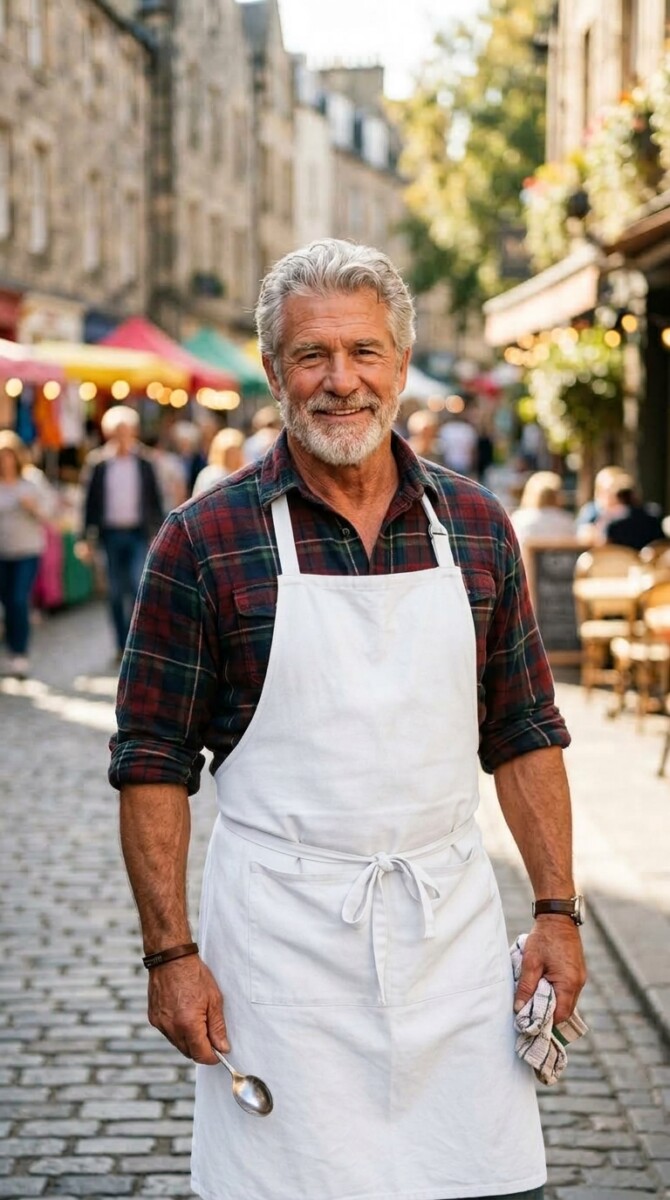
Samuel Ortega had spent years pretending the past no longer existed.
Every morning at exactly six o’clock, he lifted the metal shutter of his small food stand, turned on the grill, arranged the plastic tables, and prepared strong coffee for workers starting their day early.
To most people in the neighborhood, he was simply “Sam,” the broad-shouldered cook with gray hair who served generous breakfasts and rarely talked about himself.
No one asked too many questions.
And he was grateful for that.
His business sat on a sunny street near several municipal buildings. He sold sandwiches, grilled meat, coffee, juices, and simple meals.
Police officers, drivers, office workers, and construction crews passed by every day.
Samuel knew their names, schedules, and preferences.
He knew who wanted coffee without sugar.
Who always ordered a double portion.
Who had a sick child.
Who was waiting for a promotion.
But almost no one knew anything about him.
The official explanation was simple: he had worked for many years in private security, saved some money, and eventually decided to open the food stand.
That was true.
But only partly.
The rest was buried much deeper in the past.
In photographs he no longer looked at.
In documents locked inside a metal box.
And in three names he could still remember without effort.
That morning, while talking on the phone behind the stand, he saw two men approaching in dark blue polo shirts and black pants.
Samuel stopped smiling.
The voice on the other end of the phone kept talking, but he barely heard it.
He recognized them.
They were no longer exactly the young men he remembered.
Many years had passed.
There was new gray hair, small scars, and faces hardened by time.
But it was them.
Daniel Cruz.
Marcos Vidal.
Two former members of a unit where Samuel had worked during a period of his life he never talked about.
The men approached slowly.
There were no visible weapons.
They were not shouting.
But the tension could be felt from several feet away.
Samuel ended the call.
“I knew you’d show up someday,” he said.
Daniel looked around.
“We knew sooner or later we’d have to talk too.”
Samuel slowly lowered the phone from his ear.
“Three men from that unit owe me the truth.”
Marcos raised an eyebrow.
“You’re still holding on to that?”
“I never stopped.”
Daniel lifted one hand.
“We’re not here to cause trouble.”
Samuel let out a dry laugh.
“Fifteen years ago, you said something similar.”
A customer waiting nearby decided to grab his bag and leave.
No one wanted to get caught in an argument that clearly had its roots far in the past.
Daniel stepped closer to the stand.
“Samuel, listen.”
“I’ve listened enough.”
Marcos glanced at the tables.
“We want to talk about Héctor.”
That name changed everything.
Samuel clenched his jaw.
Héctor Salcedo.
The third man.
The one Samuel had never seen again.
The man he blamed for destroying an important part of his life.
“Where is he?” Samuel asked.
Daniel exchanged a look with Marcos.
“He’s on his way.”
Samuel lowered his gaze.
For several seconds, he seemed to be deciding whether to leave or stay.
Finally, he pulled a chair out of the way.
“Then we’ll wait.”
Héctor arrived twenty minutes later.
He came on foot.
No security detail.
No uniform.
None of the authority Samuel remembered.
He was a man close to fifty now, thinner than he had been in the past, with dark hair streaked with gray and a tired expression.
Samuel watched him from a distance.
His heart began pounding harder than he expected.
For fifteen years, he had imagined that meeting hundreds of times.
In some versions, he shouted.
In others, he walked away.
In others, he demanded answers.
But when Héctor finally stood in front of him, Samuel felt only an enormous sadness.
“Hello, Sam,” Héctor said.
Samuel remained still.
“Don’t call me that.”
Héctor nodded.
“I understand.”
Daniel and Marcos stayed several steps away.
Héctor looked at the food stand.
“Nice business.”
Samuel gave a bitter laugh.
“You didn’t come here to talk about food.”
“No.”
“Then talk.”
Héctor took a deep breath.
“I came to tell you that you were wrong.”
Samuel’s expression hardened.
“Be careful.”
“I’m not saying you don’t have reasons to hate us. You do. I’m saying the story you were told wasn’t complete.”
Samuel placed both hands on the table.
“For fifteen years, I’ve known exactly what happened.”
“No.”
“My brother disappeared after that operation.”
“I know.”
“And you came back.”
Héctor briefly closed his eyes.
“Yes.”
“Then don’t tell me I’m wrong.”
Marcos stepped in.
“Samuel, we didn’t know the whole truth back then either.”
Samuel looked at him.
“How convenient.”
Daniel slowly shook his head.
“No. Convenient would have been never coming here.”
That made Samuel fall silent.
Héctor pulled a thick envelope from inside his jacket.
He placed it on the table.
Samuel did not touch it.
“What is that?”
“A copy of the report you never saw.”
Samuel stared at the envelope.
“I saw reports.”
“You saw the official one.”
“And this?”
“The real one.”
The distant sound of traffic seemed to fade away.
Samuel finally picked up the envelope.
Inside were photographs, printed pages, signatures, case numbers, and a document with several paragraphs highlighted.
He began reading.
At first quickly.
Then more slowly.
His expression changed.
“This says the operation was canceled.”
“Yes,” Héctor replied.
“But we went out anyway.”
“Because someone changed the order.”
Samuel looked up.
“You were in command.”
“Not that day.”
Samuel frowned.
Héctor continued.
“I received the order after it had already been altered. I believed it came from higher up. Daniel did too. So did Marcos.”
“Who changed it?”
Héctor remained silent for several seconds.
“Captain Molina.”
Samuel froze.
The name awakened another memory.
Arturo Molina.
A respected superior.
A man who later received medals and promotions.
“That’s impossible.”
“That’s what we thought.”
Héctor pointed at one of the pages.
“Look at the digital signature.”
Samuel read.
He did not understand every code, but one thing was obvious: the original authorization had a different time than the one shown in the file he had known.
“Why?”
“Because Molina was protecting someone.”
Samuel dropped the papers onto the table.
“No.”
Héctor looked at him firmly.
“Samuel, your brother discovered that information was being leaked from inside the unit.”
The world seemed to stop.
“What?”
“Raúl began suspecting it months before. He told me.”
Samuel took a step backward.
His brother Raúl had always been private.
But he had never mentioned anything like that.
“Why didn’t he tell me?”
“Because he wanted to protect you.”
The words hurt.
Samuel looked at the documents again.
There were emails.
Transcripts.
Internal notes.
A blurry photograph of Raúl entering a building.
“What did he do?”
Héctor answered:
“He gathered evidence.”
Daniel added:
“And gave it to the wrong person.”
Samuel slowly looked up.
“Molina.”
“Yes.”
The older cook leaned against the edge of the counter.
Everything he had believed for years was beginning to fall apart.
“So you didn’t abandon him.”
Héctor closed his eyes.
“We lost him.”
“That’s not the same thing.”
“No.”
“Did you look for him?”
“For hours.”
Marcos spoke.
“We went back twice, even after being ordered to withdraw.”
Samuel looked at all three men.
“You never told me that.”
“We were forbidden to talk,” Daniel said. “And when Héctor tried, he was suspended.”
Héctor smiled without humor.
“Then they gave me a choice: accept the official report or lose my career and put my family at risk.”
Samuel clenched his teeth.
“And you chose your career.”
Héctor did not argue.
“Yes.”
The answer was brutally honest.
“Then you did fail me.”
“Yes.”
“You could have spoken.”
“Yes.”
“You could have told my mother the truth before she died believing her son had been abandoned.”
Héctor lowered his head.
“Yes.”
For the first time, Samuel felt his anger settling into a clearer place.
It was not the same guilt he had imagined for fifteen years.
But it was not innocence either.
“And why are you here now?”
Héctor looked at the stand, then at Daniel and Marcos.
“Because Molina died three weeks ago.”
Samuel blinked.
“What does that have to do with anything?”
Héctor took out another document.
“Before he died, he left a statement.”
Samuel took it.
The handwriting was shaky.
It was not a perfect document or some dramatic movie confession.
It was a long, signed, notarized statement in which Molina admitted altering orders, hiding information, and sacrificing an operation to protect a corruption network that had been operating for months.
Samuel read several pages.
His breathing became heavy.
Then he found Raúl’s name.
“Officer Raúl Ortega identified irregularities. His intervention threatened the continuity of the internal operations.”
Samuel stopped reading.
He covered his mouth with one hand.
Fifteen years.
Fifteen years of hating three men.
Fifteen years of remembering his brother as the victim of cowardly teammates.
And now another truth was appearing.
Raúl had not simply been abandoned through negligence.
He had discovered something.
And he had paid a terrible price for it.
Samuel sat down.
No one spoke.
Several minutes later, he asked:
“Did you ever find his body?”
Héctor slowly shook his head.
“No.”
Samuel looked at the floor.
“Then there’s still a chance he survived.”
Daniel hesitated.
“There is technically a possibility.”
Samuel looked at him immediately.
“What does that mean?”
“It means there was never confirmation.”
“Is there something else?”
All three men became silent.
Samuel stood up.
“You didn’t come here just to give me these documents.”
Héctor breathed deeply.
“No.”
Samuel felt his heart racing.
“Tell me.”
“Molina mentioned something before he died.”
“What?”
“A transfer.”
Samuel frowned.
“A transfer of what?”
“A person.”
Marcos pulled out a photograph.
It was old.
Poor quality.
It showed a man entering a private clinic in another country.
Samuel took the image.
His hands began to shake.
“That can’t be.”
“We can’t confirm it’s him,” Héctor said. “But the date is six months after the operation.”
Samuel brought the picture closer to his face.
The man was shown in profile.
Thinner.
With a beard.
But there was something about the way he walked.
Something familiar.
“Raúl…”
His voice barely came out.
Daniel spoke carefully.
“We’re investigating it.”
Samuel looked up.
“How long have you known about this?”
“Two weeks.”
“And you waited until today?”
“We wanted to verify it before giving you false hope.”
Samuel placed the photo on the table.
The anger returned.
“Don’t ever decide for me again what truth I can handle.”
Héctor nodded.
“You’re right.”
This time, no one argued.
Hours later, the stand remained closed.
Samuel had lowered the shutter even though it was still early.
The four men sat inside the small space.
The smell of coffee still lingered in the air.
All the documents were spread across the table.
Héctor explained what they had discovered.
After the operation, an unidentified injured man had appeared at a private clinic near the border.
According to an old record, he was transferred several days later with incomplete documentation.
There were enormous gaps in the records, but an account indirectly linked to Molina had covered the medical expenses.
“Why would he keep Raúl alive?” Samuel asked.
Héctor replied:
“If Raúl had information, he could have been useful.”
“Or a threat.”
“That too.”
Samuel felt a chill.
“And afterward?”
“The trail disappears.”
“So we don’t know whether he died.”
“No.”
For the first time in fifteen years, Samuel had something both worse and better than certainty.
Hope.
And hope could be cruel.
“I want to find him.”
Daniel nodded.
“That’s why we came.”
Samuel looked at Héctor.
“You too?”
“Yes.”
“Because you feel guilty?”
Héctor thought for a moment.
“Partly.”
“And the other part?”
“Because Raúl was my friend.”
Samuel let out a bitter laugh.
“Friends speak up.”
“I know.”
“Friends don’t wait fifteen years.”
“I know.”
Héctor offered no excuses.
That began to break something inside Samuel.
Not forgiveness.
Not yet.
But the certainty that he was speaking to a monster.
Maybe Héctor had simply been a frightened man who made a cowardly decision.
That did not erase the damage.
But it made him human.
And after years behind a grill, Samuel had learned that human beings were far more complicated than perfect heroes and villains.
The search began one week later.
Samuel closed the food stand for several days.
He hung a simple sign:
CLOSED FOR FAMILY MATTERS. WE’LL BE BACK SOON.
His regular customers began asking questions.
He gave no details.
He traveled with Daniel and Héctor to the city where the old clinic had once operated.
Marcos stayed behind reviewing files.
The building was no longer a clinic.
It was now an assisted living facility.
However, part of the old archive had been sent to a municipal warehouse.
They spent two days reviewing documents.
Nothing.
On the third day, a name appeared.
Not Raúl Ortega.
But Rafael Ortiz.
An undocumented patient registered approximately six months after the operation.
Estimated age: thirty-two.
Severe injuries.
Partial memory loss.
Samuel felt his knees weaken.
“Raúl was thirty-two.”
Héctor took the document.
“We need to confirm it.”
The record showed that Rafael Ortiz was later transferred to a rehabilitation center.
The center still existed.
They arrived the next day.
The director reviewed old records and asked them to wait.
She returned with a folder.
“Yes. Rafael stayed here for almost two years.”
Samuel stopped breathing.
“Do you have a photograph?”
The woman hesitated.
“One.”
She placed the photograph on the table.
Samuel began crying before he even touched it.
It was Raúl.
Thinner.
With long hair.
But it was him.
His brother had been alive at least two years after he was declared missing.
Samuel covered his face.
Héctor stepped away.
Daniel was quietly crying too.
“Where did he go after that?” Samuel asked.
The director checked the file.
“He was discharged.”
“With whom?”
“It says here that he recovered part of his memory and decided to relocate.”
“Where?”
The woman pointed to an address.
It was a small coastal town.
Four hours away.
The drive felt endless.
Samuel said nothing.
He stared through the window.
He remembered Raúl as a teenager.
Their arguments.
Improvised ball games.
The last conversation they had.
“When I get back, I’ll help you with that business you want to start.”
Samuel smiled through his tears.
His food stand had begun with that idea.
An unfinished promise.
When they reached the coastal town, they located the address.
It was a small house near the ocean.
Samuel got out of the car.
At first, he could not walk.
Héctor approached him.
“You don’t have to do it right now.”
Samuel looked at him.
“I’ve waited fifteen years.”
He moved forward.
He knocked on the door.
Nothing.
He knocked again.
He heard footsteps.
The door opened.
A man with almost completely gray hair appeared.
There was a small scar near his eyebrow.
Samuel let out a sound that was half sob, half laugh.
The man looked at him in confusion.
Then his eyes began to widen.
“Sam…”
Samuel covered his mouth.
“Raúl.”
His brother stepped onto the small porch.
For several seconds, neither of them knew what to do.
Then they embraced.
There were no speeches.
Only fifteen years of pain collapsing all at once between two men who had believed they would never see each other again.
Héctor stayed behind.
Raúl saw him over Samuel’s shoulder.
His expression changed.
“You.”
Héctor lowered his gaze.
“Hello, Raúl.”
Raúl stepped away from his brother.
“I thought you’d never show up.”
“So did I.”
“Coward.”
Héctor nodded.
“Yes.”
Samuel looked from one man to the other.
There was too much history between them.
Too much that would eventually need to be discussed.
But not that afternoon.
Raúl invited Samuel inside.
Daniel and Héctor decided to wait outside.
For hours, the brothers talked.
Raúl explained that he woke up months later barely remembering anything.
Only fragmented images.
A street.
A face.
Samuel’s name.
The smell of grilled food.
Over time, he recovered parts of his memory, but believed his family had been informed about his situation.
“They told me no one was looking for me.”
Samuel felt anger rising.
“Molina.”
Raúl nodded.
“I think he wanted to keep me far away.”
“Mom died believing you had disappeared.”
Raúl closed his eyes.
The news struck him hard.
“No…”
Samuel took his hand.
“She never stopped waiting for you.”
They both cried.
The reunion could not repair everything.
Some losses were permanent.
But for the first time, there was truth.
Weeks later, Samuel reopened the food stand.
This time, someone else was behind the grill.
A man with gray hair, a scar near his eyebrow, and a tired smile.
Whenever customers asked who he was, Samuel answered proudly:
“My brother.”
At first, Raúl helped only a little.
Then more and more.
He discovered that he enjoyed cooking.
“So you finally opened the business,” he said one morning.
Samuel laughed.
“You took your time coming to help.”
Raúl smiled.
“I had traffic problems.”
It was the first time they were able to joke about the lost years.
Daniel and Marcos began visiting the stand.
Héctor took longer.
He felt he had no right.
Until one afternoon, Samuel called out to him.
“Are you going to stay on the sidewalk?”
Héctor looked surprised.
“I didn’t want to bother you.”
Samuel pointed to a chair.
“Sit down.”
Héctor obeyed.
Samuel placed a plate in front of him.
“This doesn’t mean I’ve forgiven everything.”
“I know.”
“Maybe I never will completely.”
“I understand.”
Samuel sat across from him.
“But my brother is alive.”
Héctor nodded.
“Yes.”
“And you came back to tell me the truth.”
“I should have done it sooner.”
“Yes.”
There was a silence.
Samuel extended his hand.
Héctor looked at it.
Then he shook it.
It was not complete forgiveness.
It was something more real.
A beginning.
Months later, Raúl decided to formally testify about what had happened.
Molina’s documents and Raúl’s testimony allowed old cases to be reviewed and the reputations of people who had been unfairly blamed for years to be cleared.
Samuel stayed beside his brother throughout the entire process.
But the most important lesson did not appear in any document.
It appeared one evening after they closed the stand, when the two brothers sat outside the business watching cars pass.
Raúl asked:
“Did you really plan to settle the score with them?”
Samuel laughed.
“For years.”
“And what would have happened?”
Samuel thought about it.
“I would have punished three men because of a story I didn’t fully understand.”
Raúl nodded.
“Anger does that.”
“Yes.”
Samuel looked at his hands.
“It makes you think you already understand everything.”
Raúl watched him.
“But you didn’t.”
“No.”
A comfortable silence followed.
Samuel smiled.
“Luckily, I waited long enough to listen.”
Raúl raised an eyebrow.
“You think fifteen years counts as waiting long enough?”
They both started laughing.
And that simple, delayed laughter became more powerful than any revenge Samuel had ever imagined.
Because in the end, he did not need to destroy anyone.
He needed to discover the truth.
And the truth gave back something he believed he had lost forever:
His brother.