Victoria had always hated one word above all others: humble.
To her, it sounded small, uncomfortable, almost offensive. In her mind, that word smelled like clothes drying behind the house, old furniture, coffee served in mismatched cups, and conversations held in low voices so the neighbors would not hear about their struggles. Humble represented everything she wanted to escape from. And without realizing it, it was also the word that pushed her farther away from the only person who had truly stood by her since childhood.
The woman she called Mom.
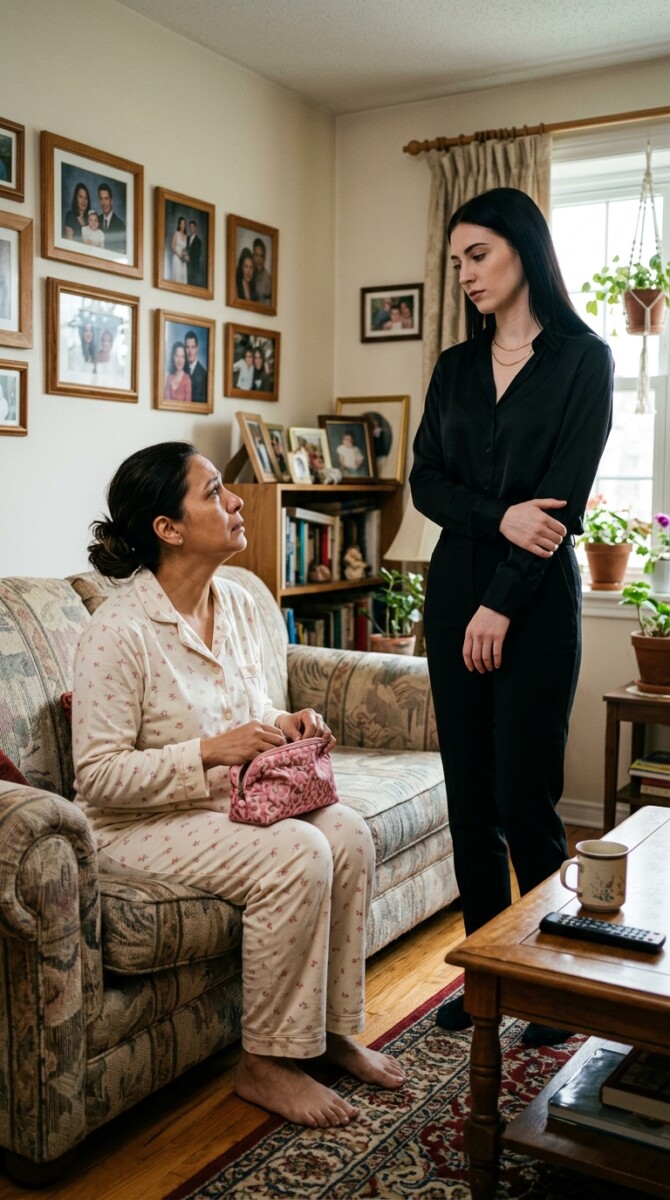
That morning, in the modest living room of the house where they had lived for years, Victoria paced back and forth, checking every detail of her clothes, handbag, and the makeup she planned to wear later.
That evening, an elegant private gathering would be held where, according to what she had been promised, José Gálvez—a young businessman increasingly regarded as one of the city’s rising fortunes—would officially announce his engagement to her in front of a select group of guests.
Victoria could not allow anything to go wrong.
She looked at her mother, who was sitting on the edge of the sofa holding a small pink makeup bag, and felt that familiar urge to correct her, polish her appearance, and hide any trace of simplicity that might embarrass her.
“Get yourself ready and put on some nice makeup,” she said coldly. “Today I’m getting engaged to a millionaire, and I don’t want my mother looking like a maid.”
The woman slowly raised her face. There was no anger in her eyes. Only a mixture of sadness, exhaustion, and a love that seemed incapable of giving up.
“But, sweetheart… he doesn’t know about our family.”
Victoria let out an impatient sigh.
“That’s exactly why. I don’t want him thinking I come from some mediocre background. Everything has to be perfect tonight.”
The woman lowered her gaze toward the small makeup bag, as though such a simple object might give her a better answer than her own words could.
Her name was Teresa.
And if anyone had truly known her, they would have understood that few people had ever loved as deeply as she did. She had worked cleaning houses, cooking meals for others, sewing hems, and caring for elderly people so she could raise the girl who had once entered her life with nothing more than her pride and early beauty.
Teresa never had an advanced education or influential connections. What she did have was resilience. And a stubborn tenderness that pushed her forward even when Victoria began looking at her with embarrassment instead of gratitude.
What Victoria did not know was that Teresa carried silences that were far too heavy.
Old silences.
Silences about decisions she had never wanted to make, children life had taken away from her, and wounds that time had never completely healed.
“Don’t be late,” Victoria said as she looked at herself one last time in the hallway mirror. “And please, don’t say more than you need to.”
Teresa nodded silently.
Sometimes she thought that the worst thing was not being judged by strangers.
The worst thing was being judged cruelly by the person for whom she had sacrificed almost everything.
Even so, she stood up.
Because a mother—or at least a woman who has chosen to love like one—often keeps walking even when her heart is begging her to sit down.
The party was being held in an event hall filled with warm lights and crystal chandeliers. There were floral arrangements, sparkling glasses, perfectly dressed waiters, and a collection of rehearsed smiles that made the atmosphere as beautiful as it was insincere.
Victoria arrived wearing a fitted black dress that highlighted both her figure and her confidence. She walked with her chin held high, carrying that mixture of ambition and nervousness felt only by people who believe they are about to step through a doorway into a better life.
José approached to welcome her with genuine warmth.
That was one of the things she liked most about him: he did not seem like a man desperate to prove how much money he had.
He was elegant, yes, but never excessive.
Well-mannered, but never arrogant.
Victoria found that fascinating because, in her imagination, it made a future beside him seem even more exclusive.
“You look incredible,” José said with a warm smile.
“Thank you,” she replied, immediately softening her voice. “Tonight means a lot to me.”
“It means a lot to me too.”
José seemed genuinely happy. He offered her a glass and introduced her to several guests, although he avoided announcing anything too soon.
Victoria noticed, but assumed it was part of the surprise.
Teresa arrived a few minutes later.
She wore a beautiful red dress, modest yet elegant, which a seamstress from the neighborhood had carefully adjusted for her. Her hair was neatly arranged, and she wore just enough makeup to bring out the calm warmth of her eyes.
She did not shine like the women in magazines, but she radiated something that, in certain places, is worth far more than luxury:
Dignity.
Even so, Victoria barely acknowledged her.
“Stay over there,” she said discreetly. “Don’t come interrupting when I’m with José.”
Teresa nodded.
She had not come to interfere.
She had come because, despite everything, she wanted to see the young woman happy.
What she never imagined was that she herself would find happiness that night for entirely different reasons.
José stepped away for a moment to speak with a few older businessmen.
Victoria remained with two women who pretended to be friendly while quietly examining her from head to toe. One of them casually asked where her family came from.
“My mother is here,” Victoria said, pointing without much enthusiasm. “But, well, we’ve always been very private people.”
The word “private” sounded elegant to her.
Much better than “poor.”
Then she heard a man’s voice behind her.
“Victoria, I want to introduce you to the woman who gave me life. My mother.”
She turned around smiling…
And her smile froze.
José was standing beside Teresa.
Teresa also seemed frozen in place, her lips slightly parted and her eyes filled with an emotion far deeper than surprise.
It was the trembling expression of someone who had suddenly found something she had long ago stopped believing she would ever recover.
Victoria needed several seconds to react.
“Your mother?” she whispered. “But she’s…!”
She did not finish the sentence.
She did not need to.
The silence between the three of them said everything else.
José looked from one woman to the other, confused by the strange intensity of the moment.
“Do you two know each other?”
Teresa clasped her hands in front of her. The glass of champagne someone had offered her remained untouched.
“I…” she began, her voice trembling. “José…”
Victoria took a step backward.
“No. This doesn’t make any sense.”
José frowned.
“What’s going on?”
Teresa took a deep breath before speaking.
“Your adoptive mother found me a few months ago,” she said, looking at José with a mixture of tenderness and old pain. “She searched for me after all these years. She showed me photographs, letters… She told me you also wanted to know the truth, but that you were waiting for the right moment.”
Victoria felt as though the floor had shifted beneath her feet.
“What truth?” she demanded.
José looked gently at Teresa.
“I was adopted when I was a baby. I’ve known since I was a child. Some time ago, I began looking for my biological mother. The investigation took months. Her identity was confirmed recently.”
He turned toward Teresa.
“It’s her.”
The sound of the party continued around them, completely unaware of the emotional earthquake unfolding in that corner of the room.
Victoria stared at Teresa as if she had never truly seen her before.
“You… you’re his mother?”
Teresa slowly nodded. Her eyes were wet.
“Yes.”
“And you never told me?”
Teresa remained silent for several seconds.
Not because she had no answer.
Because she had too many.
Finally, she said:
“Because my story wasn’t simple, Victoria.”
José stepped in calmly.
“Maybe we should sit down.”
But Victoria did not want to sit.
She wanted to understand.
Or deny it.
Or run away.
“It can’t be,” she whispered. “It can’t be that you… that you’re José’s mother.”
The word you came out filled with distance, as though the revelation had built a new wall between them—one formed not from poverty, but from shame.
José noticed.
And something in his expression changed.
For the first time, he looked at Victoria not as the charming woman he had been dating, but as someone whose face revealed an uncomfortable stiffness after discovering that the humble woman she had kept at a distance was the very woman who had given him life.
“This seems to surprise you quite a bit,” he said cautiously.
Victoria swallowed.
“It’s just… I didn’t know.”
Teresa lowered her eyes. There was no resentment in them.
But there was immense exhaustion.
“I didn’t tell you because I could never find the right moment,” she explained. “When I raised you, I was simply trying to survive. You were very young, and all I wanted was to give you some stability. Later, when you grew older, I began feeling that you were ashamed of everything connected to me. And when the possibility of finding José appeared, I didn’t want to mix everything together until I was certain.”
Victoria stared at her in confusion.
“So you’ve known for a while?”
“I only recently learned that José was the son I lost when he was born.”
Those words hit hard.
Victoria knew fragments of Teresa’s past.
She knew Teresa had suffered a terrible loss when she was young. She knew she had once worked for a powerful family and that, because of circumstances Teresa had never fully explained, she eventually found herself alone.
What Victoria did not know was that one of those silences had a name and a face standing right in front of her.
José.
The man she dreamed of marrying.
The millionaire who represented everything she believed she needed in order to escape her past.
The party began fading around her.
The chandeliers.
The tables.
The soft music.
Everything seemed distant.
“And me?” Victoria asked in a faint voice. “Where do I fit into all of this?”
Teresa looked at her with painful tenderness.
“The same place you’ve always had. You are the daughter I raised, even though you didn’t come from my body.”
José turned toward Victoria in surprise.
“She’s not your biological mother?”
Teresa gently shook her head.
“No. I started caring for Victoria when she was five, and then she came back into my life when she was a teenager. Her biological mother, who was my neighbor, died young. I took responsibility for her as best I could. I raised her. I fed her. I defended her many times. But eventually, I suppose none of that meant much to her anymore.”
She did not say it bitterly.
And that was exactly why it hurt even more.
Victoria pressed her lips together.
She remembered entire afternoons when Teresa had given up her own plate of food so Victoria could eat better.
She remembered repaired shoes, school notebooks purchased on payment plans, fevers treated with cold cloths, and nights when a warm hand gently pulled the blanket over her while she slept.
She remembered countless things she had chosen to minimize so she could convince herself that she deserved a brighter future than that simple house and that woman who was simply too good.
And suddenly, all her arrogance seemed ridiculous.
José watched her silently.
His kindness remained, but now it was mixed with disappointment.
“So the person you were ashamed of… is the woman who gave me back my past.”
Victoria looked at him desperately.
“José, I didn’t mean to…”
But she could not find a sentence quick enough to defend years of carefully disguised contempt.
Teresa was the one who softened the moment.
“This isn’t a night for fighting,” she said calmly. “It’s a night for telling the truth.”
José nodded, although his eyes remained fixed on Victoria.
“The truth matters a great deal to me.”
And the way he said it sounded like a warning.
A while later, inside a private room at the same venue, José asked that they be left alone for a few minutes.
He wanted to hear the entire story.
Teresa spoke without excessive drama, with the calmness of someone who had repeated those memories silently so many times that only the raw truth remained.
She explained that, when she was very young, she worked in the home of a powerful family. She fell in love with a man who promised to take care of her, but the situation became complicated because of differences in social status, family pressure, and cowardly decisions.
When she became pregnant, she was pushed away.
There were documents she had been pressured to sign, money involved, and after giving birth she was told that the baby would be “better off with another family.”
For years, she tried to find him, but she had neither money nor connections.
Eventually, she had no choice but to continue living.
Then she spoke about Victoria.
The daughter of a sick neighbor who died far too young.
The little girl Teresa could not simply abandon.
A strong-willed child with ambitious eyes who, without realizing it, filled part of the emptiness left by the son Teresa had lost.
Victoria listened silently.
Every word was an uncomfortable mirror.
Because Teresa’s voice carried no dramatic accusations.
Only facts.
Gestures.
Sacrifices.
And between the lines, a generosity Victoria had never appreciated as much as she should have.
José rubbed his chin thoughtfully.
“So you raised her alone.”
“Yes.”
“And even then she…”
He did not finish.
He did not need to.
Victoria felt her face burning.
“I was unfair,” she admitted for the first time. “I know that.”
Teresa looked at her.
Not harshly.
Sadly.
“What matters isn’t whether you say that because it benefits you today, daughter. What matters is whether you truly understand it.”
That word—daughter—finally broke something inside Victoria.
Because despite everything, Teresa was still calling her that.
She still claimed her through love, not blood.
Victoria lowered her head.
“I just wanted to get ahead in life.”
“Getting ahead doesn’t require stepping on the person who helped you stand up,” Teresa replied with a gentleness that carried more weight than any scream could have.
José remained silent for several seconds before speaking.
“I don’t know what this means for us, Victoria.”
She looked up.
“Do you want to break up with me?”
He did not answer immediately.
“I want to understand who I was building a future with.”
It was an honest answer.
And that was precisely why it hurt.
Victoria felt a knot tightening in her chest.
Until that night, she had always believed that winning over someone like José would be her greatest victory.
Now she understood that wearing the right dress and learning how to move gracefully through an elegant room was not enough.
You also needed the kind of heart capable of recognizing the people who loved you without conditions.
And in that, she had failed.
News of José and Teresa’s reunion spread discreetly through the party, although no one learned every detail.
Some guests understood that something deeply personal had happened and had the decency not to ask questions.
Others, more curious, simply watched from a distance.
José did something Victoria had not expected.
He took Teresa by the arm and publicly introduced her as his mother.
Not with embarrassment.
Not with pity.
With pride.
He walked through the room with her, greeting businessmen, friends, and acquaintances while saying with a genuine smile:
“I want you to meet my mother.”
Teresa, her eyes shining, seemed calmer with every step.
Not because of the luxury or the attention, but because someone was finally saying out loud a bond that time had denied her for years.
Victoria watched them from a distance.
And for the first time in a long while, she felt truly poor.
Not poor in money.
Not poor in connections.
Not poor in clothes.
Poor in something much deeper.
Poor in gratitude.
Poor in humility.
Poor in love.
Later, José returned to her.
“I asked you to come to my office tomorrow,” he said calmly. “I need time to think clearly. I don’t want to make decisions while emotions are running this high.”
Victoria nodded.
“I understand.”
“But I do want you to know something.”
She looked at him with trembling hope.
“The way you treat people matters. To me, it matters more than someone’s last name, clothing, or appearance.”
He was not cruel when he said it.
He did not want to humiliate her.
He was simply being sincere.
And that sincerity hurt more than any insult could have.
Teresa approached a moment later.
“I’m going home,” she announced.
Victoria took a small step toward her.
“Wait… Mom…”
Teresa stopped.
It had been a long time since Victoria had called her that in such a voice.
“I’m sorry,” Victoria said, and this time it did not sound automatic. “I know that isn’t enough today, but… I really am sorry.”
Teresa held her gaze.
“Apologies begin to matter when they become changes.”
Victoria nodded, her eyes filling with tears.
“I want to change.”
The woman took a deep breath.
“Then start by no longer being ashamed of the story that held you up when you had nothing.”
And without any dramatic gesture, she hugged her.
It was a brief embrace.
Restrained.
But it was enough for Victoria to understand that she had not lost everything.
There was still something left to rebuild.
That night, when Victoria returned home alone, she sat on the same sofa where only hours earlier she had spoken so harshly to Teresa.
The small pink makeup bag was still there, forgotten between the cushions.
She picked it up.
It was a simple object, almost childish.
But at that moment, it represented far too much:
The quiet effort of a woman who had wanted to look nice so she could accompany Victoria on one of the most important days of her life, even knowing that her own daughter was ashamed of her.
Victoria cried.
She cried from shame.
From guilt.
From fear of losing José.
From the image of Teresa proudly walking arm in arm with the son life had returned to her.
And she also cried for the little girl she once had been—the girl who knew how to feel loved before learning to look down on simplicity.
She was still awake when morning came.
And yet, for the first time in a long while, she no longer felt obsessed with appearing perfect.
She felt something else.
An urgent need to make things right.
The next day, José received her in his office.
There was no hostility in the room, but there was seriousness.
They spoke for a long time.
He did not want to punish or humiliate her.
He wanted to know whether their relationship had a genuine future, or whether it had begun for all the wrong reasons.
Victoria was honest.
She admitted that José’s money and social position had influenced her greatly at first.
She also admitted something she had never said out loud:
She had spent so many years feeling inferior because of where she came from that she had confused social advancement with personal worth.
José listened without interrupting.
“I appreciate your honesty,” he said at last. “But I need time. And you need something more important than marrying a rich man. You need to reconcile with the woman who loved you when you had nothing to offer.”
Victoria did not argue.
She knew he was right.
During the weeks that followed, a slow and unglamorous process began.
Victoria visited Teresa regularly.
This time, not to ask for help or demand something from her, but to listen.
She learned details about Teresa’s youth, her jobs, her losses, and what it had been like to raise two children in such different ways:
One through absence.
The other through a life of sacrifice and presence.
Not everything was repaired overnight.
Teresa remained cautious.
Years of accumulated pain cannot be erased with a single apology.
But it was also impossible to ignore the genuine change taking place in Victoria.
The young woman began going to the market with Teresa, cooking beside her, asking for her advice without embarrassment, and introducing her to other people with genuine respect.
No longer as a burden who needed makeup so she would not embarrass her.
But as the strong woman who had supported her throughout her life.
José noticed the change too.
And although he did not rush back to promise her marriage, he left open a door that was even more valuable:
The possibility of a future.
Because love, when it wants to last, often looks less at the mistake itself and more at a person’s ability to transform after making it.
Months later, during a small and simple family meal, Teresa found herself sitting between the two of them.
On one side sat José, the lost son whom life had returned to her as a kind and honorable man.
On the other sat Victoria, the daughter who was not hers by blood but who was finally beginning to understand that true wealth does not always come in the form of mansions or diamonds.
There were no grand speeches that day.
Only something much harder to achieve:
Peace.
And as Teresa watched them talk, she realized that perhaps she could never recover the years that had been taken from her.
But she could celebrate something that, in its own way, was also a miracle:
She was no longer the humble woman other people wanted to hide.
She had become the quiet center of a truth that had finally come into the light.
Because in the end, the night of the great engagement did not end with a luxurious wedding.
It ended with something far more important.
A daughter forced to recognize the value of the woman who had raised her.
A reunited son proudly speaking the word “mother.”
And a lesson that no amount of money could ever buy:
Being ashamed of the love that carried you through your hardest days will always cost far more than material poverty ever could.