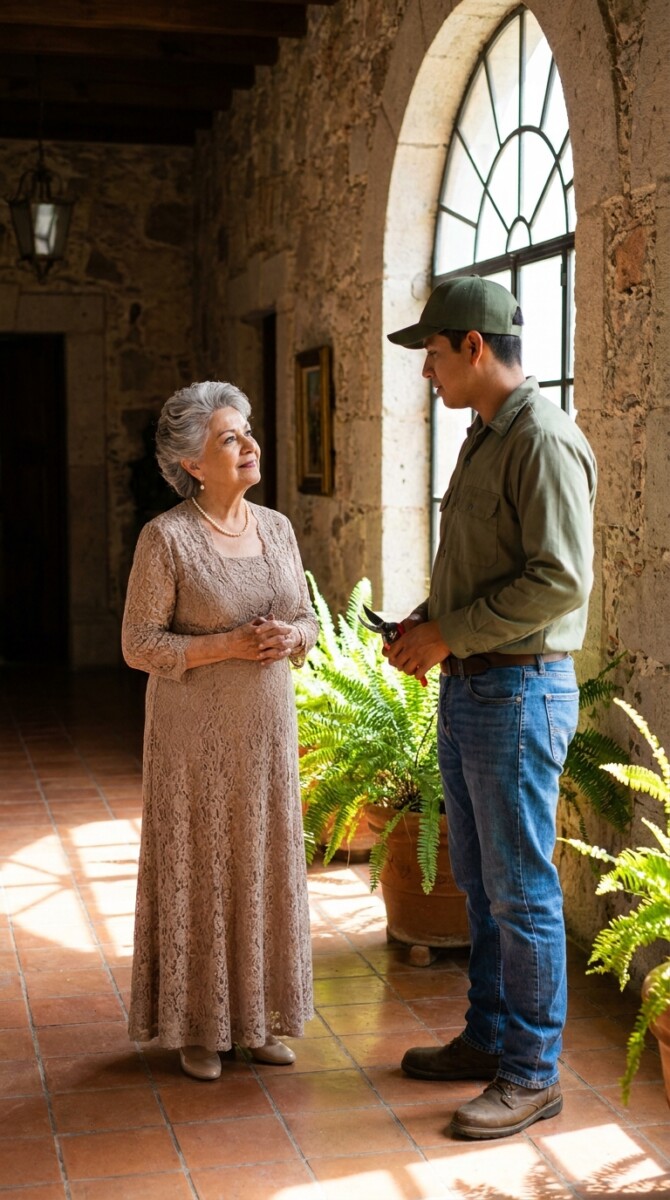
When Clara Valdés closed the door to her bedroom that afternoon, she was still trembling.
She had spent twenty years carrying a wound that had never fully healed, twenty years of discreet searches, silent tears, and unanswered questions. For two decades, she had learned to smile in front of others, to take her place as the lady of the estate, to walk through the hallways with her back straight and her pearl necklace perfectly in place, even though inside she still felt like a mother frozen in the very same day when half of her life had been taken away from her.
And now she was holding a white envelope.
A simple envelope, almost insignificant.
But inside it was the answer to a question that had shaped every year of her life.
She sat on the edge of the bed, took a deep breath, and opened once again the sheet the doctor had handed her in the hallway of the private clinic. She read the words once. Then again. Then a third time, because her heart refused to believe what her eyes had already understood.
Genetic compatibility: 99.98%.
Juan.
The young man from the garden.
The gardener in the green cap, with hands roughened by the soil and a calm expression.
Her son.
Clara let out a sob that had been living inside her for years. She pressed the paper against her chest, closed her eyes, and cried silently.
It was not elegant or controlled crying.
It was the crying of a mother who had learned to live with an emptiness and had just discovered that fate, somehow, had returned what she believed she had lost forever.
She thought about him that morning, pruning the rose bushes near the fountain while the sunlight cast soft shadows across his face.
She thought about the way he had looked at her when she told him that his eyes reminded her of her missing son.
She thought about the respectful way he had answered her, without having the slightest idea of what that conversation had stirred inside her.
“I grew up in an orphanage,” he had told her.
Every word now carried a different weight.
Clara stood up.
Her legs felt weak, but her decision was firm.
She did not want to wait.
She did not want to sit down and analyze the result, calculate the perfect moment, or ask anyone for advice.
She had already waited long enough.
She left the bedroom holding the envelope in her hands and walked through the inner corridor of the estate, illuminated by the warm afternoon light.
The echo of her footsteps seemed louder than usual.
At the end of the hallway, large pots filled with ferns and palms decorated the corridor exactly as they always had, but to Clara everything looked different.
It was as though the entire house were breathing at a new rhythm.
She sent for Teresa, the housekeeper who had been by her side for thirty years.
“Ma’am?” Teresa asked when she saw how shaken Clara was.
Clara looked at her with tear-filled eyes.
“It’s him.”
Teresa blinked in disbelief.
“What?”
Clara raised the envelope.
“Juan. He is my son.”
The woman covered her mouth with one hand.
“My God…”
“I want someone to bring him to me. No… actually, no. I’ll go find him myself.”
She went down the stairs almost with youthful urgency, something very unusual for her.
She crossed the entrance hall, stepped out onto the veranda, and headed toward the back garden, where the fragrance of jasmine mixed with the fresh scent of recently watered soil.
Juan was there, kneeling beside a low hedge, patiently removing dry leaves.
When he heard footsteps approaching, he raised his head and immediately stood, adjusting his cap respectfully.
“Ma’am? Are you feeling all right?”
Clara wanted to answer, but for a moment she could not.
She looked at him in silence.
Not as an employer.
Not as someone evaluating an employee.
She looked at him the way one looks at something deeply loved that had once been feared lost forever.
He frowned slightly.
“Did something happen?”
Clara extended the hand holding the envelope.
“Juan… I need to talk to you.”
He nodded.
“Of course, ma’am.”
They walked to a wrought-iron bench beneath a corridor covered in bougainvillea.
Clara sat first, while Juan remained standing, uncomfortable but attentive.
“Sit down, please,” she said.
He obeyed somewhat shyly.
Clara looked directly at him.
“A few days ago, when I saw you working near the fountain… there was something about you that shook me. I couldn’t explain it. It was your expression. The way you tilted your head. Even the way you spoke… You reminded me of someone I lost a long time ago.”
Juan remained silent.
“That’s why I asked about your family,” she continued. “And that’s why… I arranged for a test.”
The young man’s eyes changed.
There was no fear yet, but there was confusion.
“A test?”
Clara slowly nodded and opened the envelope with trembling hands.
“Juan… you did not arrive in this garden by coincidence.”
He stared at her.
“I don’t understand.”
Clara’s voice broke.
“You are my son.”
For a moment, the world seemed to stand still.
In the distance, a bird could be heard singing and the fountain murmured softly.
But between the two of them there remained only a dense, almost unreal silence.
Juan did not react immediately, as though the sentence had not yet found a logical place inside him.
“Ma’am…” he finally whispered. “That can’t…”
Clara handed him the sheet.
“I confirmed it with the doctor. The results leave no doubt.”
Juan took the paper as though he were holding something both fragile and dangerous.
He read slowly.
His eyes moved from one line to another, widening more each time.
He swallowed.
“I…” he murmured. “I don’t remember anything. Only the orphanage. They told me I was found when I was very young. That there was no clear information about my family.”
Emotion tightened Clara’s throat.
“Your name was Gabriel when you were born,” she said softly. “You were only a few months old when you disappeared.”
Juan—or Gabriel—looked up sharply.
“I disappeared?”
The woman nodded as fresh tears filled her eyes.
“It was the worst day of my life. There was an accident on the road. The car you were traveling in with your nanny was found hours later, empty. She was never found. Neither were you. They searched for weeks. Then months. Then years.”
Juan took a deep breath, visibly affected.
“And… my father?”
Clara’s expression changed.
A more bitter shadow appeared.
“Your father died two years later. He never recovered from losing you.”
The news struck the young man with a strange weight, like grieving someone he had never met and yet somehow felt belonged to him.
He lowered his eyes to the paper again.
Then he looked at his hands, rough from work.
Then at the garden.
Then at the elegant gray-haired woman sitting in front of him, watching him with a love impossible to fake.
“I don’t know what to say,” he admitted.
Clara nodded with understanding.
“You don’t have to say anything right now. I know this is too much. I just… needed you to know the truth.”
Juan took a moment before speaking.
“All my life, I thought I didn’t belong anywhere. That I had been born from a mistake or some tragedy no one wanted to remember. I always wondered why no one ever came looking for me.”
His voice grew hoarse.
“And now you’re telling me that someone did.”
Clara extended one hand and very gently placed it over his.
“I looked for you every day, son.”
The word son was what finally broke him.
He did not cry immediately, but his eyes filled with such pure emotion that Clara understood that perhaps he too had been waiting his entire life for something like this, even without knowing exactly what it was.
That evening, they did not have dinner in the main dining room.
Clara asked for dinner to be served in a smaller, more intimate sitting room overlooking the garden.
She wanted to speak with him without witnesses, without formalities, without the ridiculous distance that luxury sometimes creates.
Juan arrived changed, still wearing simple clothes but freshly washed and with his hair more carefully arranged than usual.
He sat across from her with a mixture of nervousness and respect.
There was light soup, freshly baked bread, and hot tea on the table.
Nothing extravagant.
Clara did not want to impress him.
She wanted to know him.
They talked for hours.
Juan told her about his childhood at the San Miguel orphanage, the difficult mornings, afternoons spent studying, temporary jobs, and the unexpected love he discovered for plants and outdoor work.
He explained that he had never truly resented life, although he had learned not to expect too much from it.
Clara listened with absolute attention.
Then it was her turn.
She told him about the estate, about his father, and about what he had been like as a baby before disappearing: a calm child with an intense gaze who tightly gripped the finger of whoever was holding him.
She showed him old photographs and albums that had been stored for years inside a wooden box.
Juan looked at them with a silent hunger, as though trying to recover an entire history all at once.
That was when an unexpected detail appeared.
In one photograph, a young woman could be seen in the background holding him.
It was not Clara.
Nor was she simply another employee.
Juan pointed at the picture.
“Who is she?”
Clara studied the image and her expression hardened slightly.
“Her name was Elvira. She was the nanny who was with you on the day you disappeared.”
“And she said she didn’t remember anything?”
“She never said anything,” Clara replied with a different kind of sadness. “They never found her.”
Still, something about the photograph left Juan thoughtful.
He said nothing at the time, but a strange sensation ran through him.
The woman’s face seemed vaguely familiar.
Not because of memory, but because of something stranger.
Instinct.
The following day, Clara announced to the entire household staff that Juan would temporarily stop working in the garden and that, while certain matters were being reorganized, he would stay inside the main house.
The reactions varied.
Teresa cried with joy.
Some employees crossed themselves.
Others simply stared in shock.
But no one openly objected…
except one person.
Ricardo Valdés, Clara’s nephew, administrator of the estate, and a man who had always assumed that sooner or later he would inherit a large portion of the family fortune, received the news with a smile that was far too stiff.
“Aunt Clara, are you sure about this?” he asked, trying to sound cautious rather than alarmed. “This is a very delicate decision.”
Clara looked at him with elegant coldness.
“As sure as a mother can be when she finds her son again.”
Ricardo lowered his head.
“I’m not saying it isn’t emotional. I just think we should be… careful. You know how people are. Opportunists sometimes appear.”
Juan, who was present in the room, said nothing.
But he did notice the way Ricardo avoided looking him in the eyes for too long.
Clara ended the conversation without hesitation.
“The results have already been verified. I don’t need any more opinions.”
Ricardo smiled uncomfortably and left.
Later, it was Teresa who brought the first real piece of the larger puzzle.
She entered the bedroom now being used by Juan carrying a small cardboard box.
“I found this in the old storage room,” she said. “These were belongings kept from many years ago. Mrs. Clara hadn’t looked through them since… well, since everything happened.”
Inside were newspaper clippings, papers, a baby blanket, and an old notebook.
On one of its pages, there was an address written by hand.
Juan read it several times.
“What is this?”
Teresa frowned.
“I don’t know. But it’s signed by Elvira.”
The address belonged to a small town nearly two hours away from the estate.
When Clara learned about it, she did not hesitate.
“We’re going tomorrow.”
They left early in a discreet car, just Clara, Juan, and Teresa.
The drive was long, passing through rural stretches and narrow roads.
Eventually, they arrived at a modest house with a low gate and walls worn by time.
It took a while before the door opened.
The woman who appeared was elderly, with a curved back and trembling hands.
But there was recognition in her eyes even before anyone spoke.
Clara froze.
“Elvira…”
The old woman lowered her gaze.
“I knew this day would come.”
No one raised their voice.
No one created a scene.
Sometimes, when the truth arrives after so many years, it comes more like exhaustion than an explosion.
Sitting in the humble living room of the house, Elvira confessed what had happened.
She had not kidnapped him for money.
She had not sold him.
She had been pressured by someone close to the family.
Someone who feared the child would inherit everything and wanted him removed from the picture.
She was offered money and protection if she disappeared with him and broke all connection with the family.
The plan was to leave him at an institution far from the city and pretend that both of them had died or run away.
Clara felt her blood run cold.
“Who?” she asked.
Elvira cried.
“Your brother-in-law, ma’am. Don Ernesto.”
Ernesto.
The younger brother of her late husband.
The man who had handled financial matters for years after her husband’s death.
The man who, coincidentally, had served as temporary guardian of the estate until Ricardo, his son, later took over the administration.
Juan clenched his fists but remained calm.
“Did my cousin know I was alive?”
Elvira shook her head desperately.
“I think his father knew. Ricardo… I don’t know. But when Don Ernesto became sick and knew he was dying, he came looking for me. He wanted me to praise what he had done, as though he had saved the family fortune. He left me money to keep quiet. I accepted it… and I carried this guilt for all these years.”
Clara closed her eyes for a moment.
She did not cry.
She had passed beyond that stage.
Now there was something else inside her.
Clarity.
They returned to the estate as evening fell.
Ricardo was waiting for them in the study, nervous.
The moment he saw their faces, he understood that something had changed.
Clara entered first.
Then Juan.
Teresa closed the door.
“Sit down, Ricardo,” Clara said.
He turned pale.
“What happened?”
Clara placed the notebook, a copy of Elvira’s signed confession, and the genetic test results on the desk.
“What happened is that I now know the entire truth.”
Ricardo tried to maintain his composure.
“I don’t know what you’re talking about.”
Juan looked at him firmly.
“Your father had me taken away.”
Silence filled the room immediately.
Ricardo looked away for only a second.
That was enough.
“I had nothing to do with that,” he finally said. “By the time I found out, many years had already passed.”
“But you knew,” Clara replied.
He swallowed.
“I found out years later. My father confessed before he died.”
“And you stayed silent.”
“What did you expect me to do?” he finally exploded. “It was already done! If I spoke, I would have destroyed the family!”
Clara looked at him with impeccable coldness.
“No. What you protected was not the family. It was your own convenience.”
Ricardo had no answer.
Juan did not feel uncontrollable rage.
He felt something sadder.
The confirmation that part of his absence had not been an accident or fate.
It had been ambition.
Clara stood.
“As of today, you are removed from all administration of this estate. My attorneys will receive all necessary documentation tomorrow morning. And you would be wise to cooperate.”
Ricardo opened his mouth, but there was no defense left to make.
He left that same night.
The house felt strangely lighter afterward.
Weeks later, Juan began adapting to his new life.
He did not stop being who he was.
He still woke up early, walked through the garden, and helped the workers whenever he could.
But he also began occupying a different role.
He learned about the family archives, discovered the history of his parents, reviewed accounts, studied documents, and became interested in the management of the property.
Clara watched him with quiet pride.
She did not try to recover twenty lost years all at once.
She knew love cannot magically erase absence.
It must be built.
Confirmed.
Learned.
One afternoon, while they were drinking coffee on the veranda, Juan looked at her with a faint smile.
“Sometimes I still have trouble believing it.”
“So do I,” Clara admitted.
He turned the cup between his hands.
“For a long time, I dreamed of finding an answer. I never imagined it would be so close. Or that I had been walking over it every morning while watering the hydrangeas at this house.”
Clara laughed softly, her eyes bright with restrained tears.
“Fate has very strange ways of asking for forgiveness.”
Juan looked toward the garden he knew so well.
“Do you know what the strangest part is?”
“What?”
“For the first time, I don’t feel like I’m missing a place to return to.”
Clara reached across and placed her hand over his.
“Because you’re already home, son.”
And this time, when Juan heard that word, it did not hurt.
It belonged to him.
