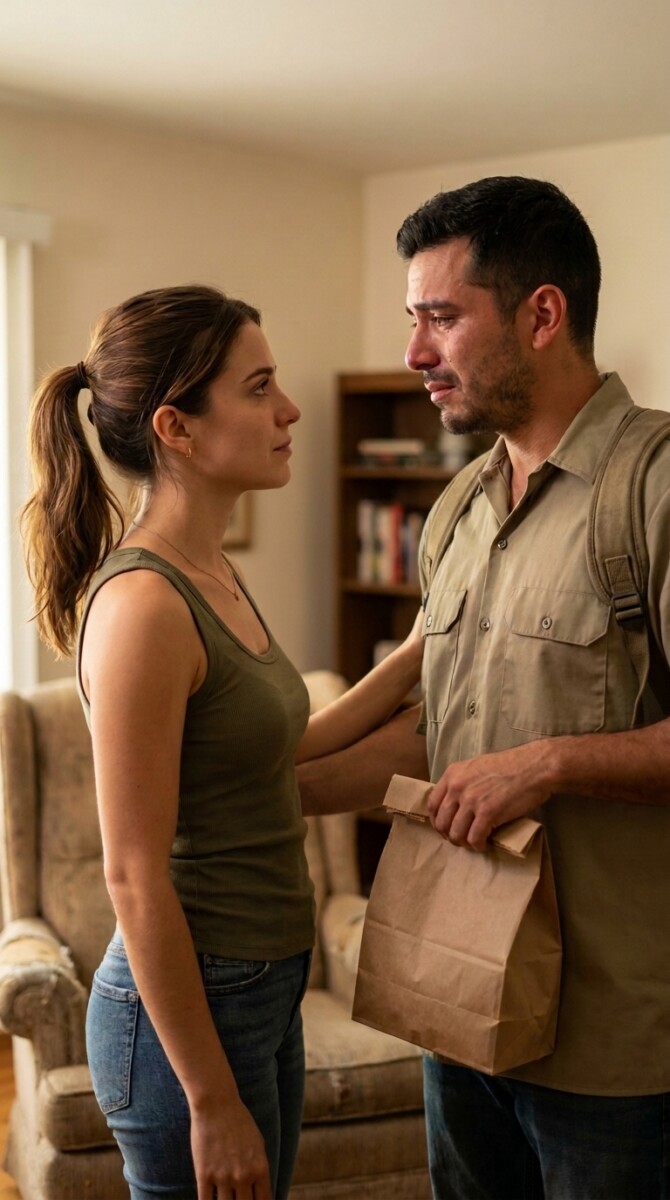
Roberto stood still in the doorway of the living room, holding the glass food container in his hands as if it weighed far more than it actually did.
He still had his backpack over one shoulder. His work shirt, lightly covered in dust, carried fresh wrinkles from a sleepless night and from a morning when he had left the bedroom trying to make as little noise as possible. He had not expected to find Camila awake. Much less had he expected her to be waiting for him with lunch already prepared.
The night before, they had argued more intensely than they had in a long time.
Not over some passing little issue, but over the kinds of things that quietly build up until one day they explode through the wrong sentence. They talked about money, exhaustion, the house, the plans they kept postponing, Roberto’s overtime hours, and the distance that had slowly settled between them without permission. In the middle of their anger, they said things they did not need to say. Words people sometimes throw out not because they are completely true, but because they know exactly where they will hurt.
Roberto had barely slept a few hours.
Camila had probably slept even less.
That was why he could not understand what was happening now.
“We’ve been fighting since yesterday,” he said, looking at the container. “We said some terrible things to each other… why did you make me lunch?”
Camila stood in front of him, steady and calm, with that particular way she had of holding on to her composure even when she was hurt. She wore an olive-green T-shirt, simple jeans, and her hair pulled back into a ponytail.
Her face looked tired.
But it did not look hardened.
“Because it’s what I’m supposed to do,” she replied. “Being angry doesn’t change my commitment to taking care of you.”
The sentence landed in the room with a strange kind of force.
It was not romantic in an easy way.
It was not dramatic.
It was not an instant reconciliation or an attempt to pretend that nothing had happened.
It was something else.
Something deeper.
Something even a little uncomfortable.
It was her way of saying: I am still hurt, but I will not let pride interfere with what truly matters.
Roberto swallowed hard.
He wanted to say something quickly, something that would loosen the knot forming in his throat, but he could not.
He simply lowered his eyes toward the container.
“Camila…”
She stepped closer and gently placed one hand on his arm.
“Hunger doesn’t know anything about pride, Roberto. We can be hurt, but that doesn’t mean we stop being partners. Go to work.”
He looked up at her.
For the first time since the argument, he saw something that his anger the night before had prevented him from noticing.
She was tired too.
She was hurt too.
And even so, she was choosing to care.
“Forgive me… and thank you, my love,” he murmured, his voice breaking.
Camila did not answer with a hug or a big smile.
She simply nodded.
“We’ll talk when you get back.”
And at that moment, that was enough.
Roberto left the house with the food container in one hand and a heavy feeling in his chest.
The street was alive as always: engines, people in a hurry, a vendor passing by with his cart, the late-morning sunlight reflecting off the windows.
But Roberto walked as though he were carrying a conversation inside himself that had not yet truly begun.
He got on his usual bus, sat near the window, and stared at his reflection in the glass.
Dark circles under his eyes.
Several days of stubble.
An expression he did not like at all.
He thought about the argument.
It had all started with something that seemed small.
Camila had asked whether they could finally visit her mother on Saturday because she had been inviting them for weeks.
Roberto answered badly, using that dry tone that had become increasingly common whenever he came home exhausted.
Then Camila mentioned how little time they spent together.
He said he worked precisely so that nothing would be missing at home.
She replied that a relationship could not survive on paid bills alone.
And after that, as often happens, they stopped arguing about the issue in front of them and began attacking each other with all the things they had been storing away.
Roberto accused her of sometimes failing to understand the pressure he felt to keep everything together.
Camila accused him of turning his exhaustion into distance.
At one point, he told her that perhaps she did not appreciate everything he did.
Hurt, she answered that caring for someone was about more than simply bringing home money.
That sentence had infuriated him at the time.
Now, sitting on the bus with the lunch container on his lap, he could no longer deny that there was truth in her words.
He arrived at the construction site shortly before eight.
The sound of tools, the yellow hard hats, the dust, and the familiar physically demanding routine served as a distraction at first.
He greeted his coworkers, put on his gloves, and started the workday.
For several hours he carried materials, checked measurements, moved structures, and followed instructions.
His body continued working even while his mind kept returning to the image of Camila handing him his lunch.
At noon, he sat with two coworkers in a shaded corner to eat.
One of them was Ernesto, an older man who had spent decades working in construction.
Ernesto looked at Roberto as he opened the glass container.
“They sent you a feast today,” he commented.
Inside was chicken with rice, fresh salad, and slices of golden fried plantain prepared exactly the way Roberto liked them.
There was even a small piece of avocado wrapped separately.
Roberto let out a breath through his nose, almost like a sad laugh.
“After the fight we had last night, this feels like a miracle.”
“Ah,” Ernesto said while opening his bread and cheese. “Then it isn’t a miracle. That’s the good kind of love.”
Roberto looked at him from the side.
“The good kind of love?”
“Yes. The kind that doesn’t depend on someone’s mood. The kind that doesn’t disappear because there was yelling. The kind that doesn’t get confused with pride.”
Roberto lowered his gaze toward the food.
“Sometimes I think I’ve made her tired of me.”
Ernesto placed his hard hat beside him and took a drink of water before answering.
“Listen, kid. Relationships don’t fall apart only because people argue. They fall apart when one person starts believing that being angry gives them the right to stop caring. That’s when the serious damage begins.”
Roberto listened silently.
“If she made you food today,” Ernesto continued, “she didn’t do it because last night didn’t hurt her. She did it because she still knows the difference between being hurt and abandoning someone. Don’t confuse that with weakness. That kind of strength is rare.”
Roberto set his fork down for a moment and felt something tighten inside him.
“Last night I told her everything was on my shoulders,” he admitted. “As if I were the only one holding anything together.”
“Are you?”
Roberto thought about the clean house.
The clothes always folded.
The coffee ready at dawn.
The way Camila stretched small amounts of money intelligently when the month was tight.
The way she waited awake when he came home late.
The plans she had postponed so the two of them could become more financially stable.
“No,” he answered, almost in a whisper. “I’m not.”
Ernesto nodded, as though that answer mattered more than any advice he could possibly give.
When Roberto finished eating, he found a folded napkin at the bottom of the container.
He opened it and saw Camila’s handwriting:
“Don’t forget to drink water. And don’t climb any scaffolding if you’re still dizzy. You looked pale yesterday.”
Nothing else.
No hearts.
No sweet phrases.
No decorative apologies.
Just care.
The kind of care that pays attention even when someone is angry.
Roberto felt ashamed of himself.
Not the kind of shame that humiliates a person, but the kind that appears when someone clearly realizes they have been harsher than necessary with a person who did not deserve it.
The rest of the workday felt long.
Not because he worked less, but because his mind was somewhere else.
At four in the afternoon, while he was helping secure a metal structure, one of his coworkers briefly lost his balance.
Nothing serious happened, but the scare was enough to alarm everyone.
Roberto was one of the first people to grab him.
When the supervisor confirmed no one was injured, everyone finally relaxed.
But the incident left Roberto with one thought he could not shake:
Ordinary days can change in seconds.
And you never know whether the last thing you said before leaving home was a pointless wound or something worth remembering.
When his shift ended, Roberto gathered his things but did not go directly to the bus.
First, he stopped at a small flower shop on the corner.
He looked through the options for a while, feeling awkward.
He did not want to show up with an empty gesture, as though a bouquet could solve the conversation they still needed to have.
In the end, he chose a simple arrangement, nothing too flashy.
He also stopped at a nearby bakery and bought Camila’s favorite sweet bread.
When he boarded the bus, he carried the flowers in one hand, the bag of bread in the other, and one firm decision:
That night, he was not going to justify himself.
He was going to listen.
He was going to apologize sincerely.
By the time he arrived home, the sun was already going down.
The door was slightly open, and soft music could be heard coming from the kitchen.
Roberto entered quietly.
Camila was chopping onions in front of the stove.
She had not even changed her clothes.
There were obvious signs that she had also had a long day.
Still, the house smelled like dinner had just started cooking.
She turned when she heard the door.
The first thing she noticed was the flowers.
She did not smile right away.
“You’re home early.”
“Yes.”
He placed the bread on the table and awkwardly offered her the flowers.
“I’m not trying to buy your forgiveness with these,” he said immediately. “But I didn’t want to come home empty-handed either.”
Camila accepted the flowers without quite knowing what to do with the gesture.
She placed them in a tall glass of water because they did not own a proper vase.
Then she leaned against the table.
“All right,” she said. “Let’s talk.”
And they talked.
Without raising their voices.
Without trying to score points.
Without turning the conversation into a trial.
Roberto was the first to open up.
He told her he was exhausted, yes, but that it did not justify the way he had spoken to her.
He admitted that for weeks he had trapped himself inside the belief that everything depended on him, as though his own exhaustion mattered more than anyone else’s.
He admitted that lately he came home with his body present but his mind somewhere else.
Camila listened without interrupting him.
Then it was her turn.
She said she understood the pressure Roberto carried and admired how hard he worked, but that she had started feeling lonely inside their marriage.
She missed the man who used to tell her about his day, not just the man who left his boots by the door and sat silently in front of the television.
She did not need luxury or huge promises.
She needed a life they were truly sharing.
“I don’t want to fight with you about everything,” she said. “But I also don’t want to get used to feeling like you’re right beside me and far away at the same time.”
The words hurt.
But only because they were true.
Roberto ran a hand over his face.
“I didn’t realize how much I was pushing you away from me.”
Camila slowly shook her head.
“I shut down about some things too. I also speak from exhaustion sometimes. I’ve also held on to frustrations. I don’t want to make you the villain, Roberto. I just want us to remember that we’re on the same team.”
He looked up.
That sentence reminded him exactly of what she had said that morning:
“We can be hurt, but that doesn’t mean we stop being partners.”
Then he finally understood something he had refused to look at honestly until that day:
Mature love does not always look like it does in movies.
Sometimes it does not come wrapped in grand declarations.
Sometimes it arrives in a glass food container with rice, chicken, and a napkin reminding you to drink water.
“Ernesto told me something at work today,” Roberto said. “He said relationships don’t fall apart only because people argue. They fall apart when someone stops caring because they’re angry.”
Camila looked at him carefully.
“He’s right.”
“I don’t want to be that kind of man.”
Her shoulders relaxed slightly, like someone finally realizing she was no longer speaking alone.
“Then don’t be.”
Roberto moved closer slowly.
“I want to do better. Not by making huge promises overnight, but for real. By listening to you. By being present. By stopping myself from using exhaustion as an excuse.”
Camila held his gaze.
There was tenderness there, but also the kind of clarity that would not allow the moment to disappear as though nothing had happened.
“I want to do better too,” she said. “But we need actions, not just good intentions on an emotional day.”
“I know.”
And he truly did.
That night, they ate dinner together.
There was no tension, although both of them were still emotionally sensitive.
Afterward, they washed the dishes together.
Later, they sat in the living room with the window open, the distant noise of the street entering the room like someone else’s breathing.
They talked about practical things.
How to organize their finances better.
How to reclaim Saturday afternoons as time for themselves.
How they would visit Camila’s mother that weekend.
How Camila might return to a course she had put on hold.
Roberto also suggested something they had avoided for months because of money and pride:
Couples counseling at the neighborhood community center, where affordable sessions were available.
Camila looked surprised.
“You would do that?”
“If it helps us stop stumbling over the same problems, yes.”
She slowly nodded.
“Then let’s do it.”
That night did not solve every problem.
It did not suddenly erase the exhaustion, financial uncertainty, their individual personalities, or the future disagreements they would inevitably have.
But it accomplished something more important.
It reminded both of them where the center of their relationship was.
It was not about who was right.
It was about how they wanted to love each other inside a real life.
The following days were different.
Not because they suddenly became a perfect couple, but because they began paying attention to small things they had previously ignored.
Roberto started sending her a message during his workday, even if it was only to ask how she was doing.
Camila learned to speak more clearly when she felt overwhelmed instead of waiting until everything accumulated and exploded.
On Saturday mornings, they walked to the market together.
Sometimes they bought something small and cooked together.
Other times, they simply talked.
One afternoon, several weeks later, Roberto came home from work later than usual.
He was exhausted, his boots covered in dust, sweat around his neck, and pain running through his back.
When he entered the house, he found the table already set and Camila half asleep on the couch with a closed book resting on her chest.
He approached quietly, covered her with a light blanket, and went into the kitchen.
There, next to the plate she had left for him, he found a simple note:
“Heat up the soup. It tastes better with lemon. And don’t forget that I love you, even when you drive me crazy.”
Roberto laughed to himself in the kitchen.
Then, where she could not see him, he had to discreetly wipe his eyes.
Because in the end, he had finally understood the most important lesson of all:
True love is not demonstrated only on easy days.
Not only through beautiful hugs.
Not only through happy photographs.
Not only through grand words.
It is demonstrated when pride invites someone to walk away…
and they choose to keep caring anyway.
And from that lunch after the fight onward, Roberto promised himself he would never forget that again.