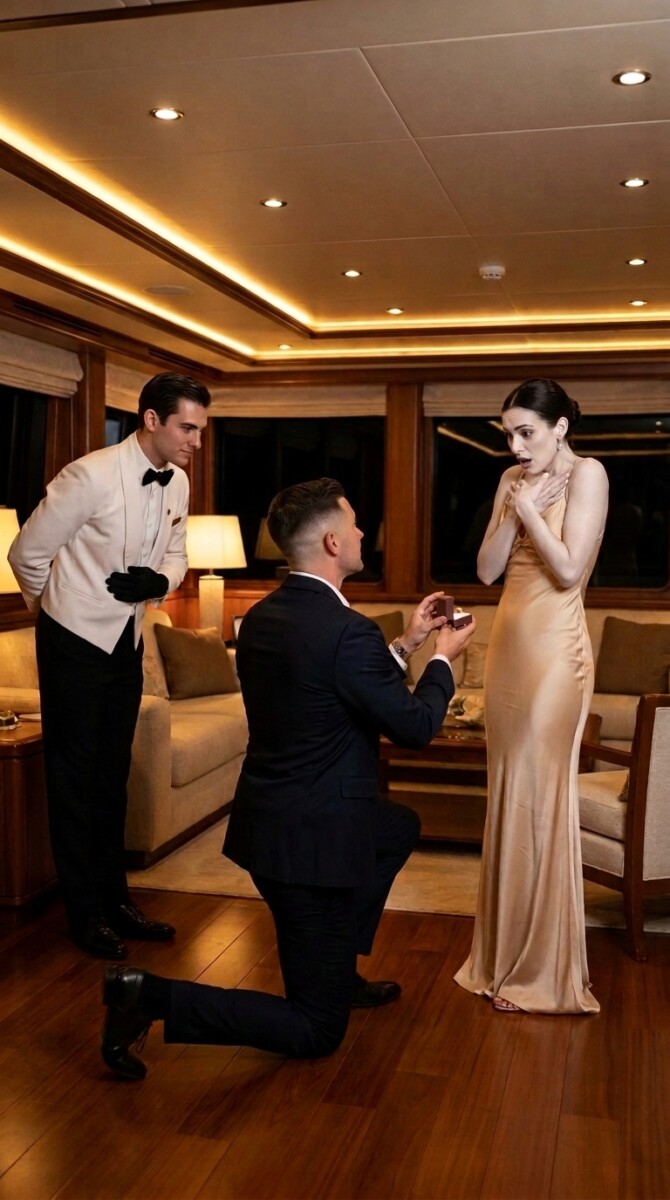
When the butler spoke those words—“Sir, your helicopter is ready”—the silence inside the yacht’s cabin became so heavy that even the sound of the sea seemed to stop for a moment.
The young man who was still kneeling, holding the small open velvet box in his hands, did not change his expression. He did not smile mockingly. He did not suddenly stand up. He did not try to enjoy the impact of the revelation. He simply raised his eyes slowly toward the woman standing in front of him and watched as, for the first time that night, her confidence began to crack.
Only a few seconds earlier, she had been standing there, elegant and cold, her chin slightly raised, looking at him as though his proposal had been an insult.
“Do you really think I’m going to marry you?” she had said. “I’m too expensive for someone like you. I need men with real money.”
Now, however, her eyes moved from the butler to the young man, from the young man to the window, from the window to the luxurious interior of the yacht, as if suddenly every detail she had ignored was screaming the truth at her all at once.
The yacht.
The butler.
The helicopter.
And the man she had just humiliated.
“Your… helicopter?” she finally asked, her voice noticeably lower.
The young man gently closed the ring box and stood up without rushing.
His face was calm, but there was something tired in his eyes. It was not the dramatic anger of someone looking for revenge. It was the quiet disappointment of someone who had just confirmed a painful suspicion.
“Yes,” he replied. “My helicopter.”
She took a small step backward.
“No… I don’t understand.”
He watched her for a few seconds before answering.
“That is exactly what I came here to find out.”
The woman pressed her lips together. For the first time, her composure failed her.
Her name was Veronica. They had been dating for a year and a half. They met at a charity event in the city, where he had arrived dressed simply, without announcing his last name, his wealth, or his position. All she knew was that his name was Gabriel, that he worked in “family businesses,” and that he lived a much more discreet life than the men who usually surrounded her.
Gabriel had done that intentionally.
He had grown up surrounded by people who measured the value of others by the size of their car, the brand of their watch, or the last name appearing on the cover of a magazine. He learned far too early that money attracted many people… but not always the right ones. After a previous relationship had ended for exactly that reason, he decided to hide his true wealth from anyone who seemed overly interested in superficial things.
With Veronica, he wanted to believe things would be different.
At first, in fact, they were.
She was elegant, charismatic, very beautiful, and knew how to move comfortably in any social environment. Gabriel was attracted to her confidence and to the ease with which she spoke about art, travel, and ambition. But over time, he began noticing certain cracks: dismissive comments about people with modest jobs, a constant obsession with status, unnecessary comparisons, and her habit of asking how much everything cost before allowing herself to enjoy it.
Even so, he wanted to give her one more chance.
That night on the yacht, he had not only planned a proposal.
He had also planned a test.
Not an act of cruelty.
A moment of truth.
That was why he had chosen to appear in the same simple style she had known from the beginning. That was why he never revealed that the yacht belonged to his family. That was why he allowed her to believe that the elegant dinner was borrowed luxury, an occasional extravagance arranged by a romantic man who “did not have enough money.”
Veronica spoke again, but this time her voice was no longer arrogant. She sounded unsettled.
“Gabriel… is this yacht yours?”
He slipped the ring box into the inside pocket of his jacket.
“Yes.”
“And the helicopter too?”
“Yes.”
Veronica’s expression changed completely.
There was no longer contempt in her eyes.
There was calculation mixed with embarrassment.
“I… I didn’t know.”
Gabriel gave a slight nod.
“I know.”
The butler stood to one side, his eyes respectfully lowered with the impeccable discretion of someone who had witnessed too many other people’s secrets to be surprised anymore. He silently waited for instructions.
Veronica let out a nervous laugh.
“Well… this is crazy. If you had told me before…”
Gabriel interrupted her gently, but without yielding an inch.
“If I had told you before, I never would have known what you really thought of me when you believed I had nothing to offer you except who I am.”
The words landed heavily.
Veronica tried to recover.
“That’s not what it was.”
“Yes, it was.”
“I was just upset, Gabriel. You surprised me, caught me off guard, said everything all at once…”
“I didn’t ask you for a perfect answer,” he replied. “I only asked for an honest one. And you gave it to me.”
She stared at him silently.
Perhaps, for the first time in a long while, someone had left her without an easy way out.
Gabriel took a deep breath and looked briefly toward the window. Outside, the lights of the harbor reflected across the dark water.
“I thought tonight was going to change my life,” he said calmly. “And in a way, it did. Just not in the way I imagined.”
Veronica stepped closer.
“Wait… are you telling me this is all over because of a misunderstanding?”
Gabriel looked directly at her.
“It didn’t end because of a misunderstanding. It ended because of the truth.”
She tried to touch his arm, but he stepped back slightly—just enough to create distance without turning it into a spectacle.
“Thomas,” he said to the butler, “please escort Miss Veronica to the dock. Have the driver take her home.”
Veronica’s eyes widened in disbelief.
“You’re throwing me out?”
“I’m trying to prevent an even more painful scene.”
“Gabriel, don’t be ridiculous. We can talk about this properly.”
“We already did.”
She clenched her jaw.
“You’re just going to discard me like this?”
He paused for a second before answering.
“I’m not discarding anyone. I’m simply accepting what you just showed me.”
For several moments, Veronica’s pride fought against her fear.
In the end, fear won.
“I’m sorry,” she said quickly. “Really. I’m sorry. I didn’t mean it that way.”
Gabriel looked at her without cruelty, but also without illusion.
“I don’t doubt that you’re sorry now.”
That sentence hurt more than a shout could have.
Thomas approached politely and indicated the exit.
Veronica hesitated. She looked back one last time, almost as if expecting Gabriel to call her name before she walked through the door.
He did not.
Minutes later, alone in the cabin, Gabriel poured himself a glass of water and stood motionless, staring out at the sea.
Thomas returned.
“Miss Veronica has left, sir.”
Gabriel nodded.
“Thank you.”
The butler hesitated before leaving.
“Forgive me for saying so… but I believe you did the right thing.”
Gabriel gave him a tired smile.
“When you love someone, Thomas, you always hope you misunderstood them.”
“Sometimes understanding correctly can also be a form of relief.”
Gabriel thought about those words while the helicopter waited for him on the upper deck.
That night, he did not return to his main residence. Instead, he went to his grandfather’s home, where the older man had spent weeks insisting that he wanted to finally meet the woman his grandson intended to marry.
Don Ernesto was still awake, sitting in the library with a cup of tea and his lifelong habit of recognizing bad news before anyone had to explain it.
“You don’t look like a newly engaged man,” he said as soon as Gabriel entered.
Gabriel dropped into an armchair.
“Because I’m not.”
Don Ernesto did not seem surprised.
“What happened?”
Gabriel told him everything.
No drama.
No embellishment.
Only facts, words, and silences.
When he finished, the old man slowly nodded.
“Then it was necessary.”
“That doesn’t make it hurt any less.”
“Important truths rarely arrive comfortably.”
Gabriel leaned back and ran a hand across his face.
“You know what the worst part is? Part of me wanted her to prove me wrong. I wanted her to say something so sincere, so genuine, that it would make me feel foolish for ever doubting her.”
Don Ernesto looked at him with calm sadness.
“That doesn’t make you naïve. It makes you human.”
During the following days, Gabriel avoided answering messages.
Not just Veronica’s.
Mutual friends had also started hearing, through some careless leak, that a dinner on a yacht had ended badly.
But Veronica had no intention of disappearing that easily.
At first, she sent long, carefully written apologies.
Then came short, emotional messages.
After that, tearful voice recordings.
Finally, flowers arrived at the main office of Gabriel’s family business group.
He did not respond.
Not because of pride.
But because he had already heard everything he needed to hear.
A week later, she appeared at the corporate tower.
Impeccably dressed, wearing dark sunglasses and carrying a desperate determination, she managed to reach reception by claiming she had a personal meeting with Gabriel.
They did not allow her upstairs, but her name was sent to his office.
When Gabriel saw the note, he hesitated for a few seconds.
His assistant looked up.
“Would you like me to tell her you’re not here?”
Gabriel considered it.
Then he shook his head.
“No. Let her come up.”
He received her in a small, understated meeting room, far from any display of superiority.
Veronica entered while trying to maintain her composure.
“Thank you for seeing me.”
“You have ten minutes,” he replied.
She sat down, but she did not look comfortable.
“I’ve thought a lot about what happened.”
Gabriel said nothing.
“I know I made a mistake.”
He remained silent.
“And I know how it looked.”
“It wasn’t about how it looked,” he corrected her. “It was about what happened.”
She lowered her gaze for a moment.
“Fine. You’re right. I was cruel.”
The honesty was late, but clear enough that he at least listened carefully.
“I grew up in an environment where everyone measures people by what they have,” Veronica continued. “I’m not saying that to excuse myself. Only… to explain that I became that way without realizing it. I started believing that choosing the right person meant making sure I was with someone powerful, someone ‘on my level.’ And when I looked at you, I cared about you, but I also had doubts. I doubted because I didn’t see what I expected to see.”
Gabriel rested his forearms on the table.
“And now you do?”
Veronica took too long to answer.
That single extra second was enough.
“That’s what I thought,” he said.
She frowned.
“Don’t be unfair.”
“I’m not being unfair. I’m being precise.”
Veronica took a deep breath.
“Gabriel, what I felt for you was real.”
“I’m not saying everything was a lie.”
“Then why won’t you give me a chance to prove I can change?”
He looked at her with a mixture of firmness and sadness.
“Because you don’t build a marriage while hoping the other person learns to respect you after discovering your net worth.”
The sentence left her motionless.
Veronica gripped her handbag tightly.
“No one has ever spoken to me like this.”
“Maybe someone needed to.”
There was a long silence.
Then Gabriel added, this time without harshness:
“Look, I don’t wish anything bad on you. Truly. I hope you find what you’re looking for. But I now understand that I cannot continue building a life with someone who only recognized my value after discovering how much my doors cost.”
Veronica released a small breath, somewhere between sadness and defeat.
“So this really is over.”
“Yes.”
She slowly stood.
This time, she did not argue.
Before leaving, however, she looked at him one last time.
“The problem is that now I finally see the man you really are.”
Gabriel answered calmly:
“No. Now you see what I own. I hope someday you learn to understand the difference.”
Veronica walked away with her shoulders lower than usual.
And although that conversation did not restore Gabriel’s happiness, it gave him a strange, clean sense of peace.
It felt as though closing that door had allowed fresh air into a room that had been heavy for far too long.
The following weeks were filled with work.
Gabriel took on more responsibility within the family group, traveled with his grandfather to several meetings, and returned to projects he had put aside while thinking about marriage.
To his surprise, he discovered that pain became less important when he stopped feeding pointless questions.
He no longer wondered what might have happened if she had answered differently.
It did not matter.
The night on the yacht had already given him the answer he needed.
A month later, his grandfather practically forced him to attend a charity gala organized by a scholarship foundation.
Gabriel went without much enthusiasm, convinced he would spend two hours greeting people and smiling politely while feeling exhausted.
But something unexpected happened that evening.
The young woman coordinating one of the silent auctions had a problem with the registration system, and Gabriel ended up helping her for a few minutes purely by chance.
She was around thirty years old, with brown hair tied back simply and a very direct way of speaking that immediately felt refreshing to him.
Her name was Clara.
She was not wearing a flashy dress, nor did she move with the carefully rehearsed social elegance Gabriel had seen countless times in those circles.
She was focused on working.
Solving problems.
Coordinating people.
Thanking volunteers.
When Gabriel fixed a technical issue with the system, she smiled at him with relief.
“I’m officially adopting you as our logistical savior,” she said.
He laughed.
“I didn’t know that was an actual category.”
“At events like this, it is. And a very important one.”
They talked for only a few minutes.
Then she returned to her responsibilities and he continued with his evening.
But near the end of the event, they met again beside a table covered with folders, lists, and half-empty glasses.
“Thank you for helping me earlier,” Clara said.
“It was nothing.”
“Nothing for you. For me, it was the difference between an organized night and a disaster in high heels.”
Gabriel smiled.
It was a simple conversation.
No calculation.
No borrowed glamour.
And yet it felt lighter than many sophisticated dinners he had endured in the previous months.
Before leaving, Clara extended her hand.
“If you ever want to genuinely collaborate with the foundation, we need people who can solve problems without creating drama.”
“That sounds tempting.”
“It is. We have terrible coffee and very few medals.”
He laughed again.
“Then yes. It definitely sounds honest.”
Nothing romantic happened that night.
Or the following day.
Or even the following week.
What happened was better.
Gabriel began attending some of the foundation’s meetings.
Clara turned out to be intelligent, hardworking, quietly funny, and completely uninterested in impressing anyone.
They discussed ideas, budgets, scholarship programs, and fundraising campaigns.
Sometimes they stayed afterward talking about books, the city, complicated families, stupid mistakes, and why wealthy people often believed donating money without getting personally involved was enough.
With Clara, Gabriel never felt the need to hide what he had.
And strangely enough, knowing the truth did not change anything essential between them.
Clara treated him the same whether he arrived in a simple car or whether she saw him leaving an important executive meeting.
She did not seem interested in appearance.
She cared about consistency.
Months later, one afternoon on the foundation’s terrace while they were reviewing documents, Gabriel realized something that was both obvious and uncomfortable:
He did not miss Veronica.
He missed the idea of being loved properly.
And now, for the first time in a long while, he believed that kind of love might truly exist.
When he admitted this to his grandfather, Don Ernesto smiled with almost embarrassing satisfaction.
“The girl from the foundation?”
Gabriel frowned.
“How do you know?”
“I’m eighty years old. And for the first time in months, you’re talking about a woman without using a single adjective to describe how she looks. That is usually a good sign.”
Gabriel burst out laughing.
His relationship with Clara did not become an immediate fairy tale.
It developed slowly.
Healthily.
Realistically.
And perhaps that was why it mattered more.
When Gabriel began thinking about marriage again a year later, he no longer felt the need to create tests or emotional disguises.
Because he had learned something simple but powerful:
The right person does not need you to hide your light in order to prove that they can love you.
And they are not so blinded by the shine that they forget the person standing inside it.
As for Veronica, time did what time always does.
Life carried them in different directions.
Occasionally, her name appeared in a society magazine or in photographs from events beside new people.
Gabriel felt no resentment when he saw her.
Only a permanent sense of distance.
One afternoon, purely by coincidence, they met again in an art gallery.
They greeted each other politely.
She looked more mature now, less anxious to prove something with every movement she made.
“You look well,” she told him.
“Thank you. So do you.”
They spoke for only a few minutes.
Before saying goodbye, Veronica said something that, this time, sounded completely sincere.
“That night on the yacht was the hardest lesson of my life.”
Gabriel looked at her calmly.
“Sometimes the lessons that hurt the most are the only ones that truly stay with us.”
She nodded.
“You were right about something. I didn’t know how to distinguish between seeing a person and seeing what that person could give me.”
Gabriel did not smile triumphantly.
He simply gave a slight nod.
“I hope you know the difference now.”
Veronica answered with quiet honesty.
“I’m learning.”
And that was all.
Nothing more was necessary.
Months later, when Gabriel proposed to Clara, he did it somewhere much simpler than the yacht from the first proposal.
It happened in the garden of his grandfather’s house, during a peaceful afternoon, surrounded by coffee, simple flowers, and the certainty that he no longer needed to stage an elaborate scene to discover the truth.
Clara looked at him for a few seconds before answering.
“Yes,” she said.
Then she smiled.
“Although I should warn you about something.”
“What?”
“If a butler appears right now and tells you the helicopter is ready, I swear I’m going to laugh about it for the rest of my life.”
Gabriel laughed too.
And in that moment, he understood that what he had lost on the yacht that night had actually given him something far more important:
The ability to stop chasing appearances and finally wait for something real.
Because in the end, it was not the yacht.
It was not the helicopter.
It was not the fortune.
What changed his life was discovering that some rejections hurt…
but they also save you.
They save time.
They save dignity.
And sometimes, they save your entire future from ending up in the hands of someone who never learned how to love beyond the price of things.