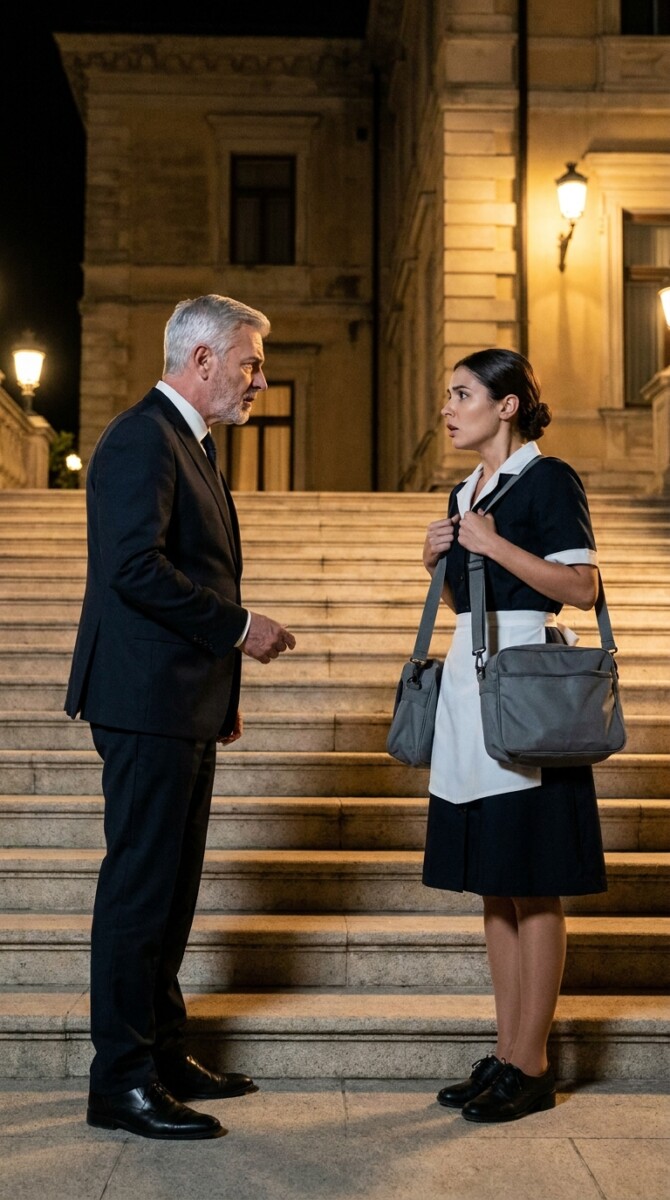
María stood frozen on the stone steps, clutching the straps of her two bags against her chest, her heart beating so hard that she could barely hear the night wind.
Her employer was still standing in front of her, wearing the unsettling calm of someone who had just said something impossible and was completely convinced of it.
“But if you agree to marry me, you will become the owner of everything.”
María blinked several times, as if doing so might help her arrange the words inside her head.
“Sir…” she finally murmured. “You can’t be serious.”
Don Ernesto Valdivia, owner of the mansion and several properties in the city, did not look away.
“I haven’t been this serious about anything in years.”
María took a step back.
She was twenty-seven years old, had two young children waiting for her at her sister’s house, and a life far too complicated to accept a conversation that sounded as though it had come straight out of a novel.
She had worked in that house for two years. She arrived before dawn, cleaned enormous rooms, changed the sheets of guests who barely remembered her name, and always left late, her feet aching but grateful to have steady employment.
Don Ernesto was not a warm man, but neither was he cruel. He was strict, quiet, and accustomed to giving orders without repeating himself. That was why his confession unsettled her even more.
“My daughter Camila has been preparing documents for months,” he continued. “She says I’m no longer capable of managing my assets. Tomorrow she plans to file them and request complete control of everything.”
María frowned.
“But how can she do that?”
“By claiming that I’m losing my mind.”
“And is that a lie?”
Don Ernesto raised his eyebrows.
“You ask that as if you have doubts.”
María swallowed.
“I… I don’t know. It’s just… you’re suddenly telling me to marry you.”
Against all expectations, he gave a faint smile.
“That sounds quite reasonable on your part.”
María shook her head.
“I don’t understand why me.”
Don Ernesto glanced toward the entrance of the mansion, as though making sure no one was watching them.
“Because you’re the only person in this house who doesn’t treat me like a walking wallet.”
The sentence might almost have been funny if it had not been filled with exhaustion.
María remained silent.
“In two years,” he continued, “you have never asked me for a personal favor, never tried to get close to me out of self-interest, and never joined in the staff gossip. You do your job, take care of your children, and leave. That is worth more than you imagine.”
“But that doesn’t mean I should marry you.”
“I didn’t say you should. I said I’m proposing it.”
María felt dizzy.
“No, sir. I can’t accept something like that.”
Don Ernesto studied her carefully, but he did not insist right away.
“Fine,” he finally said. “Then at least listen to the whole truth before you leave.”
María hesitated.
She wanted to go. She wanted to run to the bus stop, hug her children, and pretend that night had never happened. But the way he said “the whole truth” made her stay.
“Twenty-six years ago,” Don Ernesto said, “my wife died. Since then, I raised Camila alone. I gave her everything. Education, travel, small businesses so she could learn, connections. She never lacked anything. The problem is that she confused inheritance with entitlement.”
María said nothing.
“In recent months, she started pressuring me to sell some of the properties. I refused. Not because I don’t trust her, but because I know how she manages things. She spends impulsively, trusts flatterers, and surrounds herself with people who only applaud her.”
“Maybe she can learn,” María said cautiously.
“Learning is difficult when someone has never had limits.”
The man pulled an envelope from inside his jacket.
“These are copies of the documents she plans to file tomorrow. One of the family attorneys sent them to me.”
María looked at the envelope.
“And what do you expect me to do with that?”
“Nothing yet. I just want you to know I’m not making this up.”
María did not reach for it.
“I don’t understand lawyers.”
“You don’t need to understand lawyers to recognize betrayal.”
The word fell heavily between them.
María thought about her own problems, about the rent being two weeks overdue, about the uniform she had ironed in a hurry, about her children sometimes asking why she worked so much. All of that felt very far removed from a world of inheritance, mansions, and battles over fortunes. And yet she was standing right in the middle of it.
“Sir,” she finally said, “even if all of this is true… marrying me won’t fix who your daughter is.”
“No,” he replied calmly. “But it will stop her from taking control tomorrow. If I get married, my situation changes. The scandal will force her to stop and reveal her true intentions too soon.”
María’s eyes widened.
“So this is a strategy.”
“It’s protection.”
“For you.”
Don Ernesto looked directly at her.
“And for you too.”
María gave a small, disbelieving laugh.
“For me? I’m barely trying to make it to the end of the month.”
He took several seconds to answer.
“Exactly.”
María then realized that he knew more about her life than she had imagined.
“Don’t be alarmed,” he said. “I didn’t investigate anything strange. I only know the basics. That your oldest son needs new glasses, that your little daughter still hasn’t been admitted to public daycare, and that you take extra shifts whenever the manager offers them.”
María felt invaded and, at the same time, strangely seen.
“You shouldn’t have paid attention to that.”
“I pay attention to more than people think.”
There was a long silence.
“I don’t want to buy you,” he finally added. “If you say no, then no means no. But if you accept, you won’t be a decorative figure. I’ll give you a clear legal agreement, protection for your children, and complete freedom if you ever want to end the marriage. Nothing hidden.”
María looked at him as though trying to determine whether he was speaking out of desperation or clarity.
Perhaps both.
“I need to think about it.”
“You have tonight.”
“That’s not thinking. That’s rushing.”
“Camila arrives tomorrow at nine with her attorneys.”
María lowered her gaze.
“My children are waiting for me.”
Don Ernesto nodded.
“Go. But take this.”
He held out the envelope.
This time María accepted it.
“If you decide not to come back tomorrow, I’ll understand.”
She nodded and walked down the steps almost in a daze.
That night, she barely slept.
Her sister, Julia, heard her pacing back and forth in the kitchen.
“What’s wrong with you?”
María hesitated to tell her.
Then she did.
Julia listened with her mouth open, first convinced it was a joke and then becoming far too serious.
“That sounds dangerous.”
“I know.”
“Do you trust him?”
María thought about it.
“I don’t really know him. But he doesn’t seem like a man who has lost his mind either.”
Julia looked at the envelope, read a few pages without understanding much, and sighed.
“If this is true, that daughter is coming after everything.”
María sat down.
“I don’t want to get involved in rich people’s problems.”
“You’re already involved.”
The statement was harsh, but true.
“What would you do?” María asked.
Julia took a moment before answering.
“I wouldn’t marry for money,” she said first.
María nodded.
“But I also wouldn’t ignore an opportunity if it could change your children’s lives and, at the same time, stop an injustice.”
María stared at the table.
She was not thinking about dresses, romance, or ridiculous fantasies.
She was thinking about stability, about college her children might otherwise never be able to afford, about the home she had always dreamed of renting without having to share it, about the possibility of making one major decision for herself.
But she was also thinking about the moral weight of accepting.
At dawn, she made a decision.
She returned to the mansion.
They found her entering through the kitchen just as the first employees were arriving.
The manager looked at her strangely.
“So early?”
“The boss asked me to come.”
She gave no further explanation.
Don Ernesto was in his office, dressed in a dark suit as though he had been awake for hours.
When María appeared in the doorway, he understood before she said a word.
“Yes?” he asked, with a calmness that barely concealed the tension.
María held his gaze.
“Yes. But with conditions.”
He nodded immediately.
“I’m listening.”
“First: my children go wherever I go. Second: everything must be in writing. Third: I don’t want to feel trapped. If this goes badly, I want to be able to leave without having to fight just to survive.”
Don Ernesto almost smiled.
“Agreed.”
“And fourth…”
“Go on.”
María took a deep breath.
“Don’t treat me as though you’re doing me a favor. If I’m going to enter into this, I’ll do it with dignity.”
His small, sad smile finally appeared.
“That is exactly what I hoped you would say.”
By eight-thirty, a justice of the peace was already in the mansion’s main library.
Everything happened quickly, quietly, and more strangely than María could ever have imagined.
Julia arrived as a witness with a stunned expression.
The butler signed as well.
Don Ernesto and María gave brief answers, with no embellishment, no music, and no flowers.
At exactly nine o’clock, when Camila Valdivia entered the main sitting room accompanied by two attorneys and a confident expression, she found her father sitting at the head of the table…
And María beside him.
Camila stopped dead.
“What does this mean?”
Don Ernesto placed his coffee cup calmly onto its saucer.
“Good morning, Camila.”
“I asked you what this means.”
María felt the hostility like an icy current.
Don Ernesto spoke without raising his voice.
“It means that, as of forty minutes ago, María is my wife.”
The silence was so abrupt that one of the attorneys cleared his throat out of pure discomfort.
Camila went pale.
“That’s ridiculous.”
“Legally valid, however,” he replied.
“She manipulated you.”
María clenched her hands beneath the table but said nothing.
Don Ernesto did.
“Be careful with the next thing you say.”
Camila let out a nervous laugh.
“You married the employee? That’s your great response? This only proves that you’re not well.”
“No,” he replied. “It proves that I can still make decisions that don’t benefit you.”
Camila slammed the documents down on the table.
“You don’t know what you’re doing.”
“I know perfectly well what I’m doing. I also know what you were planning to do.”
One of the attorneys intervened cautiously.
“Don Ernesto, perhaps it would be better to discuss this privately.”
“No.”
He pointed to the papers.
“Since you brought those documents, we can start by reviewing why my daughter claims I’m mentally incompetent while, at the same time, attempting to move forward with the sale of three properties to a company in which she would coincidentally hold a majority interest.”
Camila opened her mouth but failed to find an answer quickly enough.
María watched her and realized then that Don Ernesto was not improvising.
He had been waiting for this moment.
The conversation became tense.
The attorneys began weighing every word.
Camila went from outrage to defense.
Don Ernesto had evidence, dates, signatures, printed emails.
By midmorning, Camila’s plan was already falling apart.
When the attorneys finally requested that the meeting be suspended so they could reassess the situation, Camila approached María with barely contained fury.
“Do you think this makes you somebody?”
María, who would have lowered her eyes the day before, did not do so this time.
“No. But it reminds me that I was already somebody, even if you never noticed.”
Camila looked at her with contempt.
“This won’t last.”
“Maybe not,” María said. “But today you didn’t come here to protect a confused man. You came to take what belonged to him before the time was right. And that is something everyone will remember.”
Camila clenched her jaw and walked away.
The door shut behind her with a sharp thud.
The room fell silent.
María released the breath she had been holding for several minutes.
Don Ernesto slowly leaned back in his chair.
“You did very well.”
María turned toward him.
“I still don’t know if I did the right thing.”
He nodded.
“That is also a good sign.”
The following days were a controlled storm.
There were rumors among the staff, phone calls from relatives, tension in the local press after news of the marriage leaked, and a brief but scandalous legal battle.
However, the evidence Don Ernesto possessed was enough to stop his daughter’s maneuver and open an investigation into some of her dealings.
María went from cleaning hallways to sitting in meetings where she barely understood half the words being used.
But she learned quickly.
Don Ernesto kept his promises.
He provided María with an independent attorney, arranged for her and her children to live in a smaller house on one of his properties, and put guarantees in writing that would protect her even if everything ended badly.
What was surprising was that, as the months passed, it stopped feeling like a strange arrangement and began turning into a genuine alliance.
Not the kind of love found in novels.
Something rarer and perhaps more solid.
Respect.
Don Ernesto discovered that María possessed a practical intelligence many of his advisers lacked.
She knew how to read people, notice small lies, organize everyday chaos, and ask exactly the questions others were too afraid to ask because they feared looking ignorant.
María, for her part, discovered that beneath the suit and rigidity was a man exhausted from living surrounded by self-interest.
He was not perfect.
Sometimes he remained authoritarian, stubborn, and far too accustomed to making decisions for everyone else.
But he listened when someone spoke honestly to him.
A year later, Camila signed an agreement.
She retained a reasonable portion of her future inheritance but lost all ability to interfere with the management of the assets during her father’s lifetime.
She left the city for a while.
That same week, María took her children to see the large garden of the house where they were now living.
Her oldest son, Daniel, ran after a ball.
Little Sofi laughed as she swung, as though the world had never been difficult.
Don Ernesto watched from the terrace.
“They seem to like it.”
“They like having space,” María replied.
He nodded.
“It’s good for you too.”
María gave a slight smile.
“I still wake up thinking all of this could disappear.”
“Everything can disappear,” he said. “That’s exactly why it’s worth building something that can remain.”
María looked at him.
“And what do you think is remaining?”
Don Ernesto took a moment before answering.
“A family different from the one I imagined.”
She did not know what to say.
Months later, during a quiet dinner, María finally dared to ask the question she had kept to herself since that night on the steps.
“If I had said no… what would you have done?”
Don Ernesto placed his glass on the table.
“Fought alone.”
“And would you have won?”
He thought before answering.
“Maybe. But I would have lost something else.”
“What?”
He looked at her with that restrained seriousness that never completely left him.
“The chance to discover that the most loyal person in this house did not share my last name.”
María lowered her eyes to hide her emotion.
She did not know whether what they had could be called love.
Perhaps it did not matter.
They had begun with an absurd proposal, a real fear, and an urgent negotiation.
But what they built afterward was not fake at all.
And that was why, years later, whenever someone whispered behind her back that the employee had simply been lucky, María no longer bothered arguing.
Because no one had seen the nights of uncertainty, the written conditions, the difficult decisions, the dignity she defended from the very beginning, or the courage it took to enter a world that was not hers without losing herself in the process.
The truth was much simpler and far more uncomfortable for those judging from the outside:
It had not been luck.
It had been character.
And that was the real surprise the ambitious daughter never saw coming.
Not that her father married the employee.
But that the woman she had always considered invisible turned out to be the only person capable of standing firm when the entire mansion began to collapse.