Chapter 1: The Architecture of Intimidation and the Burden of Generational Wealth
The dining room of the Harrington Manor was less a space for enjoying a meal and more a meticulously curated theater designed to enforce the overwhelming weight of generational wealth upon anyone who dared to step inside. The ceilings soared thirty feet high, adorned with intricate, hand-painted frescoes depicting Renaissance pastoral scenes that had been commissioned by the family’s ancestors in the late nineteenth century. Suspended from the center of this architectural masterpiece was a massive Baccarat crystal chandelier, its hundreds of faceted drops catching the flickering light of the towering candelabras placed at intervals along the grand mahogany dining table. The table itself was a relic of historical significance, polished to a mirror-like finish that reflected the sterling silver cutlery, the gold-rimmed Limoges porcelain plates, and the crystal wine goblets that cost more than a standard automobile.
At the head of this intimidating arrangement sat Eleanor Harrington, the matriarch of the family. Eleanor was a woman who wielded her wealth not merely as a tool for comfort, but as a weapon of absolute social dominance. She was dressed in a sweeping gown of deep, crushed burgundy velvet that seemed to absorb the light around her. Her neck was encased in a heavy, elaborate collar of deeply saturated blue sapphires and brilliant-cut diamonds, a set that had been heavily featured in prominent high-society magazines. Her face, maintained through a rigorous and exorbitantly expensive regimen of cosmetic enhancements, was a rigid mask of practiced superiority. Throughout her sixty-two years of life, Eleanor had never encountered a problem that could not be solved by writing a check, nor a person she could not belittle into absolute submission.
Tonight, her primary target was seated halfway down the expansive table.
Clara Reyes sat with a quiet, unshakeable dignity that seemed to effortlessly repel the toxic energy radiating from the head of the table. Clara was twenty-eight years old, stunningly intelligent, and entirely unimpressed by the superficial trappings of the Harrington estate. She was dressed in a simple, flawlessly tailored champagne silk slip dress that whispered of elegance rather than screaming of expense. Clara was the fiancé of Edward Harrington, Eleanor’s only son, and in Eleanor’s eyes, Clara was an unacceptable interloper.
Clara had not been born into money. She had grown up in a small, noisy, working-class apartment in Queens, New York. Her father was a mechanic who came home with oil stained into his calluses, and her mother was a public school teacher who worked nights tutoring to make ends meet. From a young age, Clara had possessed a fascination with the earth’s natural geometry, a passion that led her to secure scholarships, work three simultaneous jobs, and eventually graduate at the very top of her class from the prestigious Gemological Institute of America (GIA). She had not married into wealth; she had built her own highly successful, independent gemstone appraisal and consulting firm. She was a woman of science, of hard facts, and of uncompromising integrity.
To Eleanor, this background made Clara a «peasant.» Throughout the first three courses of the dinner—a lavish spread of seared foie gras, truffle-infused wild mushroom risotto, and perfectly roasted duck à l’orange—Eleanor had engaged in a relentless campaign of psychological warfare. She made thinly veiled, condescending remarks about Clara’s neighborhood, offered mock sympathy for the «struggles of the lower classes,» and repeatedly mispronounced Clara’s surname with deliberate, theatrical exaggeration.
Clara absorbed every insult with a polite, measured smile. She did not raise her voice. She did not cry. She simply parried the social daggers with sharp, intelligent wit, much to the quiet amusement of the other twenty high-society guests who had been invited to witness this gladiatorial dinner party. Beside her, Edward held her hand tightly beneath the heavy linen tablecloth, his knuckles white with suppressed anger. He loved Clara fiercely, and he despised the toxic environment his mother constantly cultivated.
Standing quietly in the shadows near the roaring marble fireplace, entirely removed from the dinner service, was William Harrington. The patriarch of the family was a stark contrast to his wife. William was a stern, highly principled man of business. He was deeply conservative in his personal conduct, valuing discretion, honesty, and financial prudence above all else. He was swirling a snifter of aged scotch, his sharp, observant eyes locked onto his wife. He was not stepping in to stop Eleanor’s cruel monologue. He was waiting. He was watching the trap slowly, inevitably spring shut.
Chapter 2: The Refraction of a Lie and the Science of Truth
As the liveried staff silently cleared the dinner plates and began to serve small, delicate crystal bowls of lemon sorbet to cleanse the palate, Eleanor decided it was time for her grand finale. This was the moment she had orchestrated the entire evening around. She tapped the side of her crystal wine glass with a silver dessert spoon. The sharp, high-pitched chime sliced through the low hum of conversation, bringing the massive dining room to an immediate, breathless halt.
Eleanor stood up slowly, her burgundy velvet gown pooling around her chair. She signaled to her personal butler, who stepped forward carrying a small, heavy box bound in faded, antique blue velvet. Eleanor took the box, holding it delicately between her manicured fingers as if it were a holy relic. She fixed her gaze entirely on Clara. The room was so silent that the crackling of the logs in the fireplace sounded like gunshots.
«Clara, my dear,» Eleanor began, her voice dripping with a saccharine sweetness that failed to mask the underlying venom. She pitched her volume perfectly so that every prominent socialite, CEO, and heir at the table could hear every single syllable. «Edward has informed me that you two have finally settled on a date for your… quaint little wedding.»
Edward shifted in his seat, preparing to stand and end the charade, but Clara squeezed his hand beneath the table, anchoring him in place. She maintained her calm, level gaze on the matriarch.
«As the mother of the groom,» Eleanor continued, slowly walking around the edge of the table toward Clara, «it is my traditional duty to pass down a piece of our family’s legacy to the next generation. Given your… unfortunate background, and the undeniable reality that you bring absolutely zero generational wealth or historical pedigree to this union, I felt it was my charitable duty to elevate your standing.»
Eleanor stopped directly beside Clara’s chair. With a theatrical flourish, she snapped the antique blue velvet box open.
Nestled inside, resting on a bed of faded white silk, was a massive, glittering stone set in a heavy platinum band. To the untrained, sycophantic eyes of the dinner guests, it was a breathtaking masterpiece—a colossal gem that caught the candlelight and threw it back in sharp, blinding flashes. It was presented as the legendary Harrington Diamond, a supposedly flawless, twenty-carat Old Mine Cut diamond that had been the crown jewel of the family’s private vault for over five generations.
«Since you grew up so poor,» Eleanor said, delivering the prepared lines with a vicious, triumphant smirk, «I decided to gift you our priceless family diamond. Try not to lose it, peasant.»
A collective gasp echoed through the dining room. Several guests looked down at their laps, mortified by the sheer, unadulterated cruelty of the statement. Others watched with breathless anticipation, waiting to see if the working-class girl would finally break down, cry, or flee the room in utter humiliation.
Clara Reyes did none of those things.
She did not flinch. She did not display a single ounce of emotional distress. Instead, the mind of a master gemologist immediately took over. Before she even touched the ring, her highly trained eyes began to analyze the optical properties of the massive stone sitting in the box.
A genuine diamond, especially an Old Mine Cut with its distinctive high crown, deep pavilion, and large culet, interacts with light in a very specific, aggressive manner. It possesses an exceptionally high refractive index of 2.417. When light enters a true diamond, it is violently slowed down, bent, and bounced off the internal facets, returning to the viewer’s eye as brilliant flashes of white light (brilliance) and dispersed spectral colors (fire).
The stone in the box was large, yes. It was cut to mimic the shape of the Harrington heirloom. But to Clara’s expert eye, the stone was visually dead. The light entering it seemed to leak out of the bottom rather than reflecting back up. The flashes of color were too pastel, too uniform, lacking the sharp, aggressive dispersion of a genuine carbon crystal. Furthermore, she could subtly see the «read-through» effect; if she were to place the stone over a piece of printed text, she knew she would be able to read the letters through the pavilion, a physical impossibility for a properly cut diamond due to total internal reflection.
Clara reached out with a steady hand and plucked the ring from the velvet box. She held it up toward the light of the chandelier. She noticed that the facet junctions—the edges where the flat planes of the stone met—were slightly rounded and soft. Diamond is the hardest natural substance on earth; its facet junctions are polished to razor-sharp, microscopic precision. Only softer materials, like glass or cubic zirconia, exhibit rounded, abraded edges after being cut and handled.
«It is quite large, Eleanor,» Clara said, her voice echoing clearly in the silent room. She did not sound grateful. She sounded entirely clinical.
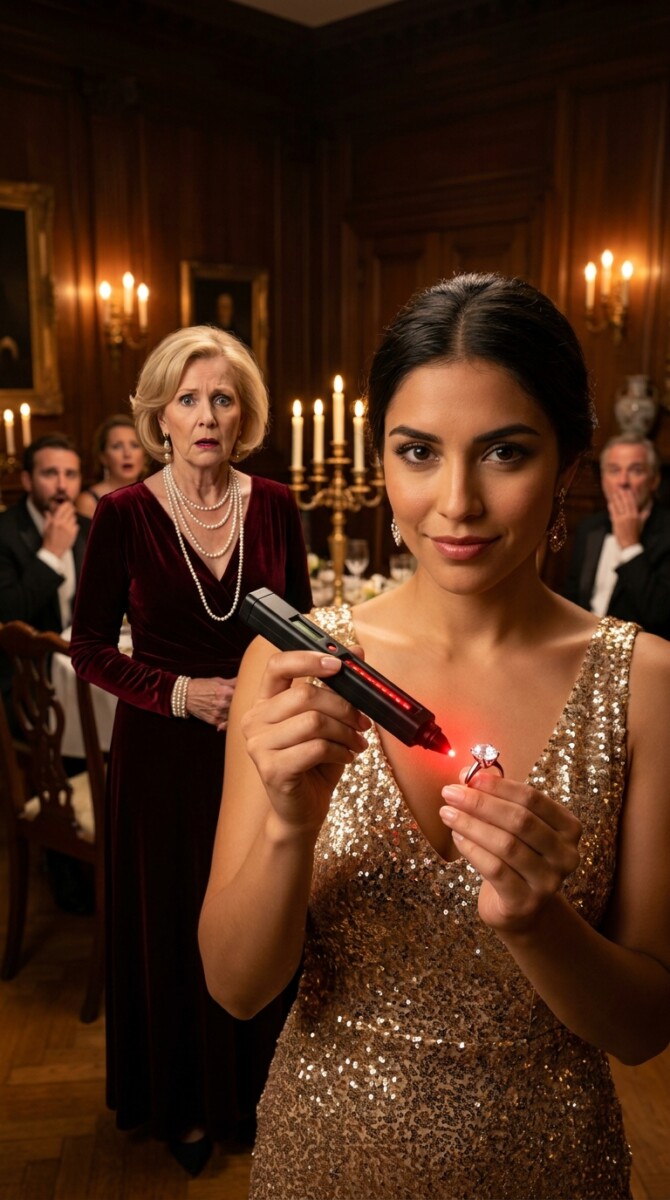
Clara reached down with her left hand and picked up her small, elegant evening clutch from the floor. She unclasped it and reached inside. She bypassed her lipstick, her compact, and her phone. Her fingers closed around a sleek, titanium-cased instrument no larger than a thick fountain pen. It was a high-end, professional thermal conductivity tester—a standard, indispensable tool that Clara carried with her at all times, a habit formed from years of emergency appraisals and unexpected consultations.
She brought the instrument up to the table. She flicked a tiny switch on the side, and a small green light illuminated on the device, indicating it was powered on and calibrated to the ambient temperature of the room.
Eleanor frowned, a flicker of confusion breaking through her triumphant smirk. «What on earth is that? Put that away and put the ring on.»
«Diamond,» Clara explained calmly, addressing the entire table as if she were giving a lecture to her first-year GIA students, «is the most effective thermal conductor of any known natural material on the planet. It conducts heat even better than copper or silver. Glass, cubic zirconia, and synthetic moissanite, however, are thermal insulators. They do not conduct heat.»
Clara pressed the metallic, needle-like tip of the tester firmly against the flat table facet of the massive stone.
If it were a diamond, the device would instantly detect the rapid transfer of heat away from the probe, triggering a loud, continuous beep and a flashing green LED bar.
The room held its collective breath.
The probe touched the stone. The device remained entirely silent. A single, stubborn red LED light glowed, indicating zero thermal conductivity.
Clara lowered the tester and looked directly into Eleanor’s eyes. The matriarch’s smirk had completely vanished, replaced by a sudden, rigid tension.
«I’m a certified gemologist,» Clara stated, her voice ringing with absolute, undeniable authority. «And this is a ten-dollar piece of glass.»
A shockwave rippled through the guests. Whispers erupted instantly.
«How dare you!» Eleanor shrieked, her composure shattering into a million pieces. Her face flushed a deep, violent crimson. «You insolent, ungrateful little fraud! You tamper with my family’s priceless heirloom and then have the audacity to accuse me of—»
«I am not accusing you of anything, Eleanor,» Clara interrupted, her voice rising just enough to cut through the matriarch’s hysterical shouting. She set the fake ring down on the table with a dismissive clatter. «I am simply stating a scientific fact. And furthermore, I know exactly why this piece of glass was in the family vault.»
Clara stood up, smoothing the front of her silk dress. She looked past Eleanor, her gaze landing on the shadows near the fireplace.
«Your husband told me,» Clara revealed, dropping the final, devastating weight onto the table. «He told me you secretly sold the real diamond to pay off your disastrous offshore gambling debts.»
The words hung in the air, absolute and catastrophic.
Pure, unadulterated panic exploded across Eleanor’s face. The carefully constructed facade of the untouchable society matriarch disintegrated in a fraction of a second. She physically recoiled as if she had been struck. Her eyes darted wildly around the room, meeting the shocked, horrified stares of her peers. She knew the secret was out. She knew her financial ruin was now public knowledge.
With jerky, mechanical movements, Eleanor turned around.
The panic on her face intensified into sheer terror, creating a cinematic portrait of a woman realizing her absolute doom. Stepping out of the shadows, his face a terrifying mask of controlled, righteous fury, was William Harrington.
Chapter 3: The Meltdown and the Exodus of the Elites
William did not shout. He did not need to. The sheer, overwhelming gravity of his silent presence was enough to suck the remaining oxygen out of the dining room. He walked slowly toward the head of the table, his footsteps echoing like a judge’s gavel striking a block. He stopped beside Eleanor, who was now trembling so violently that the heavy sapphires around her neck clattered against one another.
«William,» Eleanor gasped, her voice a desperate, high-pitched wheeze. «William, please. She’s lying. This peasant is trying to humiliate me. She switched the ring! She brought a fake to destroy our family!»
William looked down at his wife. His eyes, usually cool and calculating, were burning with a profound, agonizing disgust. He had spent his entire life building and protecting the Harrington legacy, ensuring the family name was synonymous with integrity, stability, and unshakeable financial fortitude. In a matter of minutes, his own wife had turned them into a circus act.
«Do not insult my intelligence, Eleanor, and do not dare insult Clara again,» William said, his voice barely above a whisper, yet it carried to the farthest corners of the massive room. «I checked the vault myself three days ago. I noticed the stone looked… lifeless. Knowing your recent, erratic behavior, I did not confront you immediately. Instead, I quietly asked Clara to accompany me to the vault. I asked for her professional expertise.»
He picked up the glass replica from the table and held it between his thumb and forefinger, looking at it with absolute revulsion.
«Clara confirmed it was a forgery,» William continued, turning to address the stunned audience of socialites. «That led me to initiate a full, forensic audit of our personal accounts. What I found was a secondary, hidden ledger. An encrypted digital footprint that traced back over five years.»
Eleanor let out a pathetic, whimpering sob and sank into her chair, covering her face with her hands.
«My wife,» William announced to the room, completely stripping away the family’s privacy in a brutal act of necessary amputation, «has a severe, unmanageable addiction to high-stakes, illegal underground gambling. She has been traveling to unsanctioned, private poker rooms in Macau, Monaco, and international waters. She has leveraged her personal trusts to the point of bankruptcy. And when the margin calls came, when the dangerous people she owed money to demanded payment, she breached the Harrington family vault. She stole a twenty-carat, D-color, internally flawless diamond that has been in this family for over a century, sold it to a black-market shadow broker for a fraction of its true value, and commissioned this pathetic piece of glass to hide her crime.»
The dining room erupted into chaos. Several of the older guests physically clutched their pearls. Chairs scraped violently against the hardwood floor as people instinctively tried to put distance between themselves and the epicenter of the scandal. This was not a minor faux pas; this was grand larceny, fraud, and total financial ruin. In the ruthless ecosystem of high society, Eleanor Harrington had just transformed from the apex predator into radioactive waste.
«I must ask you all to leave,» William said, his voice regaining its sharp, authoritative edge. «This dinner party is concluded. You have my deepest apologies for subjecting you to this spectacle. My security staff will escort you to your vehicles.»
The exodus was instantaneous and profoundly awkward. The elite guests, who just an hour ago had been laughing at Eleanor’s cruel jokes, now scrambled for the heavy oak doors without making eye contact with her. They left behind half-eaten desserts and full glasses of wine. Within five minutes, the massive, opulent dining room was entirely empty, save for the four central figures of the tragedy.
The heavy doors clicked shut, sealing them inside.
«Edward, Clara, please remain,» William instructed. He then turned his full, terrifying attention back to his wife.
«William, I can explain,» Eleanor sobbed, mascara running down her cheeks in thick, dark rivers, staining the pristine white linen napkin she was clutching. «I was stressed. You were always working. The pressure of maintaining this lifestyle… the people I played with, they manipulated me. I thought I could win it back. I was going to buy the diamond back, I swear to you!»
«You sold a piece of our history to a criminal fence to cover your own pathetic vanity,» William stated, his voice devoid of any sympathy. «You stole from me. You stole from Edward. You stole from the future of this family. And then, as if the theft wasn’t enough, you attempted to use the forgery—the very evidence of your crime—to publicly humiliate the woman your son loves. You are not just a thief, Eleanor. You are a fundamentally cruel, hollow woman.»
«I am your wife!» Eleanor shrieked, a desperate flash of her old arrogance surfacing. «You cannot do this to me! Half of everything you own is mine! I will drag you through a divorce so ugly it will destroy the company!»
William smiled. It was a cold, predatory expression. «You clearly have not read the updated terms of our prenuptial agreement, Eleanor. The clauses regarding criminal fraud, theft of familial assets, and gross moral turpitude are ironclad. By selling the diamond, you voided the contract. You are entitled to absolutely nothing.»
Eleanor’s mouth opened, but no sound came out. The reality of her situation finally, brutally crushed the remaining breath from her lungs.
«You have one hour,» William commanded, turning his back on her. «Go upstairs. Pack a single suitcase with your personal clothing. Do not attempt to take any jewelry; security will be monitoring you. My driver will take you to a hotel in the city. I have paid for one week. After that, you are entirely on your own. Do not ever return to this house.»
Eleanor looked at Edward, her eyes begging for intervention. «Edward… my son. Please. Talk to him. You can’t let him throw me out onto the street like a commoner.»
Edward stood up. He walked over to Clara, taking her hand in his. He looked at his mother, feeling a profound, aching sadness, but absolutely no desire to save her from the consequences of her own malice.
«You made your choices, Mother,» Edward said quietly. «And tonight, you showed exactly who the real ‘peasant’ in this room is. Goodbye.»
Edward and Clara walked out of the dining room, leaving Eleanor sitting alone at the massive table, surrounded by the wreckage of her grand charade, crying over a ten-dollar piece of glass.
Chapter 4: The Gemologist’s Crusade and the Digital Trail
The following morning, the atmosphere in the Harrington Manor was heavy, akin to a house in mourning. The immediate threat of Eleanor’s toxicity had been excised, but the reality of the stolen heirloom loomed large.
William, looking as though he had aged ten years overnight, sat behind the massive mahogany desk in his private study. Edward and Clara sat opposite him. The morning light filtered through the tall windows, illuminating the dust motes dancing in the silent air.
«The police have been notified,» William said, rubbing his temples. «I have filed a formal report for grand larceny. However, the detectives were entirely unoptimistic. They explained that stones of this magnitude, when stolen by family members and sold to the black market, vanish into the ether. They are usually smuggled out of the country within forty-eight hours, broken down, and recut into smaller, untraceable diamonds.»
He looked at Clara, a deep, vulnerable despair in his eyes. «It’s gone, Clara. The Harrington Diamond survived two world wars, the Great Depression, and five generations, only to be gambled away in a back room in Macau.»
Clara leaned forward, resting her elbows on the desk, her mind already shifting into analytical mode. «William, do not write the stone off just yet. The police are looking at this as a standard theft. They are looking for a physical object. But I don’t see a diamond; I see a highly specific, immutable data set. And data leaves a trail.»
William frowned, confused. «What do you mean?»
Clara pulled her tablet from her bag and brought up a digital file. «Before the diamond was placed in the vault a decade ago, you had it certified by the GIA, correct?»
«Yes,» William nodded. «For insurance purposes.»
«Then we have its blueprint,» Clara explained, turning the tablet to face him. The screen displayed a complex, three-dimensional wireframe model of a gemstone, accompanied by rows of complex grading metrics. «A diamond is not just a shiny rock. It is a unique geological fingerprint. The Harrington Diamond is a twenty-carat, D-color, Internally Flawless Old Mine Cut. But more importantly, we have the exact angles of the pavilion, the precise percentage of the table depth, and the specific degree of the culet.»
«But the police said the thief would just recut it,» Edward interjected.
«They could,» Clara agreed. «But recutting an Internally Flawless, twenty-carat diamond is a monumental financial risk. To change the shape enough to fool a basic appraisal, a cutter would have to grind away at least three to five carats of material. At the D-color, IF grade, that is literally throwing millions of dollars of raw value into the garbage as diamond dust. A high-end black-market fence isn’t going to do that. They are greedy. They will want to maximize their profit. They might polish the girdle to remove the microscopic GIA laser inscription, but they will likely try to sell the stone intact to a private, unscrupulous collector who doesn’t ask questions about provenance.»
Clara’s eyes narrowed with fierce determination. «They think they are hiding a rock. But I know the exact, microscopic geometry of that rock. And I know the networks where stones like this are quietly moved.»
For the next three weeks, Clara transformed her high-end appraisal office in Manhattan into a command center. She temporarily suspended her regular client consultations, dedicating her immense intellect and vast network entirely to the recovery of the Harrington heirloom.
She utilized her encrypted connections within the global gemstone trade. She reached out to legendary diamond cutters in Antwerp, tight-lipped brokers in Tel Aviv, and specialized auction house authenticators in Geneva. She created a custom algorithm that constantly scraped the dark web and private, invite-only auction catalogs for any stone matching the rough dimensions, color, and clarity of the missing diamond.
She worked late into the night, analyzing blurry photographs and heavily redacted grading reports provided by her informants in the underworld. She drank endless cups of black coffee, her eyes burning from the harsh glare of her dual monitors, driven by a profound need to restore the honor of the family she was about to join, and to definitively prove that science and intellect could triumph over greed and deceit.
Finally, on a rainy Tuesday evening, the digital tripwire she had set was triggered.
An encrypted message arrived from a highly placed contact operating out of the Hong Kong gemstone district. Attached to the message was a digital catalog for a highly secretive, illegal underground auction scheduled to take place in a private, heavily guarded hotel suite in Macau.
Clara opened the file. Her heart rate spiked.
Lot number 42 was listed simply as: «The Imperial Echo – An Estate Discovery.»
The listing claimed the stone was a 19.85-carat, D-color, VVS1 Old Mine Cut diamond, originating from a recently liquidated, anonymous European royal estate.
Clara rapidly downloaded the accompanying low-resolution photographs and ran them through her 3D modeling software. She overlaid the GIA blueprint of the Harrington diamond onto the photographs of the «Imperial Echo.»
The computer processed the data for a agonizing thirty seconds before returning a result in bright green text: 99.2% Geometric Match.
The fence had done exactly what Clara predicted. They had not recut the stone. They had simply polished the girdle to remove the laser inscription and slightly abraded the culet, dropping the weight from 20.00 carats to 19.85 carats, and intentionally downgrading the clarity claim to VVS1 to avoid triggering international watchlists for stolen Internally Flawless diamonds.
Clara grabbed her phone and dialed William’s private number.
«William,» Clara said, her voice vibrating with adrenaline. «Pack a bag. We are going to Macau. I found the diamond.»
Chapter 5: The Macau Interception and the Unyielding Proof
The atmosphere in the underground auction house in Macau was suffocatingly tense. It did not look like a traditional auction at Sotheby’s or Christie’s. It was held in the expansive, heavily soundproofed penthouse suite of a luxury casino hotel. The attendees were a dangerous mixture of international oligarchs, cartel representatives, and shadow brokers, all operating under the veil of absolute, illegal anonymity. Heavily armed private security personnel stood at every exit, their eyes scanning the room with predatory vigilance.
William Harrington had utilized decades of high-level international business connections, calling in massive favors and pulling extremely dangerous strings, to secure an alias and an invitation to this illicit gathering. He was posing as a reclusive American industrialist looking to acquire untraceable hard assets. Edward accompanied him as his «security detail,» while Clara was present as his «personal gemological advisor.»
They had not come alone. Before boarding their private jet in New York, William had coordinated extensively with Interpol and a specialized task force within the Macau judiciary police. A tactical team was currently stationed in the stairwells and service elevators of the hotel, waiting for a single, pre-arranged signal from William’s heavily encrypted smartwatch.
But the authorities could not move until Clara positively, legally identified the stone. If they raided the room and the diamond was not the Harrington heirloom, the diplomatic fallout and legal liabilities would be catastrophic. The entire operation rested entirely on Clara’s scientific expertise.
Lot 42 was brought out.
The auctioneer, a slick, nervous man in a bespoke suit, placed the diamond on a black velvet display pad under a brilliant, high-intensity halogen lamp. Even from across the room, the stone was breathtaking, throwing aggressive spears of white light into the dim room.
William raised his bidding paddle. «Before I offer a minimum bid of five million dollars,» he announced, his voice projecting absolute, intimidating authority, «my advisor must examine the stone. I do not buy ‘estate discoveries’ blindly.»
The auctioneer hesitated, looking at the armed guards, but the prospect of a five-million-dollar opening bid overrode his caution. He nodded. «Two minutes, sir. At the viewing table only.»
Clara stepped forward. Her heart was hammering against her ribs, but her hands were entirely steady. She approached the viewing table, acutely aware of the dangerous men watching her every move.
She did not use a simple jeweler’s loupe. This required absolute, undeniable scientific proof. From her bag, she produced a portable, high-powered digital microscope and a specialized, handheld polariscope.
She picked up the massive diamond with a pair of titanium tweezers. To the naked eye, it was flawless. But Clara knew the secret.
Ten years ago, when William had first asked her to appraise the stone, Clara had spent hours studying it. She knew that while the GIA had graded it as Internally Flawless—meaning it had no visible carbon spots, feathers, or clouds under 10x magnification—diamonds are natural creations, formed under crushing pressure deep within the earth’s mantle. This immense pressure occasionally causes a microscopic distortion in the crystal lattice structure itself, known as «internal graining.»
This graining is entirely invisible under normal lighting. It does not affect the clarity grade. But under cross-polarized light, the strain in the crystal lattice becomes vividly apparent, revealing a unique, internal, three-dimensional pattern. It is the ultimate, unalterable fingerprint of the gemstone.
Clara placed the diamond onto the stage of the polariscope. She turned on the specialized light source and slowly rotated the polarizing filter.
For a terrifying three seconds, she saw nothing but the dark, extinct void of the diamond.
Then, she rotated the stone exactly fifteen degrees along its longitudinal axis.
Suddenly, a faint, glowing geometric pattern emerged deep within the pavilion of the stone. It looked like a ghostly, three-dimensional spiderweb, a microscopic record of the extreme tectonic violence that had birthed the crystal a billion years ago.
It was the exact, identical graining pattern Clara had mapped in her personal files a decade ago. Polishing the girdle had not changed the internal structure. Recutting the culet had not erased the crystal’s history. The science was absolute.
Clara looked up from the eyepiece. She met William’s intense gaze across the room.
She gave a single, sharp nod.
William instantly tapped the face of his smartwatch three times.
The reaction was explosive. The heavy wooden doors of the penthouse were violently breached. A dozen heavily armed tactical officers from the Macau judiciary police flooded into the room, their weapons drawn, shouting commands in Cantonese and English. The wealthy, dangerous buyers scrambled in panic, but the exits were entirely secured.
The auctioneer threw his hands in the air, backing away from the table.
Clara calmly reached out, picked up the Harrington Diamond, and slipped it safely into the padded, secure lockbox she had brought in her bag. She stepped back, allowing the authorities to secure the illegal broker and confiscate the remaining illicit inventory.
Against all odds, against the vast, dark network of the international black market, the intellect of a working-class gemologist had triumphed. The legacy had been reclaimed.
Chapter 6: The Fall from the Pedestal and the Reality of Exile
While Clara and William were securing the family’s history halfway across the world, Eleanor Harrington was aggressively discovering the brutal, unforgiving reality of her new existence in New York.
The divorce proceedings were finalized with astonishing, merciless speed. William’s corporate attorneys moved with the efficiency of a military strike. Confronted with irrefutable evidence of grand larceny, massive illegal gambling debts, and the violation of the prenuptial agreement, Eleanor’s own lawyers advised her to surrender completely to avoid federal prosecution for fraud.
She was stripped of her titles. She was removed from the boards of the prestigious charities she had used to elevate her social standing. Her access to the Harrington corporate accounts, the private jets, the Hamptons estate, and the limitless black credit cards was permanently severed.
To satisfy the remaining millions she owed to the underground gambling syndicates—debts William refused to allow to stain the Harrington name—her personal assets were entirely liquidated. Her massive collection of designer gowns, her fleet of luxury SUVs, and her extensive collection of high-end jewelry (the pieces she hadn’t already pawned) were sold at auction.
Eleanor Harrington, a woman who had once commanded armies of domestic staff and terrified the social elite of Manhattan, was reduced to a meager, court-mandated living stipend designed to keep her off the streets, but absolutely nothing more.
She was forced to sign a lease on a tiny, one-bedroom apartment on the ground floor of an aging building in a noisy, working-class neighborhood in deep Brooklyn. It was the exact type of neighborhood she used to mock Clara for originating from.
The psychological toll was devastating. The apartment smelled permanently of boiling cabbage from the neighboring unit. The floors creaked. The plumbing rattled violently whenever she turned on the faucet.
One rainy afternoon, Eleanor stood in the narrow aisle of a local discount grocery store. She was wearing a faded, off-the-rack trench coat, her face devoid of the expensive cosmetic treatments she could no longer afford. Her blonde hair, once maintained by a stylist who charged thousands of dollars a month, was growing out in dull, brassy roots.
She placed a small basket of basic necessities onto the conveyor belt of the checkout lane. Bread. Milk. A cheap block of generic cheddar cheese. A twelve-dollar bottle of red wine.
«That’ll be forty-two dollars and fifty cents,» the tired cashier mumbled, not even looking up.
Eleanor handed over a standard, low-limit debit card. She waited, staring blankly at the chewing gum display.
The machine beeped. A harsh, electronic sound of rejection.
«Card declined, lady,» the cashier said, sighing heavily. «You got another form of payment?»
Eleanor froze. Panic, entirely different from the cinematic terror she had experienced in the dining room, washed over her. This was not the panic of being caught; this was the slow, crushing panic of genuine poverty. She frantically checked her banking app on her cracked smartphone. The automated payment for her meager health insurance had cleared that morning, wiping out her remaining balance for the week.
«I… I don’t understand,» Eleanor stammered, feeling the impatient eyes of the people in line behind her burning into her back. These were regular, hard-working people. Peasant, she would have called them a year ago. Now, they were annoyed by her inability to pay for bread.
«Do you want me to put the wine back?» the cashier asked, her tone flat and devoid of the sycophantic deference Eleanor had demanded her entire life.
«Yes,» Eleanor whispered, her voice cracking. «Put the wine back. Please.»
She paid for the groceries with a handful of crumpled cash she found in her coat pocket. She walked out of the store into the freezing rain, carrying her thin plastic bags.
As she walked back to her small, noisy apartment, Eleanor finally understood the absolute truth. Her arrogance, her cruelty, her desperate need to humiliate others had never been a sign of strength. It had been a massive, fragile shield designed to hide her own profound insecurity and incompetence. Without William’s money and the Harrington name to protect her, she was entirely unremarkable. She had traded her family, her dignity, and her future for the thrill of a card game, and in the end, she had lost absolutely everything.
Chapter 7: A New Legacy Forged in Authenticity and Love
Six months after the dramatic recovery in Macau, the sun shone brightly over a sprawling, meticulously manicured botanical garden in upstate New York. It was a perfect spring afternoon, the air thick with the scent of blooming jasmine and fresh earth.
Edward and Clara were getting married.
It was not the massive, pretentious, media-frenzied society gala that Eleanor had originally tried to force upon them. There were no prominent politicians, no hedge fund billionaires, and no gossip columnists. The guest list was small, intimate, and comprised entirely of people who genuinely loved and supported them. Clara’s parents, weeping with pride, sat in the front row next to a visibly healed and deeply peaceful William Harrington.
Following the beautiful, heartfelt ceremony, William asked Clara and Edward to join him privately in a quiet, secluded gazebo overlooking a reflecting pool.
William reached into the breast pocket of his tailored suit. He pulled out the familiar, antique blue velvet box.
He opened it. The Harrington Diamond, now safely returned to its rightful place, rested on the white silk. In the natural sunlight, free from the oppressive shadows of the manor’s dining room, the stone looked magnificent.
«Clara,» William said, his voice thick with genuine emotion and profound respect. «You saved this family from absolute disgrace. You protected my son, you protected our history, and you proved that true nobility is defined by character, not by bloodlines. I would be immensely honored if you would accept this ring. It belongs to you.»
Clara looked at the massive diamond. She understood its history, its geological rarity, and the millions of dollars it represented. She looked at William, appreciating the deep sincerity of his offer.
Then, she gently reached out and closed the lid of the velvet box, pushing it softly back toward William’s chest.
«William, I am deeply honored,» Clara said, her voice warm and resolute. «But I cannot accept it.»
William looked surprised. Edward, however, smiled, knowing exactly the strength of the woman he had just married.
«That diamond,» Clara explained softly, «carries the weight of five generations. It carries the history of your ancestors, but it also carries the shadows of Eleanor’s deceit, the darkness of the black market, and the rigid expectations of a society that Edward and I are choosing not to participate in. It is a beautiful artifact, William, but it is not our future.»
William looked down at the box, slowly understanding her wisdom. «What should I do with it, then? Lock it back in the dark vault?»
«No,» Clara smiled. «Don’t hide it. Donate it. Give it to the Smithsonian Natural History Museum. Establish a permanent exhibit in the Harrington name. Let the public appreciate the sheer geological wonder of the stone. Let it be a symbol of philanthropy and scientific education, rather than a tool for intimidation and vanity.»
William stared at Clara for a long moment. A slow, genuine smile broke across his face, erasing the final traces of the burden he had carried for months.
«You are an extraordinary woman, Clara Harrington,» William said, placing the box back in his pocket. «I will call the museum directors on Monday. They will be thrilled.»
William kissed Clara on the cheek, hugged his son, and walked back toward the reception, his step lighter than it had been in a decade.
Edward wrapped his arms around Clara’s waist from behind, resting his chin on her shoulder. He picked up her left hand, looking at the ring she had ultimately chosen to wear.
It was not a twenty-carat, Internally Flawless relic. It was a stunning, two-carat, ethically sourced Montana sapphire, possessing a mesmerizing, deep teal color that shifted in the sunlight. It was flanked by two small, brilliant, lab-grown diamonds, perfectly cut and entirely free of conflict. Clara and Edward had chosen the stones together, and Clara had designed the platinum setting herself.
«It’s perfect,» Edward whispered, kissing the side of her neck.
«It is,» Clara agreed, admiring the way the sapphire refracted the afternoon light. It didn’t cost millions, and it didn’t come with a legacy of elitism. It was a ring built on absolute transparency, mutual respect, and the undeniable truth of their partnership.
Clara leaned back into her husband’s embrace, looking out over the blooming gardens. A cruel matriarch had attempted to use a ten-dollar piece of glass to shatter Clara’s spirit and maintain an empire of lies. But in the end, the glass had shattered the facade instead, clearing the way for a foundation of unyielding authenticity—a legacy that, unlike a stolen diamond, could never be taken away.